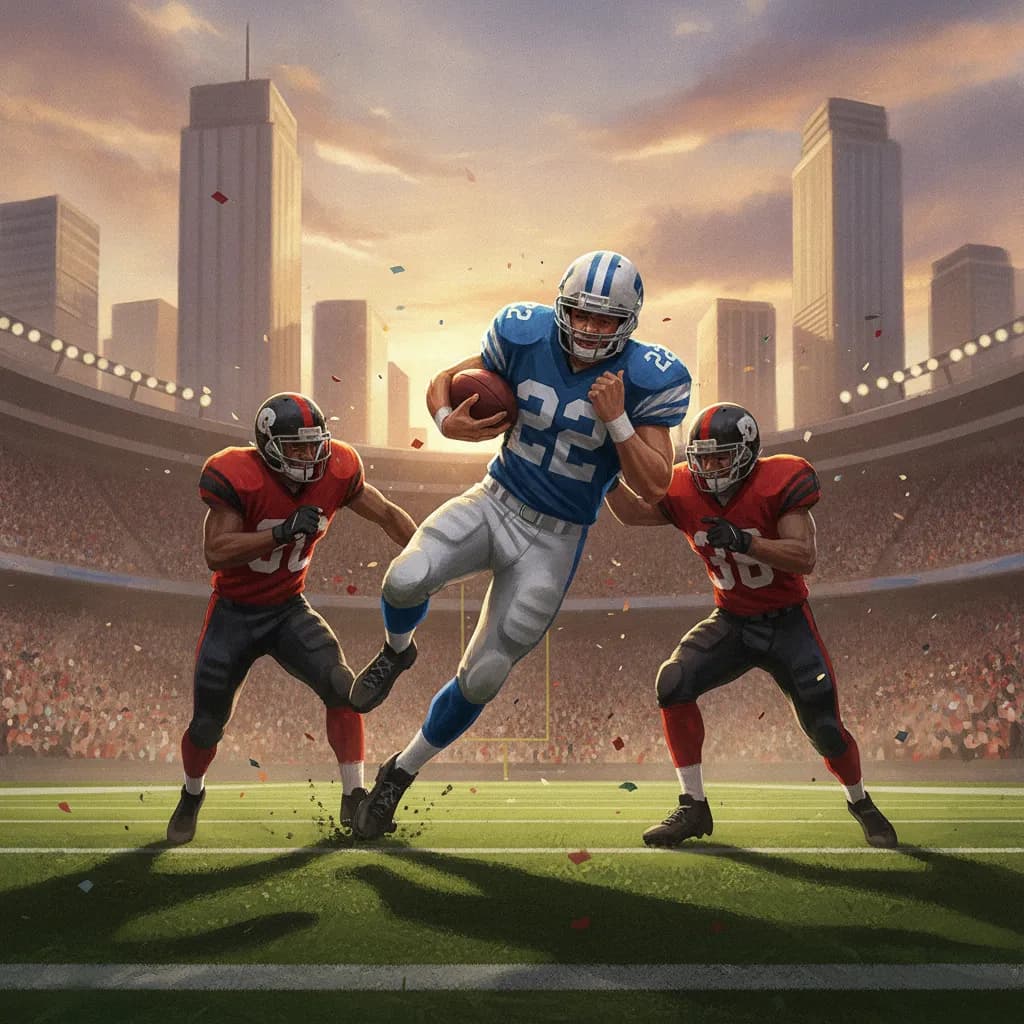
Football
The rest of the world already had a sport called football. America built an entirely different one, kept the name anyway, and never looked back.
Cheat Sheet
- Two teams of 11 alternate offense and defense; the offense has four attempts ("downs") to advance 10 yards or turn the ball over.
- A touchdown (getting the ball into the end zone) is worth 6 points, plus an extra point or two-point conversion attempt afterward.
- A field goal — kicking the ball through the uprights — is worth 3 points, typically attempted on 4th down when a touchdown looks out of reach.
- The forward pass is legal (unlike rugby), which is the single biggest rule difference between the two sports.
- A game is 60 minutes across four 15-minute quarters, but stoppages (timeouts, replays, TV breaks) routinely stretch a broadcast to over three hours.
- The Super Bowl, the NFL's championship game, is the most-watched annual television broadcast in the United States.
The 60-Second Version
Football — American football, to the rest of the world, though nobody in the US bothers with the qualifier — is played between two teams of 11, alternating between offense and defense. The offense gets four attempts, or "downs," to advance the ball 10 yards; succeeding earns a fresh set of downs, while failing turns the ball over to the opponent. Teams score by carrying or passing the ball into the end zone for a touchdown (6 points, plus a bonus extra-point or two-point attempt), or by kicking a field goal through the uprights (3 points). Unlike rugby, forward passing is legal, which is the single biggest rule difference between the two sports and shapes almost everything about how offenses are designed. A game runs four 15-minute quarters, but frequent stoppages — timeouts, replay reviews, the play clock resetting between every down — routinely stretch a broadcast well past three hours.
The Long Version
How a Drive Works
The offense gets four attempts, called "downs," to advance the ball at least 10 yards; succeeding resets the count to a fresh set of four downs, called a "first down," while failing to reach 10 yards within four attempts turns the ball over to the opponent on the spot, called a "turnover on downs." Because of that risk, teams almost always punt (deliberately kick the ball away) on fourth down if they're not close enough to convert or attempt a field goal, trading field position for safety rather than risking a turnover deep in their own territory. This down-and-distance structure is what gives football its distinctive stop-start rhythm, with every single play functioning as its own discrete, planned unit rather than part of continuous flowing action.
Scoring and Strategy
A touchdown — getting the ball into the opponent's end zone by run or pass — is worth 6 points, followed immediately by a bonus attempt: an extra-point kick (1 point) or a two-point conversion play (2 points, attempted from closer range but riskier). Field goals, kicking the ball through the raised uprights, are worth 3 points and are typically attempted on fourth down when a touchdown looks out of reach but the kick is still makeable. Offensively, the quarterback usually directs the play, throwing to receivers or handing off to running backs, while a five-man offensive line blocks defenders trying to disrupt the play; defensively, teams mix linemen rushing the passer, linebackers covering the middle of the field, and defensive backs covering receivers deep downfield.
Why It Took Over America
Football's stop-start structure, born purely out of its rules, turned out to be perfectly suited to television: natural breaks between plays create built-in windows for replays, commentary, and advertising, without disrupting the viewing experience the way commercial breaks interrupt continuous sports like soccer. That TV-friendliness helped fuel the NFL's rise to become the most-watched professional sports league in the United States by a wide margin, further reinforced by fantasy football, a hugely popular parallel hobby where fans draft real players onto imaginary rosters and score points based on their actual statistical performance each week.
Beyond the NFL
College football, governed by the NCAA, runs alongside the NFL as a genuinely massive institution in its own right, with some university programs drawing crowds and television audiences that rival professional sports, and a long-standing rivalry culture built around individual schools rather than franchises. Internationally, the NFL has invested heavily in expanding its footprint through regular-season games played in London, Mexico City, and elsewhere, but football remains, true to its very American name, overwhelmingly concentrated in the United States compared to genuinely global sports like soccer, cricket, or rugby.
Ad slot (placeholder — set NEXT_PUBLIC_ADSENSE_SLOT_ID once an ad unit is created)
Glossary
- Down
- One offensive play attempt; a team gets four to advance 10 yards.
- Touchdown
- Getting the ball into the opponent's end zone, worth 6 points.
- Quarterback
- The player who typically leads the offense, throwing passes and directing plays.
- Interception
- A pass caught by the defending team, turning over possession.
- Blitz
- A defensive tactic sending extra players to rush the quarterback quickly.