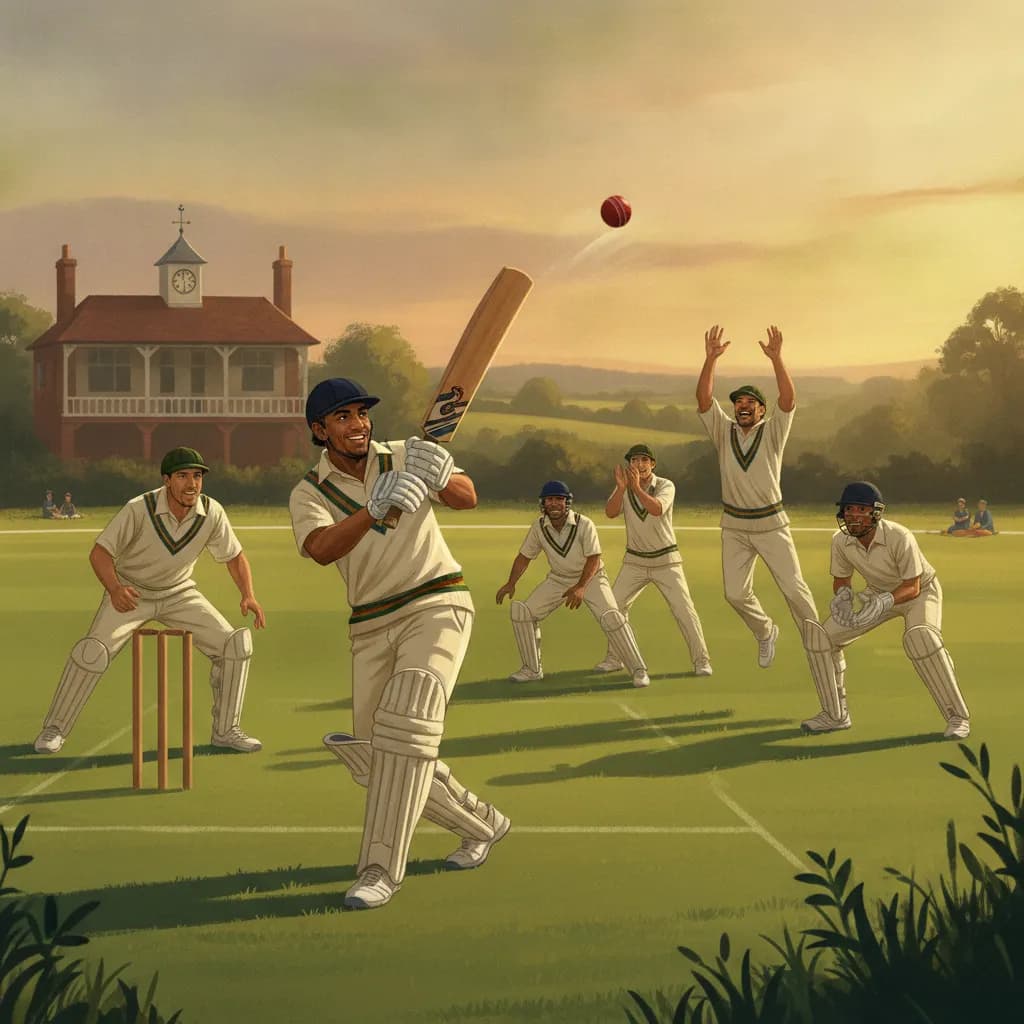
Cricket
A sport famous for matches that can run five days and still end in a draw — and somehow it's the second most-watched sport on the planet.
Cheat Sheet
- Two teams of eleven take turns batting and bowling — the batting team scores runs, the bowling and fielding team tries to get batters out.
- A "wicket" means two things at once: the three stumps a bowler aims at, and the term for getting a batter out.
- An "over" is six consecutive deliveries bowled by one bowler before a different bowler takes over from the other end.
- Runs come from running between the wickets after hitting the ball, or automatically for a boundary (4 runs, ball rolls to the edge) or a six (6 runs, ball clears the boundary on the full).
- Formats vary hugely in length: Test matches run up to five days, One Day Internationals (ODIs) wrap up in a day, and T20 matches finish in about three hours.
- Whichever team scores more runs by the end of the match (rules on how a match ends vary by format) wins.
The 60-Second Version
Cricket is played between two teams of eleven, taking turns batting and bowling. The batting team tries to score runs by hitting a ball bowled at a set of three stumps (the "wicket") and running between two wickets set 22 yards apart, while the bowling and fielding team tries to get batters out and limit runs. A bowler delivers six balls in a row (an "over") before another bowler takes over from the opposite end. Runs also come automatically for hitting the ball to the boundary — 4 runs if it rolls there, 6 if it clears the boundary without touching the ground, similar to a home run. Once ten of a team's eleven batters are out (or a set number of overs runs out, depending on the format), the innings ends and the other team bats. Whichever team has scored more runs by the finish wins — though in the longest format, a match can also end in a draw if time simply runs out first.
The Long Version
The Basics of a Match
Each team fields eleven players; when batting, two batters are on the field at any time, running between the wickets to score runs while their teammates wait their turn in the pavilion. The bowling team's job is twofold: get batters out, and prevent runs, using a rotating cast of bowlers who each bowl in sets of six-ball overs from alternating ends of the pitch. A single match, depending on format, involves anywhere from a few dozen overs to several hundred, which is part of why cricket scoring and pacing can look so unfamiliar to newcomers used to fixed-time sports.
Three Very Different Formats
Cricket's biggest quirk for outsiders is that it isn't one game length — it's three genuinely different formats under the same rules. Test cricket, the oldest and most traditionally respected format, runs up to five full days, with each team batting twice; it rewards patience and endurance over the course of a match rather than raw speed. One Day Internationals (ODIs) compress the game into a single day, with each team facing a fixed 50 overs. Twenty20 (T20) compresses things further still, to just 20 overs per side and roughly three hours total — closer in pace and spectacle to a typical American sporting event, and the format most responsible for cricket's recent surge in global commercial popularity.
How Batters Get Out
Batters can be dismissed in several distinct ways, each with its own rules: "bowled" means the ball hits the stumps directly; "caught" means a fielder catches the ball on the full after the batter hits it; "leg before wicket" (LBW) is called when the ball would have hit the stumps but is blocked by the batter's leg instead, a rule that causes as much argument among cricket fans as offside does in soccer; and "run out" happens when a fielder breaks the stumps with the ball while batters are attempting a run between the wickets. Once ten of eleven batters are out, the innings ends regardless of the format's over limit.
A Truly Global Sport
Cricket's global center of gravity has shifted decisively toward India, both commercially and competitively — the Indian Premier League (IPL), a T20 franchise competition launched in 2008, is now one of the richest sports leagues in the world by broadcast value, and has reshaped how cricket is played, marketed, and watched everywhere. The historic rivalry between England and Australia, known as "The Ashes," remains one of the sport's most storied traditions, dating back to the 1880s. Beyond South Asia, England, and Australia, cricket is also hugely popular across the Caribbean, South Africa, and much of the former British Commonwealth, giving it a genuinely global following that rivals soccer's in several regions even if it's far less visible in the United States.
Ad slot (placeholder — set NEXT_PUBLIC_ADSENSE_SLOT_ID once an ad unit is created)
Glossary
- Wicket
- Either the three stumps a bowler targets, or the term for a batter being dismissed.
- Over
- A set of six consecutive deliveries bowled by one bowler.
- Innings
- A team's turn at batting — in cricket, "innings" is used for both singular and plural.
- Boundary
- Hitting the ball to the edge of the field for 4 runs (rolling) or 6 runs (on the full, like a home run).
- Century
- A batter scoring 100 runs in a single innings — a major individual milestone.