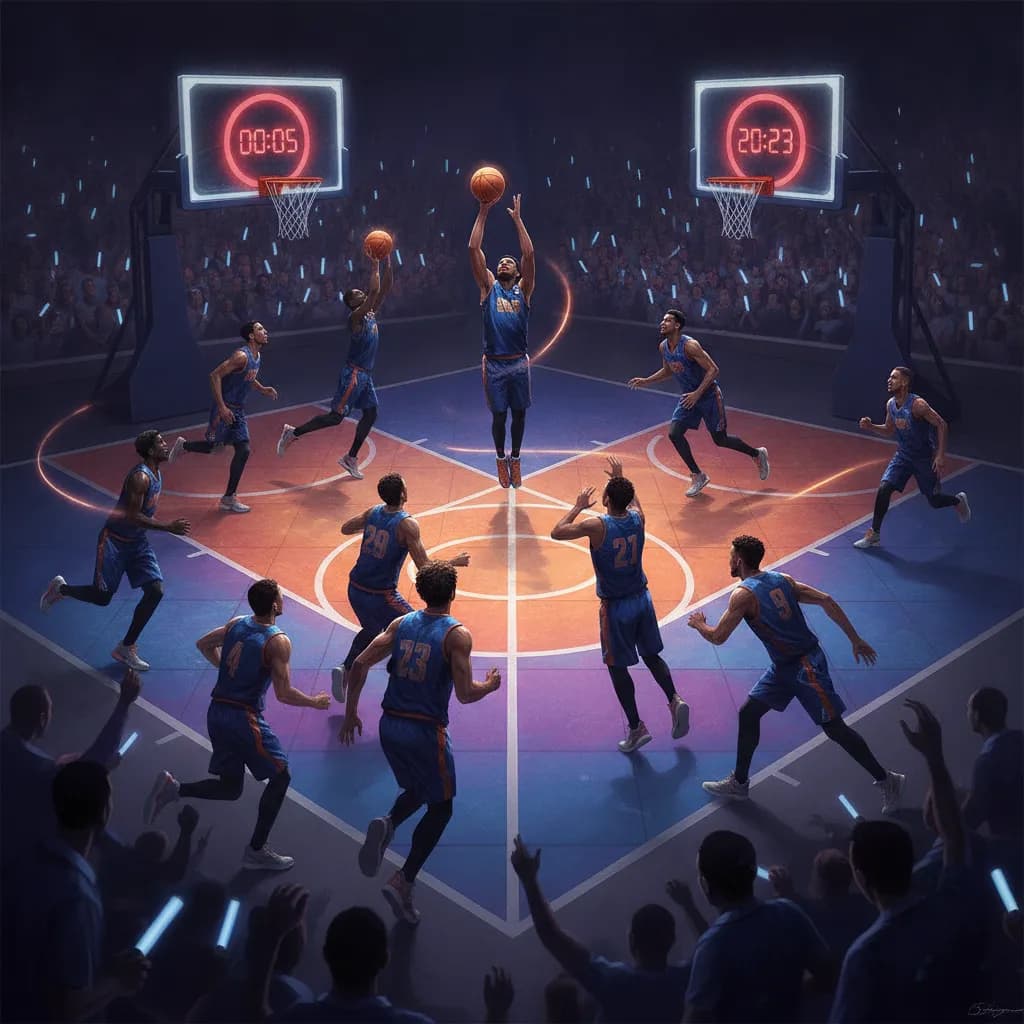
Basketball
Ten players, one hoop each end, and a shot clock ticking down that turns the whole sport into a 24-second sprint, over and over.
Cheat Sheet
- Two teams of five try to score by shooting a ball through the opponent's elevated hoop — most points after four quarters wins.
- A basket counts for 2 points inside the three-point arc, 3 points beyond it, and 1 point per free throw.
- The shot clock (24 seconds in the NBA) forces a team to attempt a shot in time or lose possession — it's why the game moves so fast.
- "Traveling" (walking without dribbling) and "double dribble" (stopping and restarting a dribble) are the two most common violations.
- Enough personal fouls sends a player to the free-throw line — and too many fouls in a game (six in the NBA) fouls a player out entirely.
- The NBA is the dominant pro league, but basketball is also a major Olympic and international sport via FIBA.
The 60-Second Version
Basketball is played between two teams of five, each trying to score by shooting a ball through the opponent's elevated hoop while defending their own. A made basket is worth 2 points from inside the three-point arc, 3 points from beyond it, and 1 point per free throw earned after a foul. Games run four quarters (length varies by league), and whoever has more points at the end wins. The shot clock — 24 seconds in the NBA — forces a team to attempt a shot within that window or hand possession back to the other team, which is why the game moves at such a relentless pace compared to lower-scoring sports. Players advance the ball by dribbling (bouncing it) or passing; walking with it without dribbling ("traveling") or stopping and restarting a dribble ("double dribble") are turnovers.
The Long Version
Origins and Invention
Basketball has an unusually precise origin story: physical education instructor James Naismith invented it in December 1891 in Springfield, Massachusetts, tasked with creating an indoor game to keep athletes active during the winter. His original setup literally used peach baskets nailed to a railing, with a ball retrieved by hand after every score until someone eventually cut a hole in the bottom. From that improvised beginning, the game spread quickly through YMCAs and colleges, and within a few decades had become one of the most popular team sports in the United States.
How a Game Works
Teams typically organize around five positions, though modern play has blurred these roles considerably: point guards handle ball-distribution and playmaking, shooting guards and small forwards score from the perimeter and midrange, and power forwards and centers operate closer to the basket, rebounding and defending the paint. Fouls — illegal contact against an opponent — accumulate individually; enough personal fouls in a single game disqualifies a player entirely (six in the NBA), and a team that fouls too often in a period sends its opponent to the free-throw line automatically regardless of whether a shot was being attempted. Beyond traveling and double dribble, other common violations include goaltending (illegally blocking a shot on its way down toward the rim) and backcourt violations (bringing the ball back over the mid-court line once it's been advanced past it).
The Global Game
The NBA is the dominant professional league by revenue, talent concentration, and global visibility, but basketball is genuinely an international sport governed worldwide by FIBA, with a full Olympic tournament and strong domestic leagues across Europe, particularly Spain, Greece, and the EuroLeague circuit that spans multiple countries. International rules differ from the NBA in small but meaningful ways — a shorter three-point line, a trapezoid-shaped lane in older rulesets, and typically shorter game length — which occasionally trips up players moving between American and international competition.
Why the Game Evolved
The modern NBA looks dramatically different from even 15 years ago, largely due to an analytics-driven shift often called the "three-point revolution": teams realized that three-point shots are mathematically more efficient on average than long two-point shots, and restructured entire offenses around maximizing three-point attempts and shots at the rim while minimizing the inefficient shots in between. That same analytical thinking also drove the "small ball" trend, with teams favoring faster, more versatile lineups over traditional, slower, back-to-the-basket centers, changing not just strategy but the kind of athlete now valued most at the position.
Ad slot (placeholder — set NEXT_PUBLIC_ADSENSE_SLOT_ID once an ad unit is created)
Glossary
- Dribble
- Bouncing the ball with one hand to legally move while holding it.
- Rebound
- Recovering the ball after a missed shot attempt.
- Assist
- A pass that directly leads to a teammate scoring.
- Turnover
- Losing possession of the ball without attempting a shot.
- Screen
- A player positioning themselves to block a defender and free up a teammate, also called a "pick."