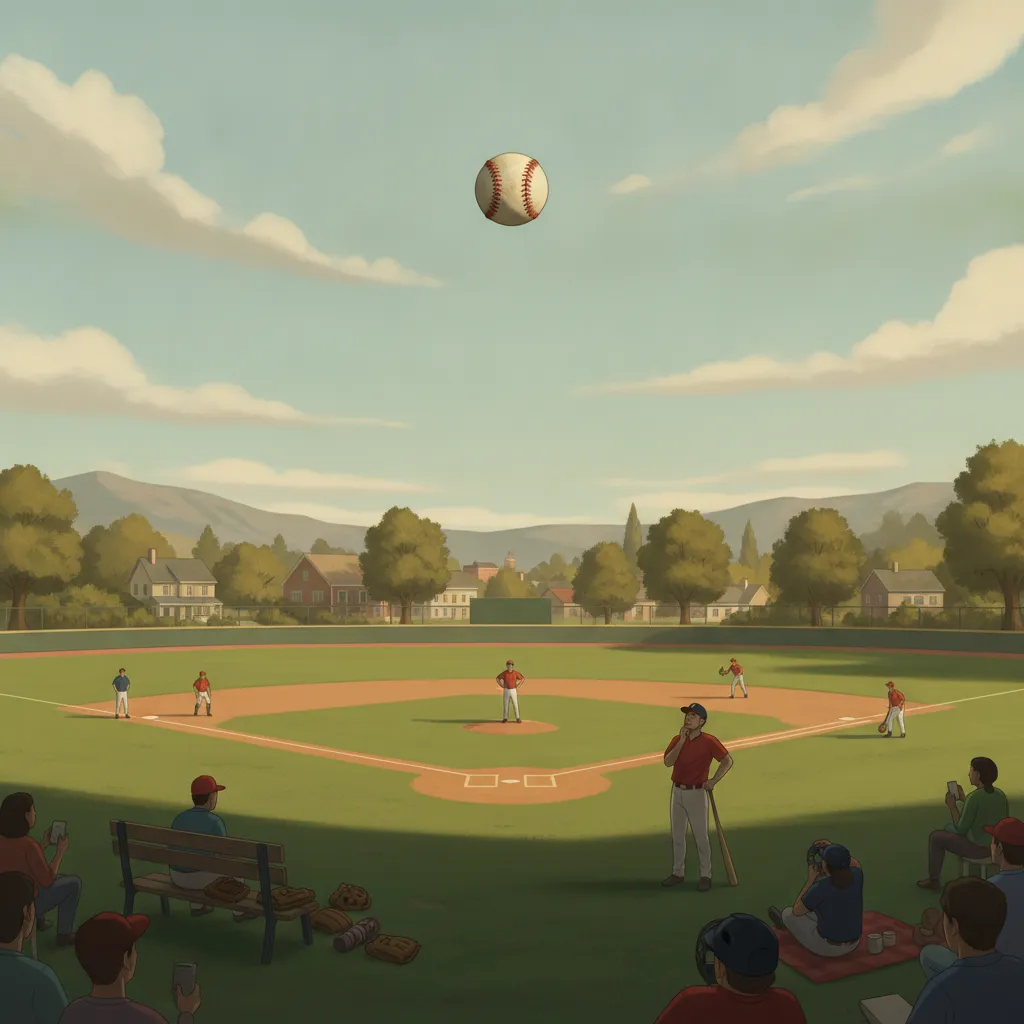
Baseball
A sport where the ball is in play for only about 18 minutes of a three-hour game, and somehow that's exactly the point.
Cheat Sheet
- Two teams of nine take turns batting and fielding across nine innings — the batting team scores by advancing runners around four bases and back to home plate.
- A pitcher throws to a batter, who tries to hit the ball into play; three strikes is an out, four balls (pitches outside the strike zone) is a walk to first base.
- Three outs end a team's turn at bat (a "half-inning"); nine innings make a full game, extended if the score is tied.
- A home run — hitting the ball out of the field of play in fair territory — scores the batter and every runner currently on base, immediately.
- Batting average, home runs, and ERA (earned run average, for pitchers) are the sport's most commonly cited stats, though modern analytics go far deeper.
- The World Series, MLB's championship, is one of the oldest continuously running championships in North American pro sports, dating to 1903.
The 60-Second Version
Baseball is played between two teams of nine, taking turns batting and fielding across nine innings. While batting, a team sends hitters up one at a time to face the opposing pitcher, who tries to get them out; a batter is struck out after three strikes (swings-and-misses or called strikes), while four pitches outside the strike zone earns a walk to first base. A batter who puts the ball in play tries to reach base safely and advance around first, second, and third base back to home plate, scoring a run each time. Three outs end a team's turn at bat, called a half-inning; once both teams have batted in an inning, nine innings make a complete game, extended into extra innings if the score is tied. A home run — hitting the ball out of the field of play in fair territory — immediately scores the batter and every runner already on base.
The Long Version
How a Game Unfolds
Each team sets a fixed batting order before the game that it must follow throughout, cycling through all nine hitters repeatedly as innings progress. On defense, a team fields nine positions: a pitcher and catcher forming the "battery," four infielders (first base, second base, shortstop, third base), and three outfielders covering left, center, and right field, each with distinct defensive responsibilities. A batter reaching base without an out — via a hit, a walk, or being hit by a pitch — becomes a baserunner, and advancing runners around the bases safely, one base at a time or several at once on a well-hit ball, is the central tactical puzzle of the offensive side of the game.
The Pitcher-Batter Duel
The one-on-one confrontation between pitcher and batter is baseball's core unit of drama, repeated dozens of times a game. Pitchers throw a variety of pitch types designed to deceive — fastballs for raw velocity, curveballs and sliders that break sideways or downward, and changeups that look like a fastball out of the hand but arrive much slower — and selecting the right pitch in a given situation, factoring in the batter's tendencies and the runners on base, is as much a strategic contest as the physical throw itself. A full count (three balls, two strikes) represents peak tension in this duel, since the next pitch will end the at-bat one way or another.
Baseball's Numbers Obsession
Baseball has always been unusually statistics-driven compared to most sports, thanks to its discrete, sequential structure (one pitch, one batter, one play at a time) that makes individual events far easier to isolate and measure than in a fluid, continuous sport. Traditional stats like batting average, home runs, and ERA have more recently been supplemented — and in many analytical circles, largely replaced — by advanced "sabermetrics," a movement popularized by the book and film "Moneyball," which showed that undervalued statistics like on-base percentage could identify better players than traditional scouting alone. That analytics revolution has since reshaped nearly every front office in the sport, changing everything from lineup construction to defensive positioning.
America's Pastime, Globally
Major League Baseball remains the sport's most prominent and highest-paying league, but baseball has genuinely deep roots well beyond the United States. Japan's Nippon Professional Baseball (NPB) has its own storied history and passionate fan base, and the sport carries major cultural weight across Latin America, especially the Dominican Republic, Venezuela, and Puerto Rico, which together produce a large share of MLB's international talent. The World Baseball Classic, an international tournament held every few years, has increasingly showcased that global talent pool on one stage, turning what's sometimes called "America's pastime" into a genuinely international competition.
Ad slot (placeholder — set NEXT_PUBLIC_ADSENSE_SLOT_ID once an ad unit is created)
Glossary
- Inning
- A full turn at bat for both teams; nine innings make a standard game.
- Strike zone
- The area over home plate, roughly between a batter's knees and chest, that defines a called strike.
- Home run
- A hit that clears the outfield fence in fair territory, scoring the batter and all runners on base.
- ERA
- Earned run average — the average number of earned runs a pitcher allows per nine innings pitched.
- Bullpen
- The area where relief pitchers warm up, also used to describe a team's group of relief pitchers collectively.