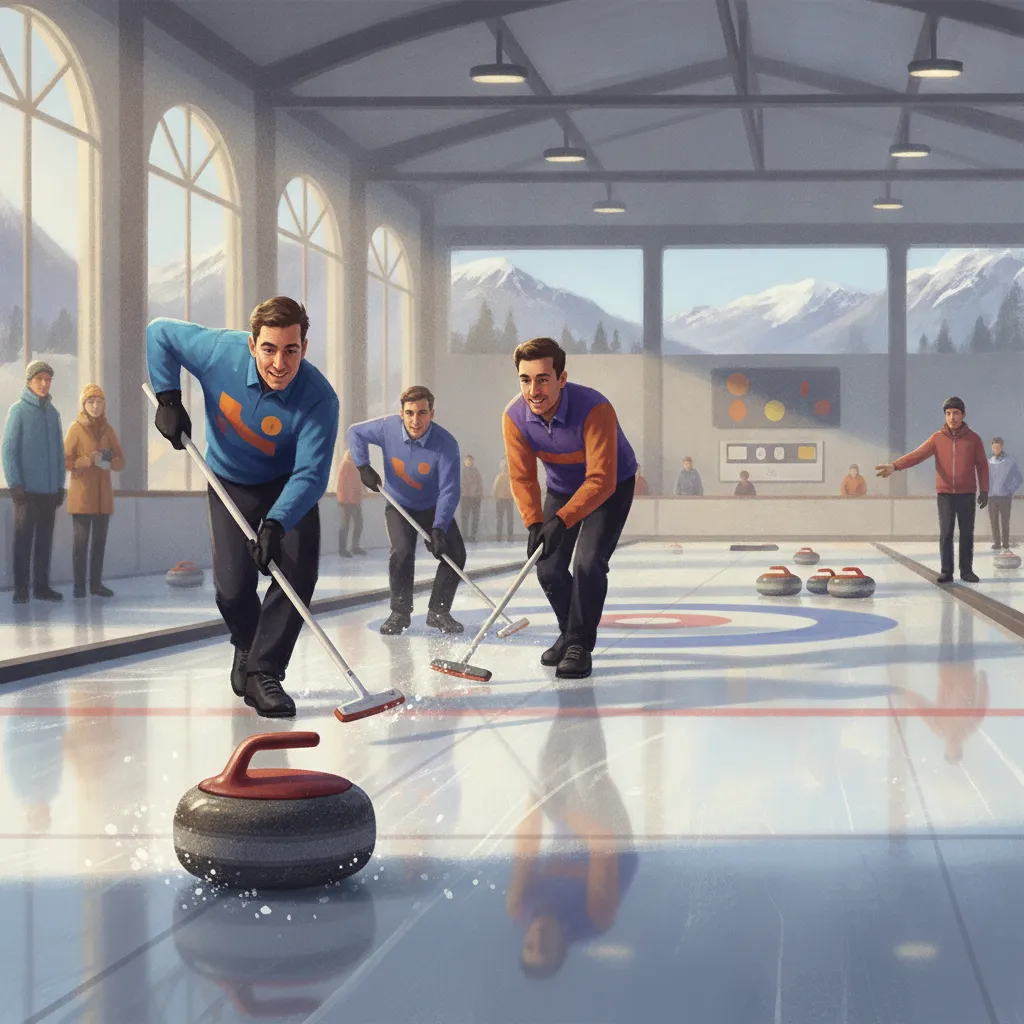
Curling
Often called chess on ice — a sport where sweeping a broom in just the right spot can bend a 40-pound stone's path by inches.
Cheat Sheet
- Curling involves sliding heavy granite stones across an ice sheet toward a circular target ("the house"), with teammates using brooms to sweep the ice and influence the stone's path.
- A match, called a "game," is divided into ends (similar to innings), typically 8-10 per game, with each team throwing multiple stones per end.
- Sweeping the ice ahead of a moving stone temporarily reduces friction, allowing players to subtly extend how far the stone travels and adjust its curve.
- Teams consist of four players (skip, third, second, lead), each throwing two stones per end in a fixed rotating order.
- Curling's strategic depth is often compared to chess on ice, since teams must plan several stones ahead, blocking and setting up future shots rather than simply aiming for the center.
- Countries like Canada, Sweden, and Scotland have unusually deep grassroots curling cultures, reflected in their consistently strong Olympic and world championship results.
The 60-Second Version
Curling involves sliding heavy granite stones across an ice sheet toward a circular target called "the house," with teammates using brooms to sweep the ice ahead of the stone and influence its path. A match, called a game, is divided into ends, similar to innings, typically 8-10 per game, with each team throwing multiple stones per end. Sweeping the ice ahead of a moving stone temporarily reduces friction, allowing players to subtly extend how far the stone travels and adjust its curve. Teams consist of four players, skip, third, second, and lead, each throwing two stones per end in a fixed rotating order. Curling's strategic depth is often compared to chess on ice, since teams must plan several stones ahead, blocking and setting up future shots rather than simply aiming for the center. Countries like Canada, Sweden, and Scotland have unusually deep grassroots curling cultures, reflected in their consistently strong Olympic and world championship results.
The Long Version
The Basic Object of the Game
The goal in curling is to slide granite stones down a sheet of ice so they come to rest as close as possible to the center of a circular target called the house, while also strategically blocking or removing an opponent's stones from favorable scoring positions. Points are awarded at the end of each round based on which team has stones closest to the center, with only the leading team's closest stones actually counting toward the score.
How an End Actually Works
A curling game is divided into ends, roughly equivalent to innings in baseball, typically numbering 8 to 10 per game. Within each end, all four players from both teams take turns throwing their two stones each, in a fixed rotating order, building toward a final scoring assessment once every stone for that end has been thrown.
The Physics (and Strategy) of Sweeping
Sweeping the ice directly in front of a moving stone briefly melts a microscopic layer of the ice surface, reducing friction and allowing the stone to travel farther and curl (curve) less than it otherwise would. Teammates use this technique in real time, reading the stone's trajectory and adjusting how vigorously and where they sweep to fine-tune both distance and final curving path toward the target.
Why It's Compared to Chess
Because every stone thrown changes the strategic layout for every stone that follows, top curling teams plan several throws ahead, deliberately using early stones to set up blocking positions ("guards") or clear paths for later, more decisive shots. This layered, sequential strategy, where the immediate goal of any single throw often serves a longer-term plan several stones down the line, is central to why the sport draws frequent comparisons to chess.
Ad slot (placeholder — set NEXT_PUBLIC_ADSENSE_SLOT_ID once an ad unit is created)
Glossary
- The house
- The circular scoring target on a curling sheet that stones are aimed toward.
- End
- A single round of play in curling, roughly equivalent to an inning, in which each team throws multiple stones.
- Skip
- The team captain in curling, who calls strategy and typically throws the team's final, most decisive stones.
- Sweeping
- Using brooms to reduce ice friction ahead of a moving stone, extending its distance and adjusting its path.
- Hammer
- The last stone thrown in an end, considered a significant strategic advantage.