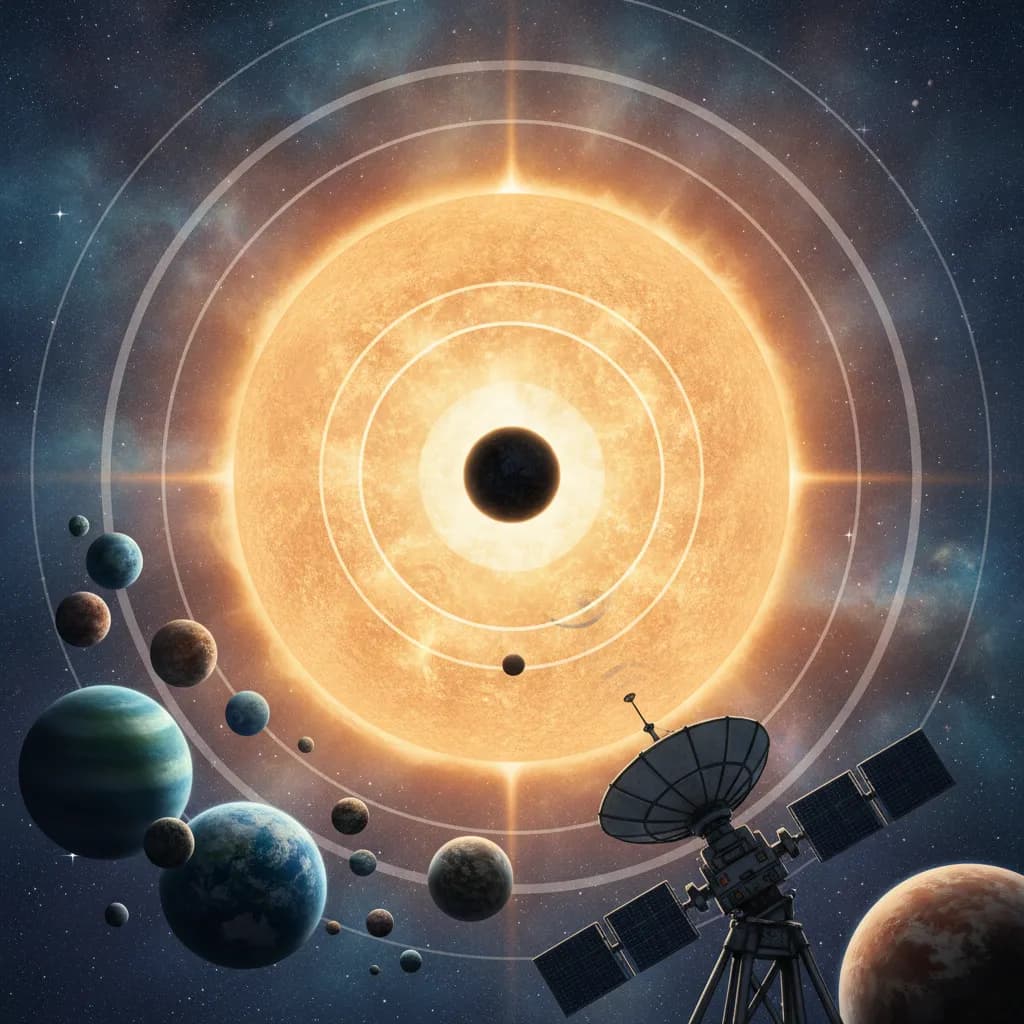
Exoplanets
A category of planet that scientists can't actually see directly in most cases — instead, they detect them by watching for a star's light flickering, ever so slightly, as something passes in front of it.
Cheat Sheet
- An exoplanet is any planet located outside our own solar system, orbiting a star other than the sun.
- Thousands of exoplanets have been confirmed since the first discovery in the 1990s, with scientists estimating that the actual total number across the galaxy is almost certainly far larger.
- Because exoplanets are generally too distant and faint to observe directly, astronomers primarily detect them through indirect methods, most notably the transit method, which detects the tiny, periodic dimming of a star's light as a planet passes in front of it.
- The "habitable zone," sometimes called the "Goldilocks zone," refers to the range of distance from a star where conditions could theoretically support liquid water on a planet's surface.
- Exoplanets have been found in a remarkably wide range of types, including gas giants larger than Jupiter, small rocky planets comparable to Earth, and unusual planets with no clear equivalent in our own solar system.
- The search for potentially habitable exoplanets is directly motivated by the broader scientific question of whether life might exist elsewhere in the universe, though no confirmed evidence of extraterrestrial life has been found on any exoplanet to date.
The 60-Second Version
An exoplanet is any planet located outside our own solar system, orbiting a star other than the sun. Thousands of exoplanets have been confirmed since the first discovery in the 1990s, with scientists estimating that the actual total number across the galaxy is almost certainly far larger. Because exoplanets are generally too distant and faint to observe directly, astronomers primarily detect them through indirect methods, most notably the transit method, which detects the tiny, periodic dimming of a star's light as a planet passes in front of it. The "habitable zone," sometimes called the "Goldilocks zone," refers to the range of distance from a star where conditions could theoretically support liquid water on a planet's surface. Exoplanets have been found in a remarkably wide range of types, including gas giants larger than Jupiter, small rocky planets comparable to Earth, and unusual planets with no clear equivalent in our own solar system. The search for potentially habitable exoplanets is directly motivated by the broader scientific question of whether life might exist elsewhere in the universe, though no confirmed evidence of extraterrestrial life has been found on any exoplanet to date.
The Long Version
Thousands Confirmed, Many More Likely Out There
Since the first confirmed exoplanet discovery in the 1990s, astronomers have confirmed thousands of additional exoplanets, and given the sheer scale of our galaxy alone, scientists estimate the actual total number of exoplanets across the Milky Way is almost certainly far larger than the number confirmed so far, with detection technology continuing to improve and expand what's observable.
Detecting Planets You Can't Actually See
Because exoplanets are generally far too distant and faint relative to their host stars to observe directly, astronomers rely primarily on indirect detection methods, most notably the transit method, which detects the tiny, periodic dimming of a star's light as an orbiting planet passes directly in front of it from our vantage point, an approach that has enabled the vast majority of exoplanet discoveries to date.
The Search for a "Just Right" Distance From a Star
The concept of the habitable zone, sometimes informally called the "Goldilocks zone," describes the specific range of distance from a star where conditions could theoretically support liquid water on a planet's surface, neither too close and scorchingly hot nor too far and frozen, a key factor astronomers consider when evaluating whether a given exoplanet might plausibly support life.
An Enormous Range of Planetary Types
Exoplanets discovered so far span a remarkably wide range of types, including gas giants considerably larger than Jupiter, small rocky planets roughly comparable in size to Earth, and various unusual planet types with no clear direct equivalent anywhere in our own solar system, significantly expanding scientific understanding of just how varied planetary formation can be across the galaxy.
Ad slot (placeholder — set NEXT_PUBLIC_ADSENSE_SLOT_ID once an ad unit is created)
Glossary
- Exoplanet
- Any planet located outside our own solar system, orbiting a star other than the sun.
- Transit method
- A common exoplanet detection technique measuring the tiny, periodic dimming of a star's light as a planet passes in front of it.
- Habitable zone
- The range of distance from a star where conditions could theoretically support liquid water on a planet's surface.
- Gas giant
- A large planet composed primarily of gas, such as Jupiter, a category also found among discovered exoplanets.
- Kepler Space Telescope
- A NASA space telescope responsible for discovering a significant share of currently confirmed exoplanets.