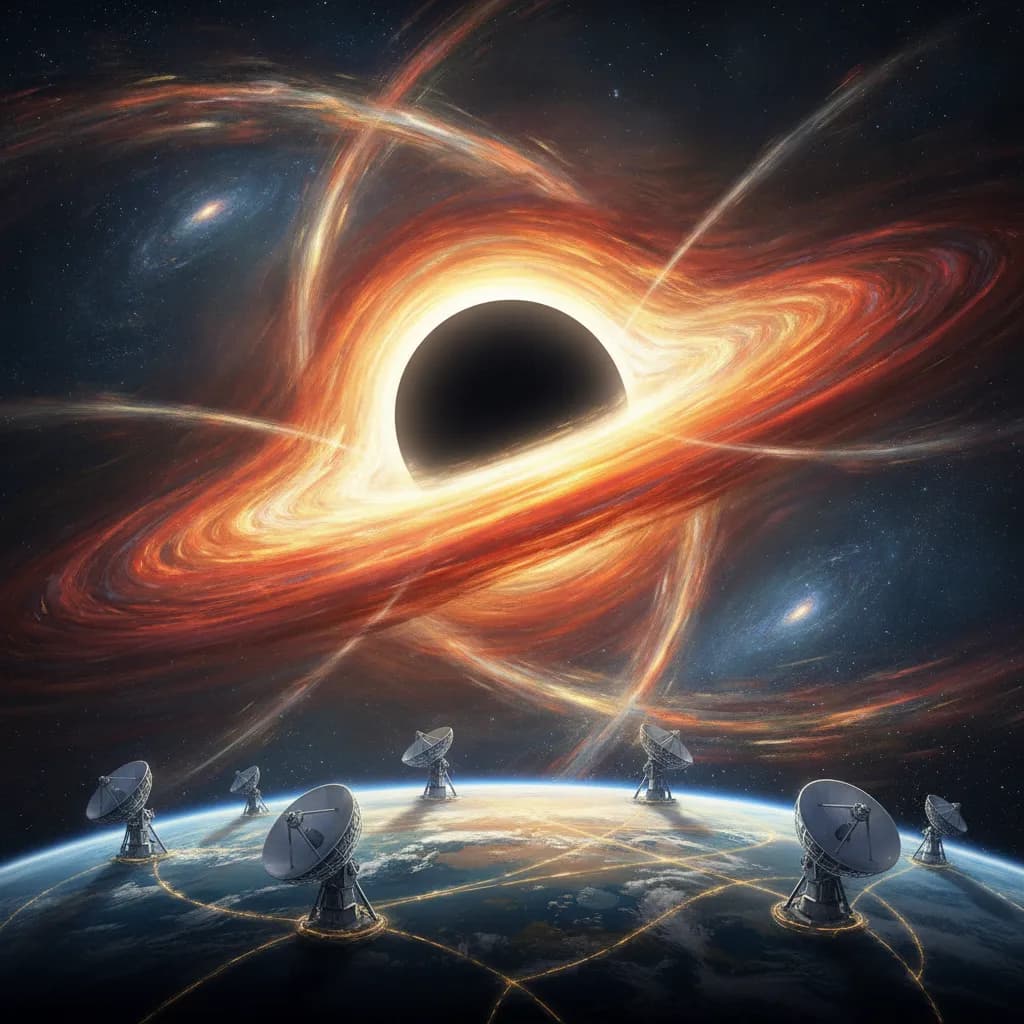
Black Holes
An object so extreme that its very first direct photograph wasn't taken by a single telescope, but by linking radio dishes across the entire planet into one Earth-sized instrument.
Cheat Sheet
- A black hole is a region of space where gravity is so strong that nothing, not even light, can escape once it crosses a boundary called the event horizon.
- Most black holes form from the collapse of massive stars at the end of their life cycle, when the star's core collapses under its own gravity after running out of nuclear fuel.
- Supermassive black holes, millions to billions of times the mass of the sun, are believed to exist at the center of most large galaxies, including our own Milky Way.
- The first-ever direct image of a black hole, released in 2019, was captured by the Event Horizon Telescope, a global network of radio telescopes working together as a single Earth-sized instrument.
- Time behaves differently near a black hole due to its extreme gravity — a clock closer to the event horizon ticks measurably slower relative to a distant observer, a real effect predicted by general relativity.
- Despite popular imagery, black holes don't actively "suck" in surrounding matter like a vacuum cleaner — objects at a safe distance orbit them just like they would any other object of equivalent mass.
The 60-Second Version
A black hole is a region of space where gravity is so strong that nothing, not even light, can escape once it crosses a boundary called the event horizon. Most black holes form from the collapse of massive stars at the end of their life cycle, when the star's core collapses under its own gravity after running out of nuclear fuel. Supermassive black holes, millions to billions of times the mass of the sun, are believed to exist at the center of most large galaxies, including our own Milky Way. The first-ever direct image of a black hole, released in 2019, was captured by the Event Horizon Telescope, a global network of radio telescopes working together as a single Earth-sized instrument. Time behaves differently near a black hole due to its extreme gravity — a clock closer to the event horizon ticks measurably slower relative to a distant observer, a real effect predicted by general relativity. Despite popular imagery, black holes don't actively "suck" in surrounding matter like a vacuum cleaner — objects at a safe distance orbit them just like they would any other object of equivalent mass.
The Long Version
What a Black Hole Actually Is
A black hole is defined by its event horizon, the boundary beyond which gravity becomes so strong that not even light, the fastest thing in the universe, can escape. Beyond that point, all known physics suggests matter continues collapsing toward a theoretical point called a singularity, where our current understanding of physics effectively breaks down.
How They Form
Most stellar-mass black holes form at the end of a massive star's life cycle: once the star exhausts the nuclear fuel that had been generating outward pressure to balance its own gravity, the core collapses inward catastrophically, and if the remaining mass is large enough, that collapse continues past the point where any known force can stop it, forming a black hole.
Supermassive Black Holes at Galaxy Centers
Beyond stellar-mass black holes, astronomers have found strong evidence that supermassive black holes, ranging from millions to billions of times the sun's mass, sit at the center of most large galaxies, including the Milky Way's own central black hole, Sagittarius A*. How exactly these supermassive black holes originally formed remains an active area of astrophysical research.
Capturing the First-Ever Image
Because black holes themselves emit no light, they can't be photographed directly in the conventional sense; instead, the 2019 image released by the Event Horizon Telescope collaboration captured the glowing ring of superheated gas and light bending around a supermassive black hole's event horizon. Producing this image required linking radio telescopes from across the globe into a single coordinated instrument effectively the size of Earth itself, since a single conventional telescope would need to be impossibly large to resolve an object that distant and that small in the sky.
Ad slot (placeholder — set NEXT_PUBLIC_ADSENSE_SLOT_ID once an ad unit is created)
Glossary
- Event horizon
- The boundary around a black hole beyond which nothing, not even light, can escape.
- Singularity
- The theoretical point at a black hole's center where matter is crushed to infinite density.
- Supermassive black hole
- An extremely large black hole, millions to billions of times the sun's mass, found at the centers of most large galaxies.
- Event Horizon Telescope
- A global network of radio telescopes that captured the first direct image of a black hole in 2019.
- Accretion disk
- A rotating disk of gas and dust spiraling into a black hole, often glowing brightly from friction and heat.