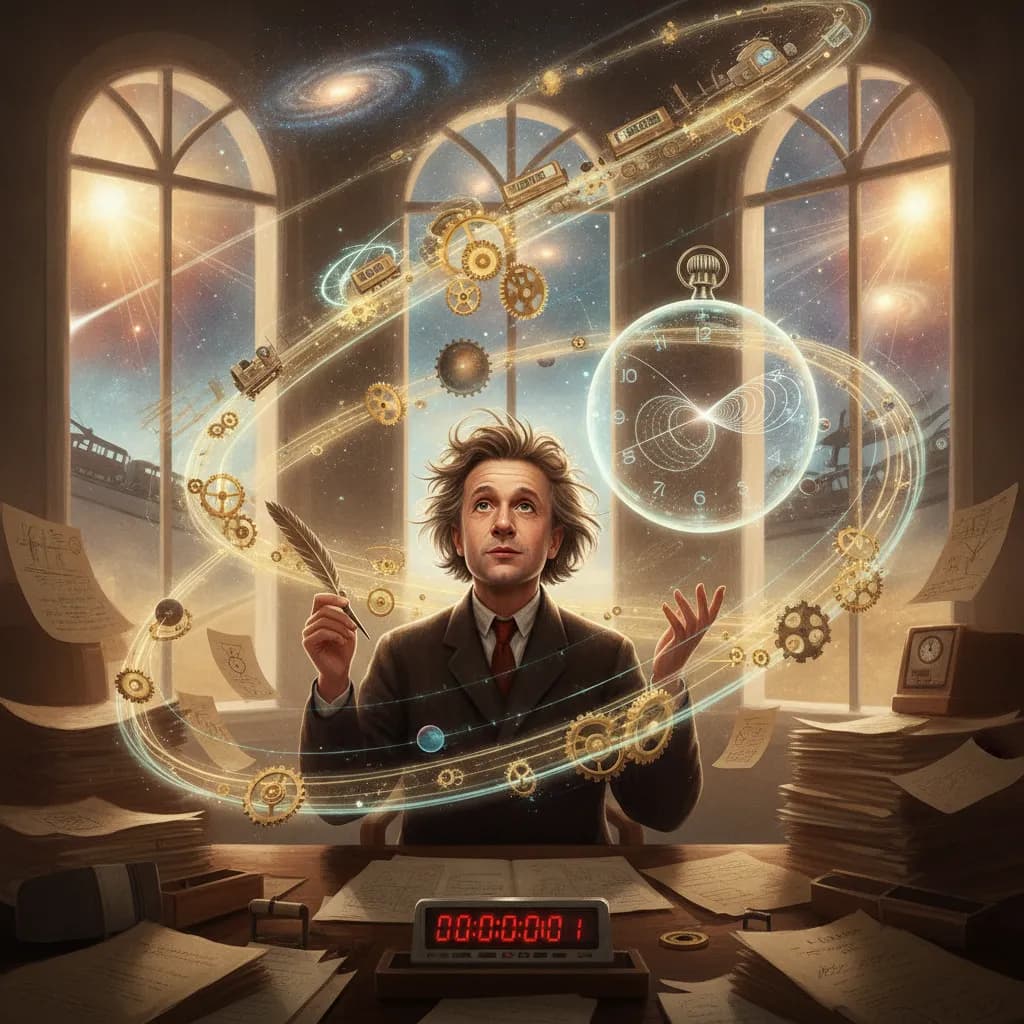
Relativity
A theory built almost entirely from thought experiments in a patent office — later confirmed true down to fractions of a second.
Cheat Sheet
- Einstein's theory comes in two parts: Special Relativity (1905), dealing with objects moving at constant high speed, and General Relativity (1915), which adds gravity into the picture.
- The core insight of Special Relativity: the speed of light is the same for every observer, no matter how fast they're moving — which forces space and time themselves to bend to keep that true.
- Time dilation means a clock moving very fast (or sitting in strong gravity) actually ticks slower relative to a stationary observer — not an illusion, a measurable physical effect.
- General Relativity reimagines gravity not as a force but as the curvature of spacetime caused by mass — a planet doesn't pull on you, it bends the space you're moving through.
- GPS satellites have to correct for relativistic time effects every day — without the correction, GPS location errors would build up by miles within hours.
- Black holes, gravitational waves, and the expansion of the universe are all direct predictions of General Relativity that were later confirmed by observation, often decades after Einstein first proposed them.
The 60-Second Version
Relativity is actually two theories. Special Relativity (1905) starts from one strange, non-negotiable fact: the speed of light is the same for every observer, regardless of how fast they themselves are moving. To keep that true, space and time have to flex — clocks moving at high speed run measurably slower, and distances contract in the direction of motion, effects called time dilation and length contraction. General Relativity (1915) extends this by reimagining gravity entirely: instead of a mysterious pulling force, gravity is the curvature of a combined four-dimensional "spacetime" caused by mass and energy — a planet doesn't reach out and pull you toward it, it bends the space you're moving through so that "straight ahead" curves toward it. Both theories sound abstract, but they have concrete, everyday consequences — GPS satellites, for instance, must constantly correct for relativistic time effects to stay accurate.
The Long Version
Special Relativity: The Speed of Light Rule
Einstein's starting point was almost absurdly simple to state and enormously disruptive to accept: light travels at the same speed for every observer, no matter how fast that observer is moving toward or away from the light source. Ordinary intuition says speeds should add up (a ball thrown from a moving train seems faster to someone standing still), but light stubbornly refuses to follow that rule. The only way to preserve it is to accept that time and space themselves aren't fixed and universal — a fast-moving clock genuinely ticks slower (time dilation), and a fast-moving object genuinely measures shorter along its direction of travel (length contraction), both confirmed repeatedly in particle accelerator experiments. The theory also produced physics' most famous equation, E=mc², revealing that mass and energy are fundamentally interchangeable.
General Relativity: Gravity as Geometry
A decade later, Einstein extended these ideas to include gravity and acceleration, arriving at a radical reinterpretation: gravity isn't a force pulling objects together in the way Newton described, but the curvature of a unified four-dimensional "spacetime" caused directly by the presence of mass and energy. A massive object like the sun doesn't reach out and grab the Earth — it bends the surrounding spacetime, and the Earth is simply following the straightest possible path through that curved space, which happens to be an orbit. This reframing explained a genuine puzzle Newton's gravity couldn't quite account for: a small, persistent anomaly in the orbit of Mercury.
Predictions Confirmed Decades Later
General Relativity made several bold, testable predictions that were confirmed only long after Einstein proposed them. In 1919, astronomer Arthur Eddington measured starlight bending around the sun during a solar eclipse, exactly matching Einstein's predicted curvature and making him an overnight global celebrity. Black holes, regions where spacetime curves so extremely that not even light can escape, were treated as a mathematical curiosity for decades before being directly observed. Gravitational waves, ripples in spacetime caused by massive accelerating objects like colliding black holes, were predicted in 1916 but not directly detected until LIGO's landmark 2015 observation — a full century later.
Relativity in Everyday Technology
Relativity isn't purely theoretical — GPS satellites orbit fast enough, and sit in weaker gravity than Earth's surface, that both Special and General Relativity's time effects apply to their onboard clocks simultaneously, and in opposite directions. Without constantly correcting for this, GPS position calculations would drift by several miles within just a day, since even tiny timing errors translate into large positional errors at the speed information travels. It's one of the clearest everyday reminders that relativity isn't just an abstract curiosity confined to physics textbooks.
Ad slot (placeholder — set NEXT_PUBLIC_ADSENSE_SLOT_ID once an ad unit is created)
Glossary
- Spacetime
- The single four-dimensional fabric combining the three dimensions of space with time, which mass and energy curve.
- Time dilation
- The effect where time passes at different rates for observers moving at different speeds or in different gravitational strengths.
- Event horizon
- The boundary around a black hole beyond which nothing, not even light, can escape.
- Gravitational wave
- A ripple in spacetime caused by massive accelerating objects, like colliding black holes.
- Reference frame
- The perspective (position and speed) from which an observer measures space, time, and motion.
Go Deeper
- NASA — Einstein's Theory of Relativity
- "Relativity: The Special and the General Theory" by Albert Einstein