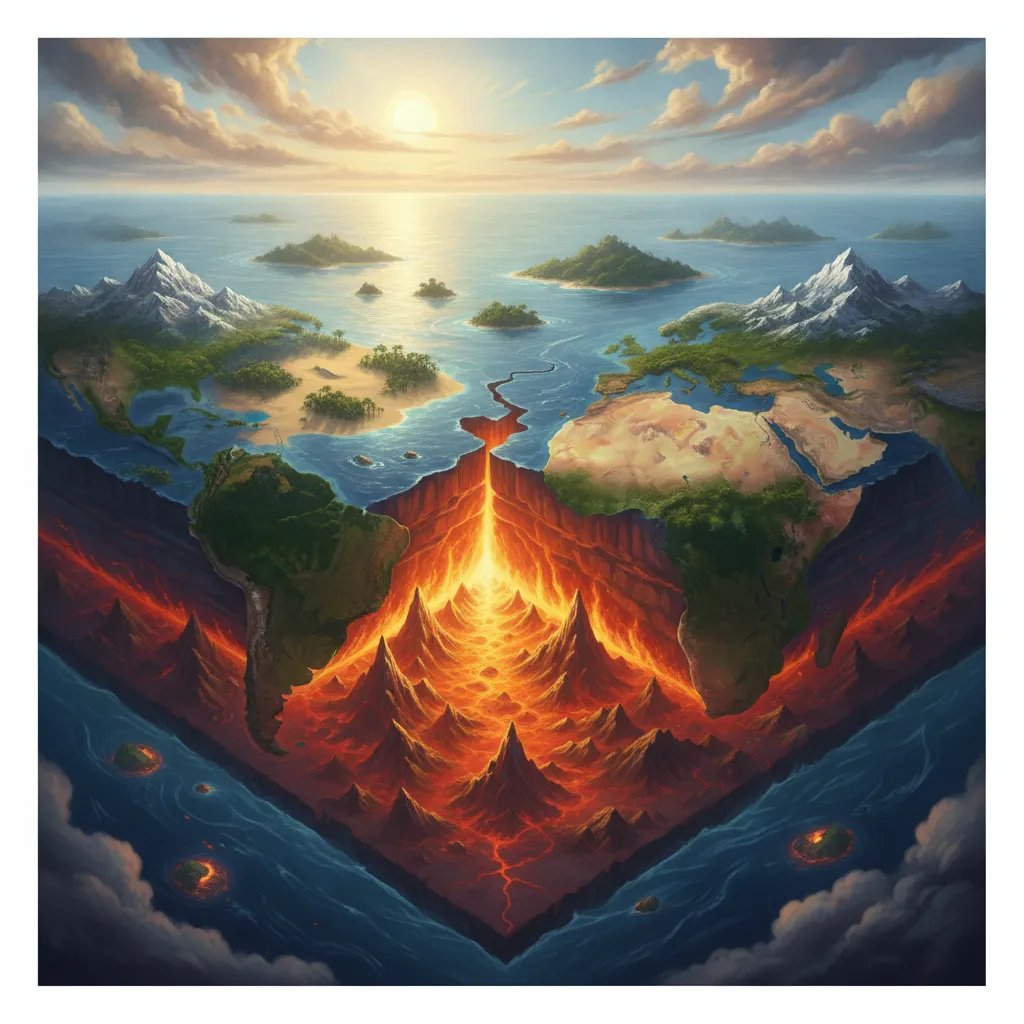
Plate Tectonics
A theory that explains why South America and Africa's coastlines look like they'd fit together — because, hundreds of millions of years ago, they did.
Cheat Sheet
- Plate tectonics is the scientific theory that Earth's outer shell is broken into large, rigid plates that slowly move over a hotter, more pliable layer beneath them.
- Plates move at roughly the speed fingernails grow (a few centimeters per year), but over millions of years this slow movement has reshaped entire continents and ocean basins.
- Most major earthquakes and volcanic activity occur at plate boundaries, where plates collide, pull apart, or slide past each other.
- The theory helped explain the striking, previously mysterious fit between the coastlines of continents like South America and Africa, now understood as pieces of a single ancient supercontinent.
- Plate tectonics wasn't widely accepted by mainstream geology until the mid-20th century, despite earlier proposals, once new evidence from ocean floor mapping made the theory much harder to dismiss.
- Continents are still slowly moving today — over the next tens of millions of years, current plate motion is projected to reshape the map in ways dramatically different from today's continents.
The 60-Second Version
Plate tectonics is the scientific theory that Earth's outer shell is broken into large, rigid plates that slowly move over a hotter, more pliable layer beneath them. Plates move at roughly the speed fingernails grow, a few centimeters per year, but over millions of years this slow movement has reshaped entire continents and ocean basins. Most major earthquakes and volcanic activity occur at plate boundaries, where plates collide, pull apart, or slide past each other. The theory helped explain the striking, previously mysterious fit between the coastlines of continents like South America and Africa, now understood as pieces of a single ancient supercontinent. Plate tectonics wasn't widely accepted by mainstream geology until the mid-20th century, despite earlier proposals, once new evidence from ocean floor mapping made the theory much harder to dismiss. Continents are still slowly moving today — over the next tens of millions of years, current plate motion is projected to reshape the map in ways dramatically different from today's continents.
The Long Version
What's Actually Moving, and How Fast
Earth's rigid outer shell is broken into a set of large tectonic plates that float atop a hotter, more pliable layer of the mantle beneath them, moving at a rate roughly comparable to how fast human fingernails grow, just a few centimeters per year. While imperceptibly slow on any human timescale, this movement compounds dramatically over millions of years, gradually reshaping the position and shape of entire continents and ocean basins.
Where Earthquakes and Volcanoes Actually Come From
The overwhelming majority of the world's earthquakes and volcanic activity occur specifically at plate boundaries, the edges where tectonic plates meet. Depending on whether plates are colliding, pulling apart, or sliding past each other, these boundaries produce dramatically different geological features, from towering mountain ranges formed by colliding plates to volcanic activity generated at subduction zones, where one plate is forced beneath another.
Solving the Puzzle of Matching Coastlines
Long before plate tectonics was accepted, observers had noticed the striking visual fit between the coastlines of continents like South America and Africa, almost as if they could be pieced back together like a jigsaw puzzle. Plate tectonics ultimately explained this observation directly: these continents were once joined together as part of a single ancient supercontinent, commonly called Pangaea, before plate movement gradually pulled them apart into their current positions over hundreds of millions of years.
A Slow Fight for Scientific Acceptance
Earlier versions of this idea, particularly Alfred Wegener's early-20th-century theory of continental drift, were initially met with significant skepticism from mainstream geologists, partly because Wegener couldn't fully explain what mechanism could actually move entire continents. It wasn't until new evidence from detailed ocean floor mapping in the mid-20th century revealed patterns consistent with plates spreading apart at mid-ocean ridges that the broader scientific community came to widely accept plate tectonics as established fact.
Ad slot (placeholder — set NEXT_PUBLIC_ADSENSE_SLOT_ID once an ad unit is created)
Glossary
- Tectonic plate
- A large, rigid section of Earth's outer shell that moves slowly over the layer beneath it.
- Plate boundary
- The edge where two tectonic plates meet, where most earthquakes and volcanic activity occur.
- Continental drift
- An earlier theory proposing that continents move over time, a key precursor to modern plate tectonics.
- Subduction zone
- A type of plate boundary where one tectonic plate is forced beneath another.
- Pangaea
- The ancient supercontinent believed to have contained most of Earth's landmass before breaking apart into today's continents.