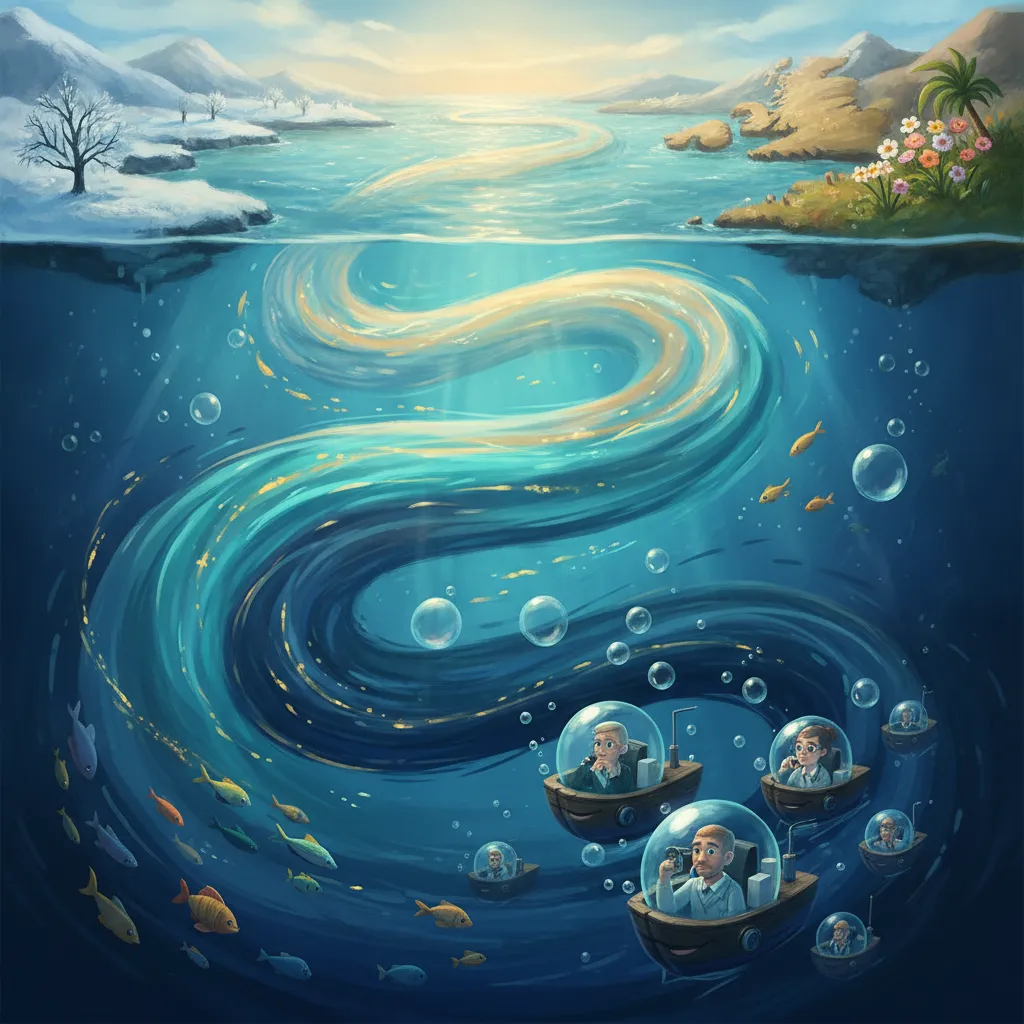
Ocean Currents
A single ocean current is a major reason Western Europe stays notably milder than other places at the same latitude — and scientists are watching closely for signs it could weaken.
Cheat Sheet
- Ocean currents are large-scale, continuous movements of seawater driven by wind, water density differences (from temperature and salinity), and the Earth's rotation.
- Surface currents are driven primarily by wind patterns, while deep ocean currents are driven mainly by differences in water density, a process called thermohaline circulation.
- The Gulf Stream, one of the most well-known currents, carries warm water from the Gulf of Mexico up the US East Coast and across the Atlantic, significantly moderating Western Europe's climate.
- Ocean currents play a major role in redistributing heat around the planet, meaning changes to major current patterns can have significant, far-reaching effects on regional climates.
- Scientists have expressed concern that melting polar ice, adding large amounts of fresh water to the ocean, could disrupt the density-driven deep circulation patterns that help drive major currents like the Gulf Stream.
- El Niño and La Niña are periodic shifts in Pacific Ocean surface temperature and currents that significantly influence global weather patterns for months at a time.
The 60-Second Version
Ocean currents are large-scale, continuous movements of seawater driven by wind, water density differences from temperature and salinity, and the Earth's rotation. Surface currents are driven primarily by wind patterns, while deep ocean currents are driven mainly by differences in water density, a process called thermohaline circulation. The Gulf Stream, one of the most well-known currents, carries warm water from the Gulf of Mexico up the US East Coast and across the Atlantic, significantly moderating Western Europe's climate. Ocean currents play a major role in redistributing heat around the planet, meaning changes to major current patterns can have significant, far-reaching effects on regional climates. Scientists have expressed concern that melting polar ice, adding large amounts of fresh water to the ocean, could disrupt the density-driven deep circulation patterns that help drive major currents like the Gulf Stream. El Niño and La Niña are periodic shifts in Pacific Ocean surface temperature and currents that significantly influence global weather patterns for months at a time.
The Long Version
What Actually Drives Ocean Currents
Ocean currents are driven by a combination of factors: wind pushing surface water in a consistent direction, differences in water density caused by variations in temperature and salinity, and the Earth's own rotation, which deflects moving water into large, curving current patterns rather than straight lines.
Surface Currents vs. Deep Circulation
Surface currents, occurring in the upper layer of the ocean, are driven primarily by consistent wind patterns and tend to move relatively quickly compared to deep ocean currents. Deep ocean circulation, by contrast, is driven mainly by density differences, colder, saltier water is denser and sinks, while warmer, less salty water rises, in a slow, global-scale process called thermohaline circulation that can take centuries to complete a full cycle.
The Gulf Stream's Outsized Climate Role
The Gulf Stream carries warm water from the Gulf of Mexico northward along the US East Coast before crossing the Atlantic toward Western Europe, transporting an enormous amount of heat along the way. This heat transport is a major reason Western European countries experience notably milder winters than other regions at similar latitudes that lack a comparable warm current nearby.
El Niño, La Niña, and Global Weather Swings
El Niño and La Niña describe periodic shifts in Pacific Ocean surface temperature and associated current patterns, occurring irregularly every few years and significantly influencing weather patterns across large parts of the globe for months at a time, from altered rainfall and drought patterns to shifts in hurricane activity, demonstrating just how far-reaching ocean current changes can be for global weather.
Ad slot (placeholder — set NEXT_PUBLIC_ADSENSE_SLOT_ID once an ad unit is created)
Glossary
- Thermohaline circulation
- The global deep-ocean circulation pattern driven by differences in water temperature and salinity (density).
- Gulf Stream
- A powerful warm-water current carrying water from the Gulf of Mexico across the Atlantic, moderating Western Europe's climate.
- Surface current
- An ocean current driven primarily by wind, occurring in the upper layer of the ocean.
- El Niño / La Niña
- Periodic shifts in Pacific Ocean temperature and currents that significantly influence global weather patterns.
- Salinity
- The concentration of dissolved salt in seawater, a key factor driving deep ocean circulation.