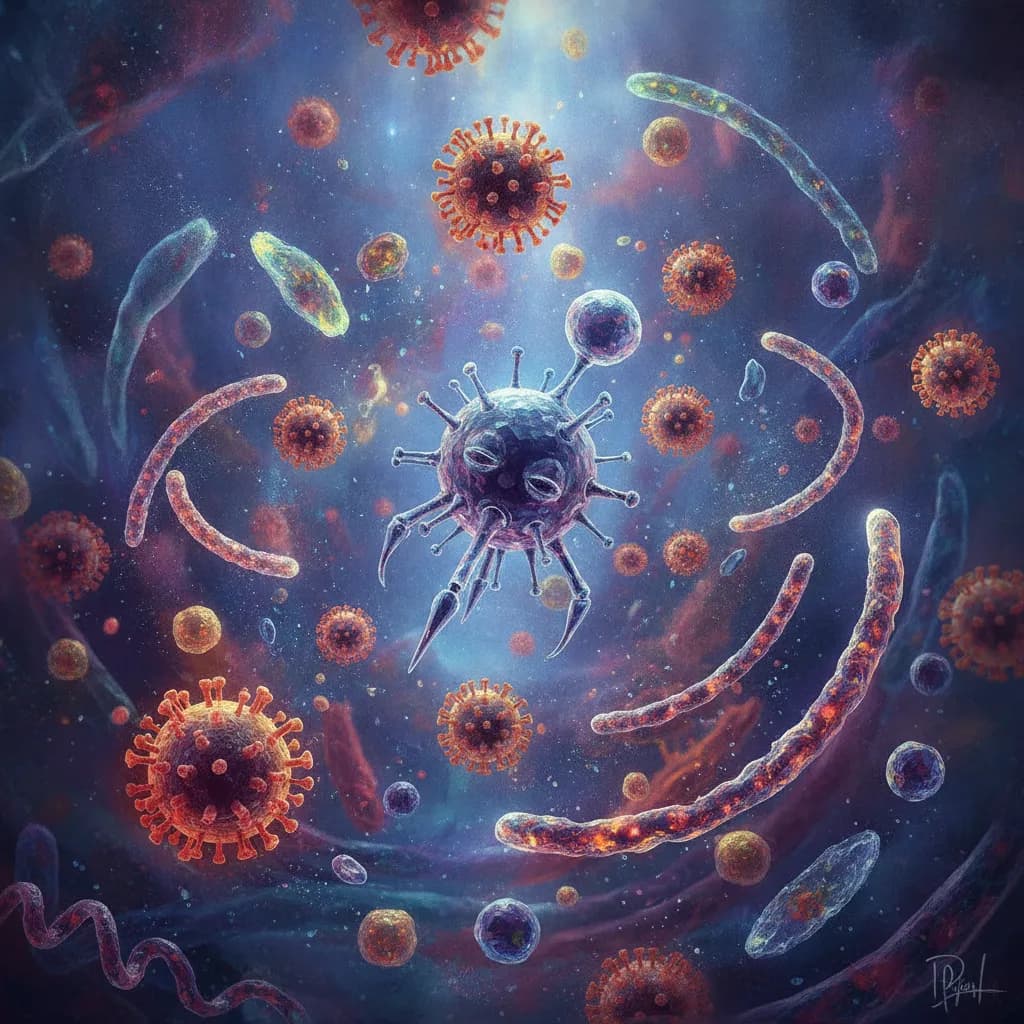
Viruses
A microscopic particle so stripped-down that scientists still debate whether it even counts as truly "alive" at all.
Cheat Sheet
- A virus is a microscopic infectious particle that can only reproduce by hijacking a living host cell's own machinery — unlike bacteria, viruses aren't considered fully "alive" on their own.
- Viruses consist of genetic material (DNA or RNA) wrapped in a protective protein shell, sometimes with an additional outer membrane called an envelope.
- Once a virus infects a host cell, it redirects that cell's machinery to produce copies of the virus, often destroying the host cell in the process.
- Vaccines work by training the immune system to recognize a specific virus (or a harmless piece or version of it) in advance, so the body can respond quickly if it encounters the real virus later.
- Viruses can mutate over time, sometimes producing new variants that spread more easily or partially evade existing immunity, a key factor tracked closely during outbreaks like COVID-19.
- Not all viruses cause serious illness — many infect bacteria, plants, or animals with no direct impact on humans, and some are even being researched as tools for targeted medical treatments.
The 60-Second Version
A virus is a microscopic infectious particle that can only reproduce by hijacking a living host cell's own machinery — unlike bacteria, viruses aren't considered fully "alive" on their own. Viruses consist of genetic material, DNA or RNA, wrapped in a protective protein shell, sometimes with an additional outer membrane called an envelope. Once a virus infects a host cell, it redirects that cell's machinery to produce copies of the virus, often destroying the host cell in the process. Vaccines work by training the immune system to recognize a specific virus, or a harmless piece or version of it, in advance, so the body can respond quickly if it encounters the real virus later. Viruses can mutate over time, sometimes producing new variants that spread more easily or partially evade existing immunity, a key factor tracked closely during outbreaks like COVID-19. Not all viruses cause serious illness — many infect bacteria, plants, or animals with no direct impact on humans, and some are even being researched as tools for targeted medical treatments.
The Long Version
What Actually Makes Something a Virus
Viruses occupy an unusual position at the edge of what's typically defined as "alive": they consist of genetic material, either DNA or RNA, packaged inside a protective protein shell, but they lack the cellular machinery needed to independently grow, generate energy, or reproduce on their own, distinguishing them fundamentally from bacteria and other genuinely independent living organisms.
How a Virus Actually Infects a Cell
A virus infects a host cell by attaching to and entering it, then hijacking the cell's own internal machinery to read its genetic instructions and produce many new copies of the virus. This process frequently damages or destroys the host cell entirely, and the newly produced viruses then go on to infect additional cells, repeating the cycle throughout the host organism.
How Vaccines Train the Immune System in Advance
Vaccines work by exposing the immune system to a harmless version, piece, or genetic blueprint of a specific virus, prompting the body to develop an immune response and produce specialized immune cells capable of recognizing that virus. If the vaccinated individual is later exposed to the actual virus, the immune system can respond far more quickly and effectively than it would have without that prior training, often preventing or substantially reducing illness.
Mutation, Variants, and Why Viruses Keep Changing
Because viruses replicate so rapidly and their genetic copying process isn't perfectly precise, mutations accumulate over time, occasionally producing new variants with altered characteristics, such as spreading more easily between people or partially evading immunity built up from earlier infection or vaccination. This ongoing viral evolution is a major reason public health officials closely track emerging variants during significant outbreaks, adjusting vaccines or public health guidance as needed.
Ad slot (placeholder — set NEXT_PUBLIC_ADSENSE_SLOT_ID once an ad unit is created)
Glossary
- Virus
- A microscopic infectious particle that reproduces only by hijacking a living host cell's machinery.
- Host cell
- The living cell a virus infects and uses to produce copies of itself.
- Vaccine
- A preparation that trains the immune system to recognize and respond to a specific virus in advance of actual infection.
- Variant
- A version of a virus that has mutated from earlier versions, sometimes altering how easily it spreads or is recognized by immunity.
- Envelope
- An outer membrane surrounding some viruses, derived partly from the host cell they emerged from.