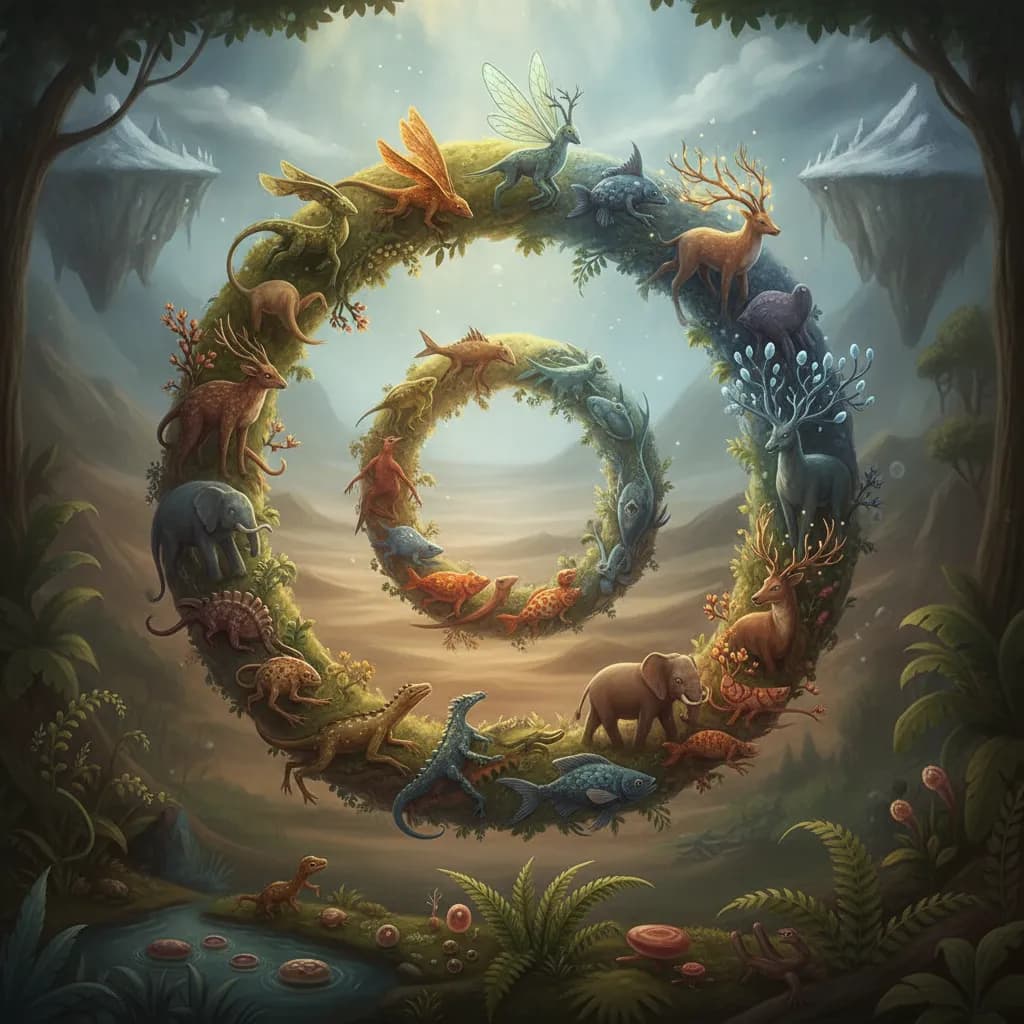
Evolution
A theory that doesn't claim organisms get objectively "better" over time — just that whatever happens to work in a given environment tends to stick around.
Cheat Sheet
- Evolution describes how species change over generations through the gradual accumulation of heritable genetic variation, driven primarily by natural selection.
- Natural selection, the core mechanism Charles Darwin identified, favors traits that improve an organism's chances of survival and reproduction in a given environment, passing those traits on more frequently.
- Evolution acts on populations over many generations, not on individual organisms within their own lifetime — an individual doesn't evolve, but a population's genetic makeup can shift over time.
- The fossil record, comparative anatomy, and, more recently, direct DNA comparison across species all independently support the same evolutionary relationships between organisms.
- Evolution doesn't produce "perfect" or "most advanced" organisms — it simply favors traits that work well enough in a specific environment at a specific time, which can change as conditions change.
- Modern evolutionary biology has expanded considerably since Darwin, incorporating genetics, molecular biology, and detailed understanding of DNA that Darwin himself had no access to.
The 60-Second Version
Evolution describes how species change over generations through the gradual accumulation of heritable genetic variation, driven primarily by natural selection. Natural selection, the core mechanism Charles Darwin identified, favors traits that improve an organism's chances of survival and reproduction in a given environment, passing those traits on more frequently. Evolution acts on populations over many generations, not on individual organisms within their own lifetime — an individual doesn't evolve, but a population's genetic makeup can shift over time. The fossil record, comparative anatomy, and, more recently, direct DNA comparison across species all independently support the same evolutionary relationships between organisms. Evolution doesn't produce "perfect" or "most advanced" organisms — it simply favors traits that work well enough in a specific environment at a specific time, which can change as conditions change. Modern evolutionary biology has expanded considerably since Darwin, incorporating genetics, molecular biology, and detailed understanding of DNA that Darwin himself had no access to.
The Long Version
What Evolution Actually Describes
Evolution describes change in a population's inherited characteristics across successive generations, distinct from change occurring within a single individual's own lifetime. Over enough generations, this gradual accumulation of genetic change can produce dramatically different descendant populations, and eventually entirely new species, from a shared ancestral population.
Natural Selection: Darwin's Core Insight
Charles Darwin's central insight was that within any population, individuals naturally vary, and some of that variation affects how well an individual survives and reproduces in its specific environment. Traits that improve survival and reproduction tend to become more common in subsequent generations simply because individuals carrying them leave more offspring, a self-reinforcing process requiring no intentional design or direction, just consistent selective pressure over time.
The Multiple Independent Lines of Evidence
Evolutionary relationships between species are supported by several genuinely independent forms of evidence: the fossil record documents physical changes in organisms across geological time, comparative anatomy reveals shared underlying structures between related species even when their specific function differs, and modern DNA comparison directly measures genetic similarity between species, consistently confirming the same evolutionary relationships that fossil and anatomical evidence had already suggested.
Modern Genetics and Evolution Since Darwin
Darwin developed his theory of natural selection decades before DNA's structure or genetic inheritance mechanisms were understood at all. Since then, the field of modern evolutionary biology, sometimes called the "modern synthesis," has integrated Darwin's original insight with genetics, molecular biology, and population-level mathematical modeling, substantially deepening and refining evolutionary theory well beyond what Darwin himself was able to establish with the tools available in his own time.
Ad slot (placeholder — set NEXT_PUBLIC_ADSENSE_SLOT_ID once an ad unit is created)
Glossary
- Natural selection
- The process by which traits improving survival and reproduction become more common in a population over generations.
- Heritable variation
- Genetic differences between individuals that can be passed on to offspring, the raw material evolution acts on.
- Fossil record
- The physical remains and traces of past life, used as key evidence for evolutionary history.
- Common ancestor
- A species from which two or more other species have both descended.
- Speciation
- The evolutionary process by which populations evolve into distinct, separate species.
Go Deeper
- "On the Origin of Species" by Charles Darwin
- Understanding Evolution — UC Berkeley