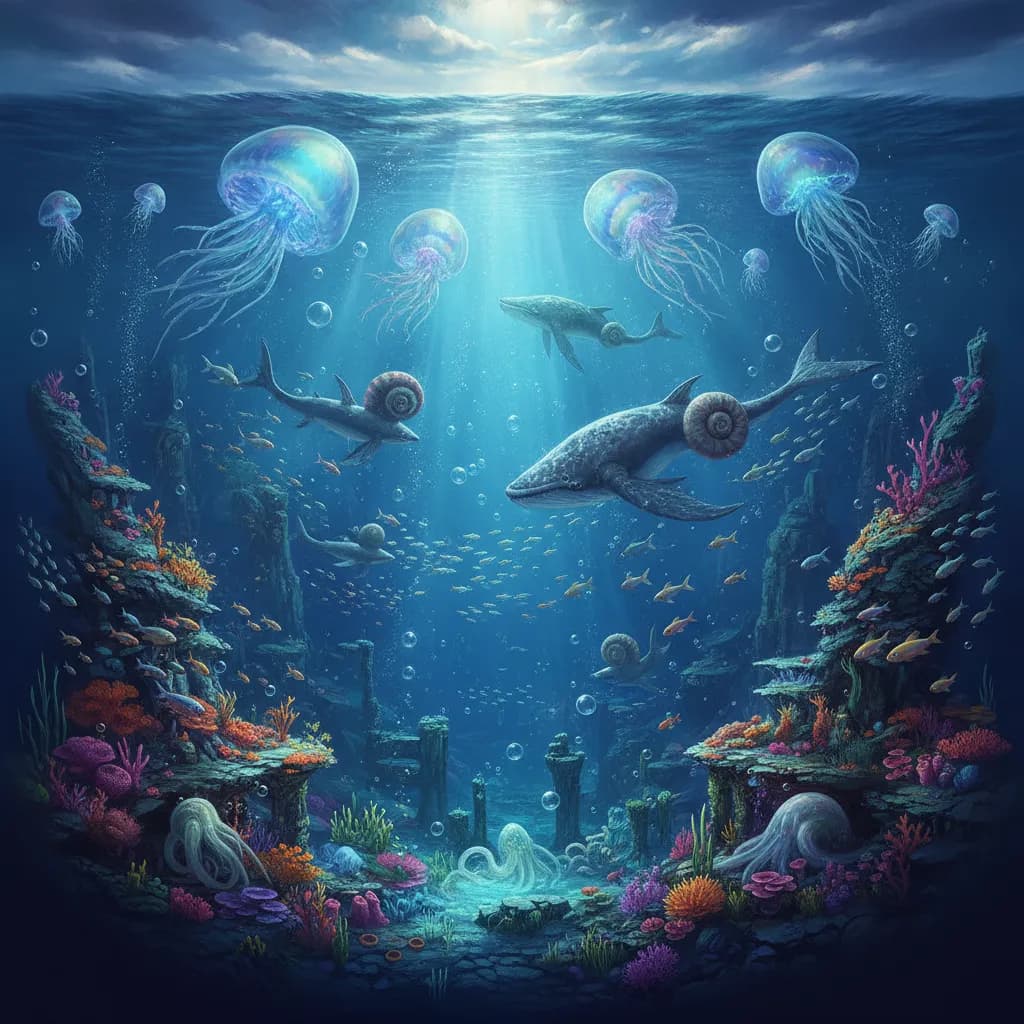
Marine Life
A planet whose oceans cover most of its surface, contain most of its biodiversity, and remain, even today, mostly unexplored.
Cheat Sheet
- The ocean covers over 70% of Earth's surface and is estimated to contain the vast majority of the planet's total biodiversity, much of it still undocumented.
- Marine life ranges enormously in scale, from microscopic phytoplankton, which produce a substantial share of the planet's oxygen, to the blue whale, the largest animal ever known to have existed.
- Coral reefs, sometimes called the "rainforests of the sea," cover a tiny fraction of the ocean floor but support an estimated quarter of all marine species.
- Ocean depth zones — from the sunlit surface down to the pitch-black deep sea — support dramatically different ecosystems adapted to extreme differences in light, pressure, and temperature.
- Scientists estimate that a substantial majority of the ocean, especially its deepest regions, remains unexplored and undocumented, meaning many marine species remain entirely unknown to science.
- Human activities including overfishing, plastic pollution, and warming, acidifying oceans pose significant and well-documented threats to marine biodiversity worldwide.
The 60-Second Version
The ocean covers over 70% of Earth's surface and is estimated to contain the vast majority of the planet's total biodiversity, much of it still undocumented. Marine life ranges enormously in scale, from microscopic phytoplankton, which produce a substantial share of the planet's oxygen, to the blue whale, the largest animal ever known to have existed. Coral reefs, sometimes called the "rainforests of the sea," cover a tiny fraction of the ocean floor but support an estimated quarter of all marine species. Ocean depth zones, from the sunlit surface down to the pitch-black deep sea, support dramatically different ecosystems adapted to extreme differences in light, pressure, and temperature. Scientists estimate that a substantial majority of the ocean, especially its deepest regions, remains unexplored and undocumented, meaning many marine species remain entirely unknown to science. Human activities including overfishing, plastic pollution, and warming, acidifying oceans pose significant and well-documented threats to marine biodiversity worldwide.
The Long Version
An Ocean of Scale, From Plankton to Blue Whales
Marine life spans an extraordinary range of scale: microscopic phytoplankton, drifting near the ocean's sunlit surface, photosynthesize and are responsible for producing a substantial share of the oxygen in Earth's atmosphere, while the blue whale, the largest animal known to have ever existed on the planet, can weigh as much as 200 tons. This enormous range reflects just how varied the ocean's ecological niches actually are.
Coral Reefs: Small Footprint, Enormous Biodiversity
Coral reefs cover only a tiny fraction of the total ocean floor, yet they're estimated to support roughly a quarter of all known marine species, earning them the nickname "rainforests of the sea." This disproportionate biodiversity stems from the complex physical structure coral colonies build over time, creating countless ecological niches for other species to inhabit.
Depth Zones and Life in Total Darkness
The ocean is divided into distinct depth zones, each supporting dramatically different ecosystems shaped by extreme differences in sunlight, pressure, and temperature: the sunlit surface zone supports the vast majority of ocean photosynthesis and familiar marine life, while the deep sea, permanently dark and under crushing pressure, hosts specially adapted organisms, some generating their own light through bioluminescence, that have evolved to survive in conditions utterly unlike the ocean's upper layers.
How Much of the Ocean Remains Unexplored
Despite covering the majority of Earth's surface, a substantial portion of the ocean, particularly its deepest regions, remains scientifically unexplored and undocumented, meaning a significant number of marine species are believed to remain entirely unknown to science. This makes ongoing ocean exploration one of the most promising remaining frontiers for genuinely new biological discovery on Earth.
Ad slot (placeholder — set NEXT_PUBLIC_ADSENSE_SLOT_ID once an ad unit is created)
Glossary
- Phytoplankton
- Microscopic ocean organisms that photosynthesize, producing a substantial share of Earth's oxygen.
- Coral reef
- A diverse marine ecosystem built from coral skeletons, supporting an estimated quarter of all marine species despite covering a small fraction of the ocean floor.
- Deep sea
- The ocean's deepest, permanently dark zones, home to organisms specially adapted to extreme pressure and lack of light.
- Ocean acidification
- A decrease in ocean pH caused by absorbed carbon dioxide, threatening many marine organisms, particularly those with calcium-based shells or skeletons.
- Biodiversity
- The variety of distinct species and ecosystems within a given environment, such as the ocean.