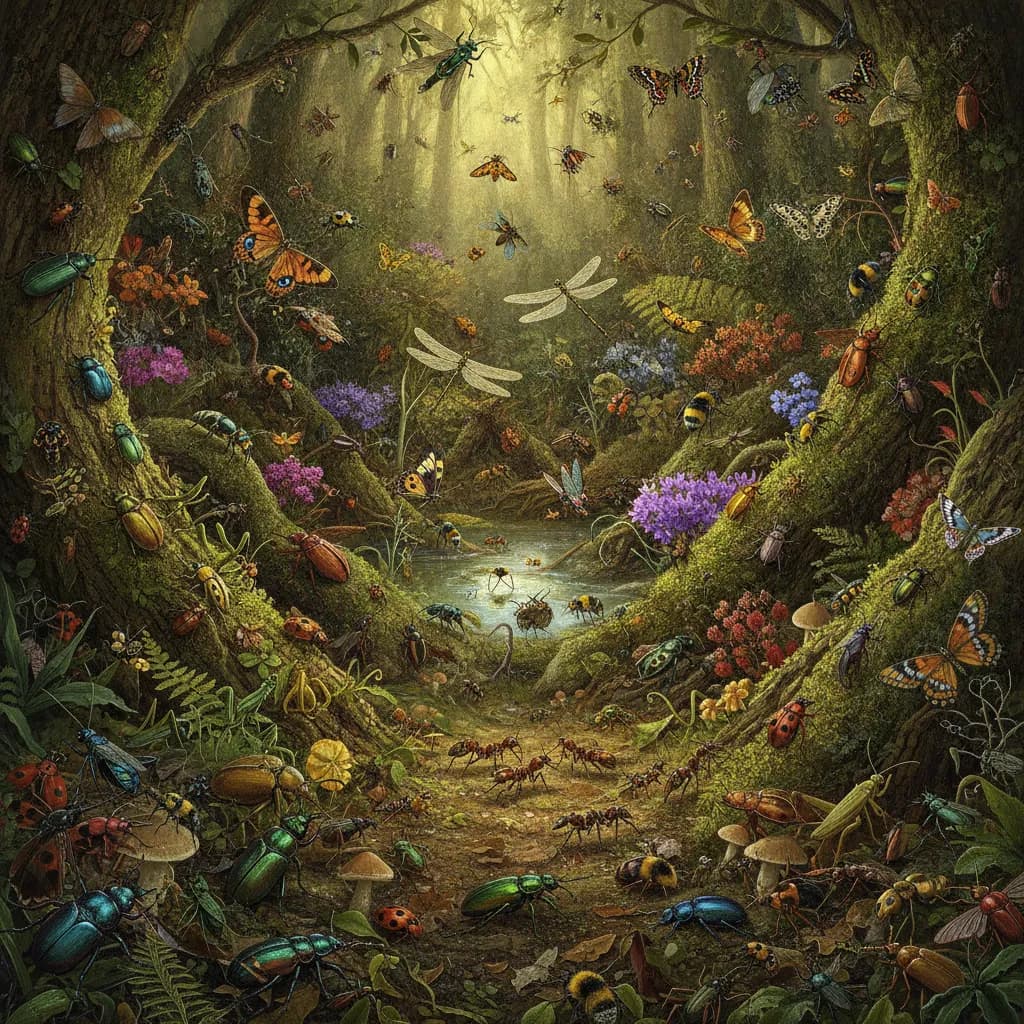
Insects
The single most numerous and diverse group of animals on the entire planet isn't mammals, birds, or fish — it's insects, by an overwhelming margin.
Cheat Sheet
- Insects are the most diverse group of animals on Earth, with over a million described species and an estimated far larger number still undiscovered or undocumented.
- Insects play crucial ecological roles, including pollinating a substantial share of the world's flowering plants and food crops, decomposing organic matter, and serving as a key food source for countless other species.
- Insect bodies are organized into three main segments, head, thorax, and abdomen, and typically feature six legs and, in many species, wings, distinguishing them from other arthropods like spiders and crustaceans.
- Many insect species undergo metamorphosis, a dramatic transformation in body structure during their life cycle, most strikingly illustrated by a caterpillar's transformation into a butterfly.
- Bees, and pollinating insects more broadly, provide a critical, often underappreciated economic and ecological service, and documented declines in some bee populations have raised significant scientific and agricultural concern.
- Insects vastly outnumber humans and nearly every other animal group in total population, with estimates suggesting there are far more individual insects alive at any given time than there are humans on Earth.
The 60-Second Version
Insects are the most diverse group of animals on Earth, with over a million described species and an estimated far larger number still undiscovered or undocumented. Insects play crucial ecological roles, including pollinating a substantial share of the world's flowering plants and food crops, decomposing organic matter, and serving as a key food source for countless other species. Insect bodies are organized into three main segments, head, thorax, and abdomen, and typically feature six legs and, in many species, wings, distinguishing them from other arthropods like spiders and crustaceans. Many insect species undergo metamorphosis, a dramatic transformation in body structure during their life cycle, most strikingly illustrated by a caterpillar's transformation into a butterfly. Bees, and pollinating insects more broadly, provide a critical, often underappreciated economic and ecological service, and documented declines in some bee populations have raised significant scientific and agricultural concern. Insects vastly outnumber humans and nearly every other animal group in total population, with estimates suggesting there are far more individual insects alive at any given time than there are humans on Earth.
The Long Version
An Almost Incomprehensible Level of Diversity
Insects represent the most diverse group of animals on the planet by an overwhelming margin, with over a million species already formally described by scientists and a considerably larger number still believed to remain undiscovered or undocumented, meaning insects alone likely make up the majority of all animal species on Earth.
The Ecological Work Insects Quietly Perform
Beyond their sheer diversity, insects perform several crucial ecological functions that much of the rest of the natural world, including human agriculture, directly depends on: pollinating a substantial share of the world's flowering plants and food crops, decomposing organic matter and recycling nutrients back into ecosystems, and serving as an essential food source supporting countless other species throughout the food web.
A Basic Body Plan, With Dramatic Transformations
Insect bodies are generally organized into three main segments, head, thorax, and abdomen, typically featuring six legs and, in many species, wings, a basic structural plan distinguishing insects from other arthropods like spiders and crustaceans. Many insect species also undergo metamorphosis during their life cycle, a dramatic restructuring of their body form, most strikingly illustrated by a caterpillar's transformation into an entirely differently structured adult butterfly.
Why Pollinator Decline Has Become a Serious Concern
Bees and other pollinating insects provide a critical, often underappreciated economic and ecological service by enabling the reproduction of a substantial share of food crops humans directly depend on, and documented declines in some bee populations in recent years have raised significant scientific and agricultural concern regarding the potential downstream effects on food production and broader ecosystem health.
Ad slot (placeholder — set NEXT_PUBLIC_ADSENSE_SLOT_ID once an ad unit is created)
Glossary
- Metamorphosis
- A dramatic transformation in body structure during an insect's life cycle, as seen in a caterpillar's transformation into a butterfly.
- Pollination
- The process of transferring pollen between flowers, enabling plant reproduction, performed by many insect species.
- Arthropod
- The broader animal group that includes insects, spiders, and crustaceans, characterized by an exoskeleton and jointed limbs.
- Exoskeleton
- The hard external skeletal structure that supports and protects an insect's body, in contrast to an internal skeleton.
- Pollinator decline
- The documented decline in some bee and other pollinating insect populations, raising significant agricultural and ecological concern.