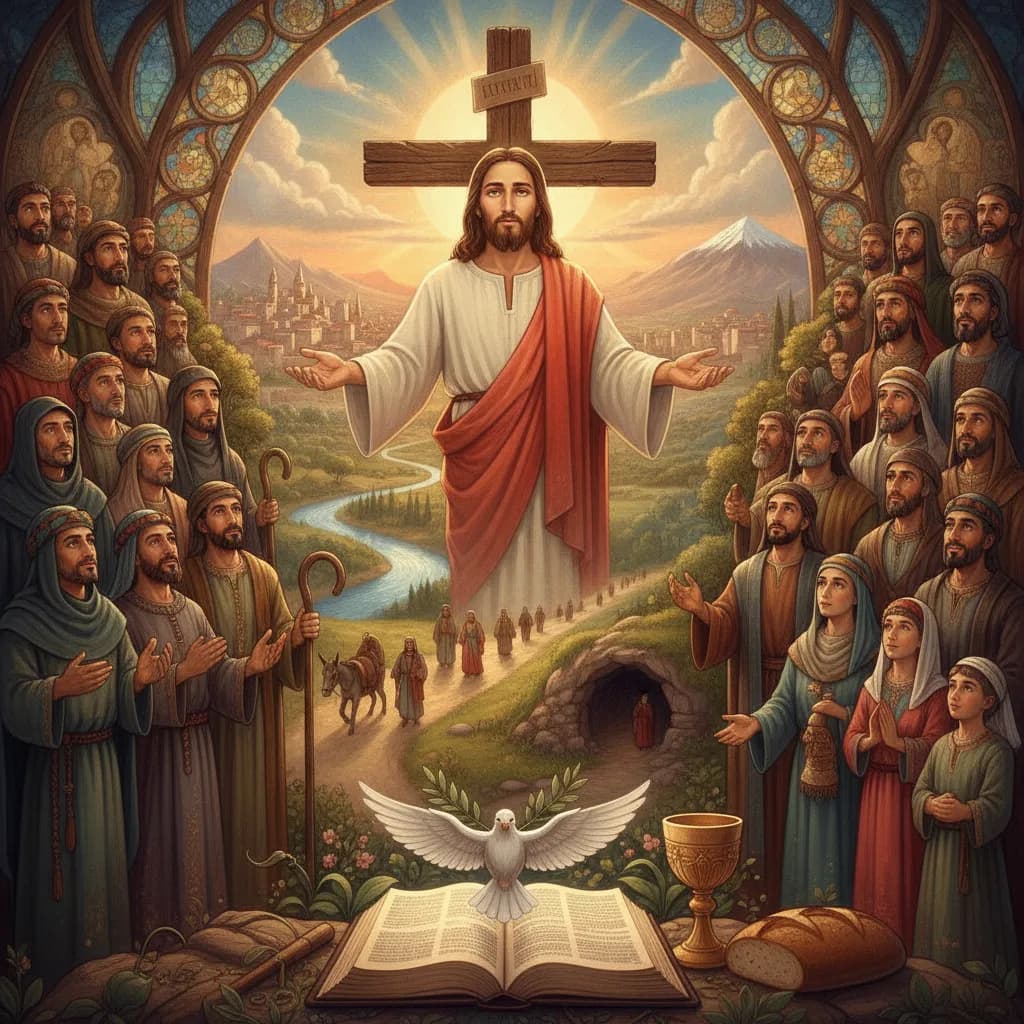
Christianity
The world's single largest religion traces its entire foundation back to the life and death of one specific person in a relatively small corner of the ancient Roman Empire.
Cheat Sheet
- Christianity is the world's largest religion by number of adherents, centered on the life, teachings, death, and resurrection of Jesus Christ.
- The Bible, Christianity's central religious text, is divided into the Old Testament, largely shared with Judaism, and the New Testament, which specifically documents Jesus's life and the early Christian church.
- Christianity holds that Jesus is the son of God and that his death and resurrection provide a path to salvation for humanity, a belief central across nearly all Christian denominations.
- Christianity split into numerous major branches over the centuries, most significantly Catholicism, Eastern Orthodoxy, and Protestantism, each with distinct traditions, leadership structures, and theological emphases.
- The Protestant Reformation, launched in the 16th century primarily by Martin Luther, was a pivotal event that led to a major, lasting split within Western Christianity.
- Christianity has profoundly shaped Western history, art, law, and culture, with its influence extending well beyond strictly religious contexts into broader Western civilization.
The 60-Second Version
Christianity is the world's largest religion by number of adherents, centered on the life, teachings, death, and resurrection of Jesus Christ. The Bible, Christianity's central religious text, is divided into the Old Testament, largely shared with Judaism, and the New Testament, which specifically documents Jesus's life and the early Christian church. Christianity holds that Jesus is the son of God and that his death and resurrection provide a path to salvation for humanity, a belief central across nearly all Christian denominations. Christianity split into numerous major branches over the centuries, most significantly Catholicism, Eastern Orthodoxy, and Protestantism, each with distinct traditions, leadership structures, and theological emphases. The Protestant Reformation, launched in the 16th century primarily by Martin Luther, was a pivotal event that led to a major, lasting split within Western Christianity. Christianity has profoundly shaped Western history, art, law, and culture, with its influence extending well beyond strictly religious contexts into broader Western civilization.
The Long Version
A Religion Centered on One Life
Christianity is built entirely around the life, teachings, death, and resurrection of Jesus Christ, a figure whose ministry took place in the 1st century CE within the Roman-controlled region of Judea, and whose followers came to believe was the son of God, forming the theological foundation from which the entire religion subsequently developed.
The Bible's Two Major Sections
Christianity's central religious text, the Bible, is divided into two major sections: the Old Testament, which is largely shared with Judaism and covers a much longer historical and theological scope, and the New Testament, which specifically documents Jesus's life, teachings, death, and resurrection, along with the activities of the early Christian church that followed.
Salvation Through Death and Resurrection
Central to Christian theology, across nearly all its various denominations, is the belief that Jesus's death by crucifixion and subsequent resurrection provide a path to salvation for humanity, a core theological claim that, despite significant variation in specific doctrine and practice across different Christian traditions, remains broadly shared throughout the religion.
From One Church to Many Branches
Christianity gradually split into several major branches over the centuries, most significantly Catholicism, Eastern Orthodoxy, and Protestantism, each developing distinct traditions, leadership structures, and theological emphases. The Protestant Reformation, launched in the 16th century primarily by Martin Luther in response to specific grievances with the Catholic Church of the time, proved a particularly pivotal event, leading to a major and lasting split within Western Christianity that produced the wide range of Protestant denominations that exist today.
Ad slot (placeholder — set NEXT_PUBLIC_ADSENSE_SLOT_ID once an ad unit is created)
Glossary
- Bible
- Christianity's central religious text, divided into the Old Testament and New Testament.
- Jesus Christ
- The central figure of Christianity, believed by Christians to be the son of God whose death and resurrection provide salvation.
- Catholicism / Orthodoxy / Protestantism
- The three major branches Christianity split into over the centuries, each with distinct traditions and leadership structures.
- Protestant Reformation
- A 16th-century movement, launched primarily by Martin Luther, that led to a major, lasting split within Western Christianity.
- Resurrection
- The Christian belief that Jesus rose from the dead after his crucifixion, central to Christian theology.