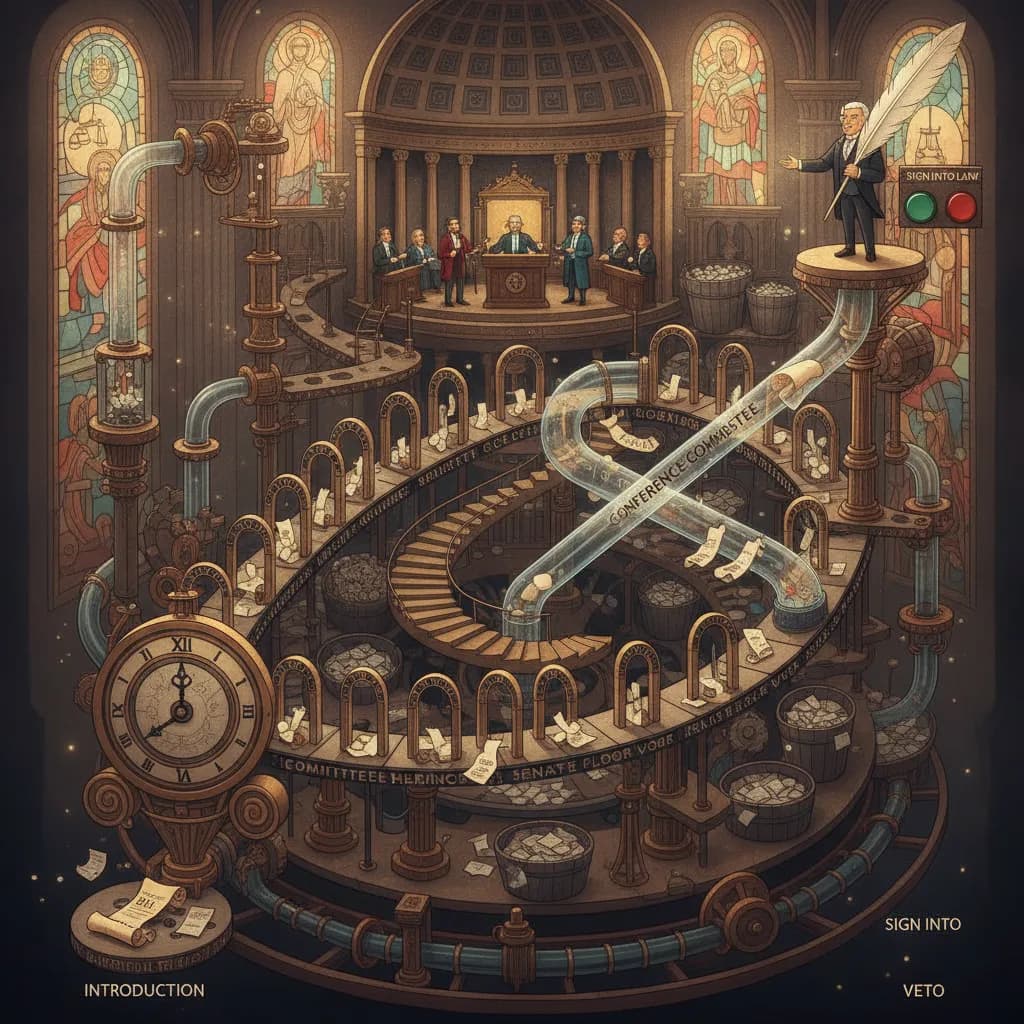
How Laws Get Made
A process with so many checkpoints that most bills introduced in Congress never make it anywhere close to a president's desk.
Cheat Sheet
- In the US, a bill can be introduced by any member of Congress and must pass both the House of Representatives and the Senate in identical form before reaching the president.
- Most bills die in committee — the smaller groups of legislators who review, amend, and vote on whether a bill even advances to a full floor vote.
- Once passed by both chambers, a bill goes to the president, who can sign it into law, veto it, or let it become law without a signature after a set period.
- Congress can override a presidential veto with a two-thirds majority vote in both chambers — a high bar, which is why most vetoes stick.
- The legislative process in other democracies varies significantly — parliamentary systems often move bills faster since the executive and legislative majority are typically aligned.
- Lobbying — organized efforts by interest groups to influence legislation — is a legal, constitutionally protected part of the process in the US, though it remains one of its most controversial aspects.
The 60-Second Version
In the US, a bill can be introduced by any member of Congress and must pass both the House of Representatives and the Senate in identical form before it can reach the president. Most bills actually die in committee, the smaller groups of legislators who review, amend, and vote on whether a bill even advances to a full floor vote in the first place. Once a bill passes both chambers, it goes to the president, who can sign it into law, veto it outright, or let it become law without a signature after a set period passes. Congress can override a presidential veto, but only with a two-thirds majority vote in both chambers, a genuinely high bar, which is why the overwhelming majority of presidential vetoes actually stick. The legislative process looks quite different in other democracies — parliamentary systems often move bills through much faster, since the executive and the legislative majority are typically aligned by design. Lobbying, meaning organized efforts by interest groups to influence legislation, is a legal, constitutionally protected part of the US process, even though it remains one of its most consistently controversial aspects.
The Long Version
From Idea to Bill
Any member of the House of Representatives or Senate can introduce a bill, often based on their own policy priorities, requests from constituents, or input from advocacy groups and lobbyists. Once introduced, a bill is formally assigned a number and referred to the relevant committee or committees based on its subject matter, which is where the vast majority of a bill's real scrutiny, and its most common point of failure, actually happens.
Committees: Where Most Bills Actually Die
Congressional committees are smaller groups of legislators organized around specific policy areas (like agriculture, armed services, or the judiciary) who review, hold hearings on, amend, and ultimately vote on whether a bill is worth advancing to a full floor vote of the entire chamber. The overwhelming majority of bills introduced in any given Congress never make it out of committee at all, whether due to lack of political support, competing priorities, or simply running out of time before the legislative session ends, which is a major reason so few of the thousands of bills introduced each Congress ever actually become law.
Reaching the President's Desk
A bill that survives committee review and passes a floor vote in one chamber must then go through the identical process in the other chamber, and any differences between the House and Senate versions must be reconciled, often through a conference committee, before both chambers vote on a final, identical version. Only after both the House and Senate have passed the exact same text does a bill go to the president, who has several options: sign it into law, veto it and send it back to Congress with objections, or simply take no action, in which case it automatically becomes law after ten days (excluding Sundays) if Congress remains in session.
Vetoes, Overrides, and Why They're Rare
If the president vetoes a bill, Congress can still make it law by overriding that veto, but doing so requires a two-thirds majority vote in both the House and the Senate, a substantially higher bar than the simple majority needed to pass the bill in the first place. Because assembling that level of bipartisan supermajority support is genuinely difficult, the large majority of presidential vetoes throughout US history have successfully ended a bill's chances rather than being overridden.
Ad slot (placeholder — set NEXT_PUBLIC_ADSENSE_SLOT_ID once an ad unit is created)
Glossary
- Bill
- A proposed piece of legislation that hasn't yet become law.
- Committee
- A smaller group of legislators who review, amend, and vote on whether a bill advances further.
- Veto
- The executive's power to formally reject a bill passed by the legislature.
- Veto override
- A legislative vote, typically requiring a supermajority, that allows a bill to become law despite a veto.
- Lobbying
- Organized efforts by individuals or groups to influence legislators' decisions on proposed laws.