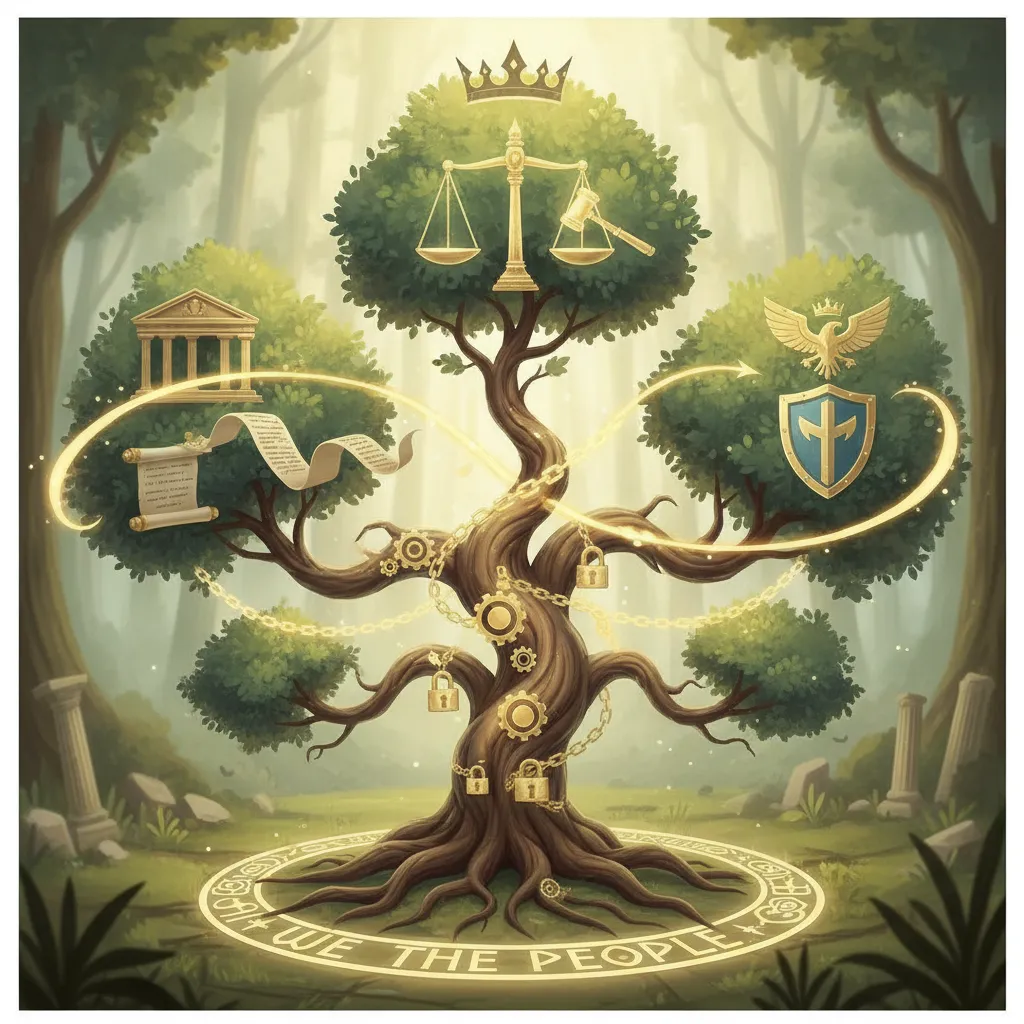
Branches of Government
A system deliberately designed so that no single branch of government can get everything it wants.
Cheat Sheet
- The separation of powers divides government into three branches — legislative (makes laws), executive (enforces laws), and judicial (interprets laws) — so no single branch holds total control.
- In the US system, this is paired with checks and balances: each branch has specific powers to limit the others, like presidential veto power or judicial review.
- The legislative branch (Congress in the US, Parliament in many other countries) is typically the body that writes, debates, and passes laws.
- The executive branch (headed by a president or prime minister) is responsible for implementing and enforcing laws, and often controls the military and foreign policy.
- The judicial branch (courts) interprets what laws mean and whether they're constitutional, ultimately having the power to strike down laws or executive actions.
- Not every democracy separates powers the same way — parliamentary systems (like the UK) fuse the executive and legislative branches more closely than the US presidential system does.
The 60-Second Version
The separation of powers divides government into three branches — legislative (makes laws), executive (enforces laws), and judicial (interprets laws) — specifically so no single branch holds total control. In the US system, this is paired with checks and balances: each branch holds specific powers to limit the others, like the president's veto power or the courts' power of judicial review. The legislative branch, Congress in the US or Parliament in many other countries, is typically the body that writes, debates, and passes laws. The executive branch, headed by a president or prime minister, is responsible for implementing and enforcing those laws, and often controls the military and foreign policy as well. The judicial branch, meaning the courts, interprets what laws actually mean and whether they're constitutional, ultimately holding the power to strike down laws or executive actions found to violate the constitution. It's worth noting that not every democracy separates powers the same way — parliamentary systems like the UK's fuse the executive and legislative branches much more closely than the US presidential system does.
The Long Version
Why Split Power at All
The separation of powers is built on a specific worry, articulated clearly by Enlightenment political theorists and later by America's founders: concentrating lawmaking, enforcement, and interpretation of law in the same hands creates too great a risk of abuse, since whoever writes the rules could also enforce them exactly as they choose and judge their own actions favorably. Splitting these functions across genuinely separate, independently empowered branches was meant to force ongoing negotiation and mutual restraint rather than allowing any single branch to govern unilaterally.
The Three Branches, One at a Time
The legislative branch, Congress in the US federal system, is primarily responsible for writing, debating, and voting on laws, as well as controlling government spending through the budget process. The executive branch, headed by the president, is responsible for enforcing and implementing those laws day to day, commands the military, conducts foreign policy, and appoints federal officials and judges. The judicial branch, the federal court system culminating in the Supreme Court, interprets what laws actually mean in specific disputes and determines whether laws or executive actions are consistent with the constitution, with the power to strike down those that aren't.
Checks and Balances in Action
Beyond simply dividing responsibilities, each branch holds specific tools to check the others: the president can veto legislation passed by Congress, but Congress can override that veto with a two-thirds vote in both chambers; the Senate must confirm the president's judicial and executive appointments; and the courts can declare a law passed by Congress or an action taken by the president unconstitutional through judicial review, though Congress and the president retain influence over the judiciary through appointments and, in extreme cases, impeachment.
Not Every Democracy Does It the Same Way
The strict three-way separation used in the US isn't universal among democracies. Parliamentary systems, like the UK's, fuse the executive and legislative branches much more tightly: the prime minister and cabinet are themselves sitting members of parliament, drawn from and directly accountable to the legislative majority, rather than elected in a wholly separate presidential contest. This generally allows parliamentary systems to pass legislation faster, since the executive typically commands a working legislative majority by design, trading off some of the built-in friction the US system deliberately introduces.
Ad slot (placeholder — set NEXT_PUBLIC_ADSENSE_SLOT_ID once an ad unit is created)
Glossary
- Separation of powers
- The principle of dividing governmental authority among distinct branches to prevent any one from becoming too powerful.
- Checks and balances
- Specific powers each branch holds to limit or oversee the others, such as veto power, judicial review, or impeachment.
- Judicial review
- A court's power to determine whether a law or government action is constitutional.
- Veto
- The executive's power to reject a piece of legislation passed by the legislature.
- Parliamentary system
- A system where the executive branch is drawn from and accountable to the legislature, rather than elected separately.
Go Deeper
- USA.gov — Branches of the U.S. Government
- "The Federalist Papers" by Hamilton, Madison, and Jay