Business Models
Two companies can sell the exact same product and still have completely different business models — it all comes down to how they actually turn that product into revenue.
Cheat Sheet
- A business model describes how a company creates, delivers, and captures value — in plain terms, how it actually makes money.
- B2C (business-to-consumer) companies sell directly to individual customers, while B2B (business-to-business) companies sell to other companies.
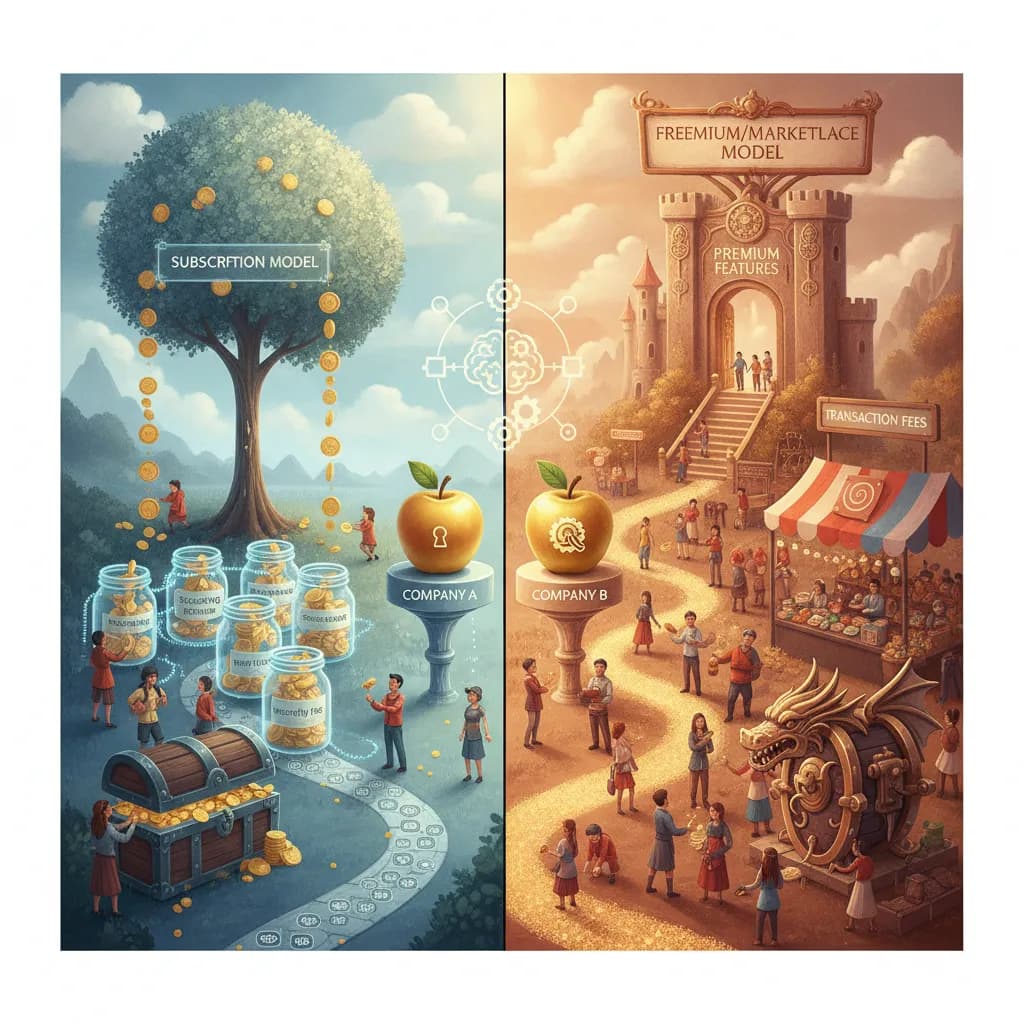
- Subscription models charge customers a recurring fee for ongoing access, favored by many modern software and media companies for their predictable, recurring revenue.
- Marketplace models, such as those used by ride-sharing or e-commerce platforms, make money by connecting buyers and sellers and taking a cut of each transaction rather than selling their own inventory.
- Freemium models offer a basic product for free while charging for premium features, betting that a small percentage of free users will eventually convert into paying customers.
- A company's business model shapes nearly every major decision it makes, from pricing and marketing to how it measures its own success.
The 60-Second Version
A business model describes how a company creates, delivers, and captures value — in plain terms, how it actually makes money. B2C (business-to-consumer) companies sell directly to individual customers, while B2B (business-to-business) companies sell to other companies. Subscription models charge customers a recurring fee for ongoing access, favored by many modern software and media companies for their predictable, recurring revenue. Marketplace models, such as those used by ride-sharing or e-commerce platforms, make money by connecting buyers and sellers and taking a cut of each transaction rather than selling their own inventory. Freemium models offer a basic product for free while charging for premium features, betting that a small percentage of free users will eventually convert into paying customers. A company's business model shapes nearly every major decision it makes, from pricing and marketing to how it measures its own success.
The Long Version
The Basic Question a Business Model Answers
A business model describes how a company creates, delivers, and captures value, which in plain terms simply means how it actually makes money, a question that sounds obvious but that companies answer in genuinely different ways depending on their product, customers, and competitive position.
Who's Actually Buying: B2C vs. B2B
B2C (business-to-consumer) companies sell directly to individual customers, typically relying on broad marketing and relatively lower-priced, higher-volume sales, while B2B (business-to-business) companies sell to other companies, often involving longer sales cycles, higher contract values, and relationships built directly with a small number of business decision-makers rather than a mass audience.
Subscriptions and Marketplaces
Subscription models charge customers a recurring fee for ongoing access to a product or service, a structure favored by many modern software and media companies specifically for the predictable, recurring revenue it generates compared to one-time sales. Marketplace models work quite differently, generating revenue by connecting buyers and sellers, as ride-sharing or e-commerce platforms do, and taking a cut of each transaction rather than selling any inventory of their own, letting the platform scale without ever owning the underlying goods or services being exchanged.
Freemium and Why the Model Matters So Much
Freemium models offer a basic version of a product for free while charging for premium features or expanded usage, a strategy that bets on a relatively small percentage of free users eventually converting into paying customers, offset by the sheer scale of free users the model can attract in the first place. Ultimately, a company's business model shapes nearly every major decision it makes, from how it prices its product and where it invests in marketing to how it defines and measures its own success internally.
Ad slot (placeholder — set NEXT_PUBLIC_ADSENSE_SLOT_ID once an ad unit is created)
Why People Care
Understanding the handful of common business models makes it considerably easier to understand how virtually any company, from a small startup to a global tech platform, actually intends to make money and sustain itself over time.
Glossary
- B2B (business-to-business)
- A business model in which a company sells its products or services to other companies rather than individual consumers.
- B2C (business-to-consumer)
- A business model in which a company sells its products or services directly to individual customers.
- Subscription model
- A business model charging customers a recurring fee for ongoing access to a product or service.
- Marketplace model
- A business model that generates revenue by connecting buyers and sellers and taking a cut of each transaction, rather than selling its own inventory.
- Freemium
- A business model offering a basic product for free while charging for premium features or upgrades.