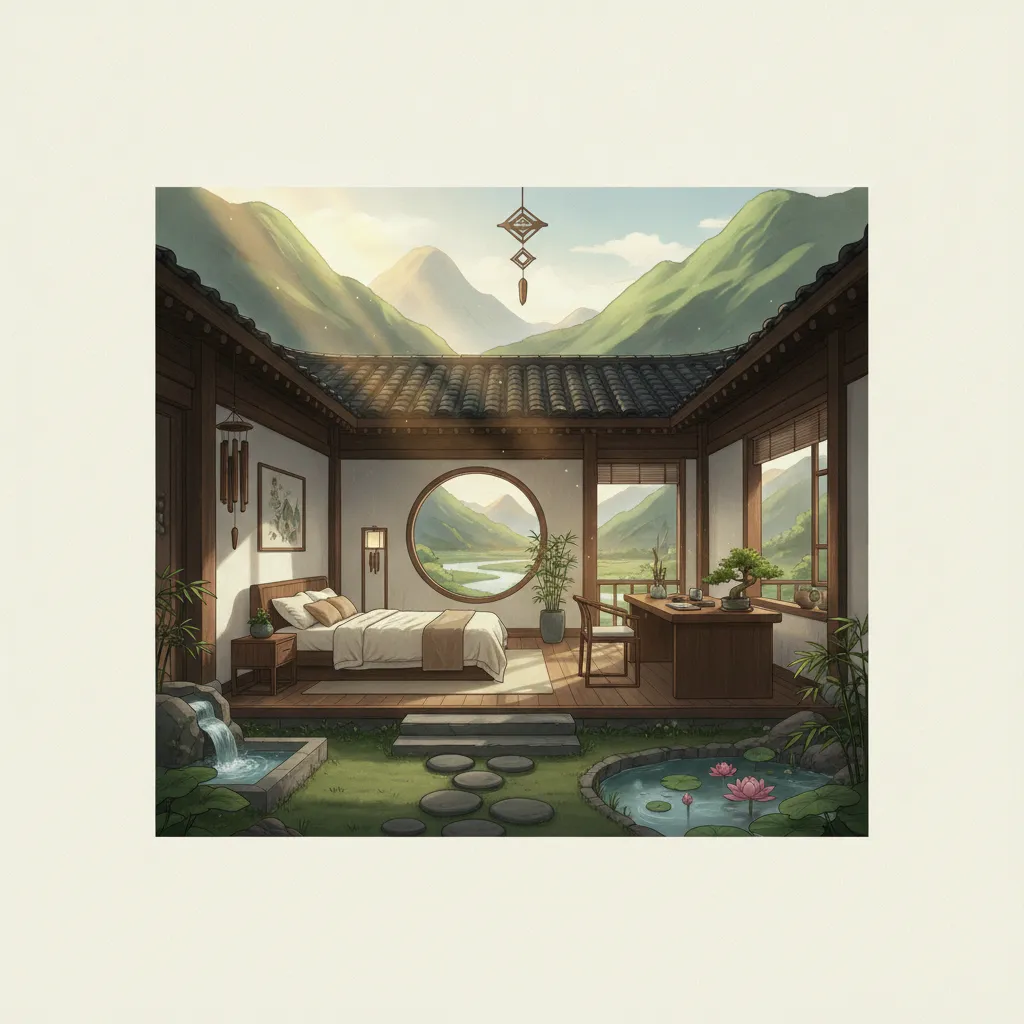
Feng Shui
A design philosophy old enough to predate most architecture as we know it, still influencing exactly where people put their beds and desks today.
Cheat Sheet
- Feng shui is an ancient Chinese practice concerned with arranging living and working spaces to promote balance, harmony, and the smooth flow of energy, or "chi."
- The bagua map, an energy map dividing a space into distinct zones associated with different life areas (such as wealth, career, or relationships), is a foundational tool used in feng shui practice.
- Furniture placement, particularly the position of a bed or desk relative to a room's door, is a common focus in feng shui, often guided by the principle of maintaining a clear view of the entrance without being directly in line with it.
- The five elements — wood, fire, earth, metal, and water — represent a core framework in feng shui, believed to interact with and balance one another within a space.
- Feng shui has no basis in modern physics or measurable scientific energy, and its principles are generally understood as a cultural and philosophical design tradition rather than an empirically tested practice.
- Despite its ancient origins, feng shui has seen significant modern adoption in interior design and architecture, including some large-scale commercial building projects, particularly across parts of Asia.
The 60-Second Version
Feng shui is an ancient Chinese practice concerned with arranging living and working spaces to promote balance, harmony, and the smooth flow of energy, or "chi." The bagua map, an energy map dividing a space into distinct zones associated with different life areas, such as wealth, career, or relationships, is a foundational tool used in feng shui practice. Furniture placement, particularly the position of a bed or desk relative to a room's door, is a common focus in feng shui, often guided by the principle of maintaining a clear view of the entrance without being directly in line with it. The five elements, wood, fire, earth, metal, and water, represent a core framework in feng shui, believed to interact with and balance one another within a space. Feng shui has no basis in modern physics or measurable scientific energy, and its principles are generally understood as a cultural and philosophical design tradition rather than an empirically tested practice. Despite its ancient origins, feng shui has seen significant modern adoption in interior design and architecture, including some large-scale commercial building projects, particularly across parts of Asia.
The Long Version
The Core Concept of Chi
At the heart of feng shui is the concept of chi, a vital energy or life force believed to flow through every living space, with the practice's central goal being to arrange furniture, objects, and architectural features in a way that allows this energy to flow smoothly rather than becoming blocked or overly chaotic.
Mapping a Space With the Bagua
The bagua map serves as a foundational tool in feng shui practice, dividing a given space into distinct zones, each associated with a different area of life, such as wealth, career, health, or relationships, allowing practitioners to make targeted adjustments to specific zones based on which area of life a person wants to focus on improving.
Furniture Placement and the Five Elements
A commonly cited feng shui principle involves furniture placement, particularly favoring a "command position" for a bed or desk that allows a clear view of the room's entrance without being directly in line with the door, a positioning believed to support a feeling of security and control. Alongside this, the five elements, wood, fire, earth, metal, and water, provide a broader conceptual framework feng shui practitioners use to balance a space's overall energy through material choices, colors, and shapes.
A Cultural Tradition, Not a Scientific One
While feng shui has no basis in modern physics or measurable scientific energy, and its principles aren't empirically testable in the way a physical science would be, it remains a significant and enduring cultural and philosophical design tradition, one that has seen substantial modern adoption in interior design and architecture, including some prominent large-scale commercial building projects, particularly across parts of Asia.
Ad slot (placeholder — set NEXT_PUBLIC_ADSENSE_SLOT_ID once an ad unit is created)
Glossary
- Chi (qi)
- The concept of vital energy or life force that feng shui practice aims to help flow smoothly through a space.
- Bagua map
- An energy map dividing a space into distinct zones associated with different life areas, a foundational tool in feng shui.
- Five elements
- Wood, fire, earth, metal, and water — a core framework in feng shui believed to interact with and balance one another.
- Command position
- A furniture placement principle in feng shui favoring a clear view of a room's entrance without being directly in line with the door.
- Feng shui
- An ancient Chinese practice concerned with arranging spaces to promote balance, harmony, and smooth energy flow.
Go Deeper
- Smithsonian — The History of Feng Shui
- Encyclopaedia Britannica — Feng Shui