World War I
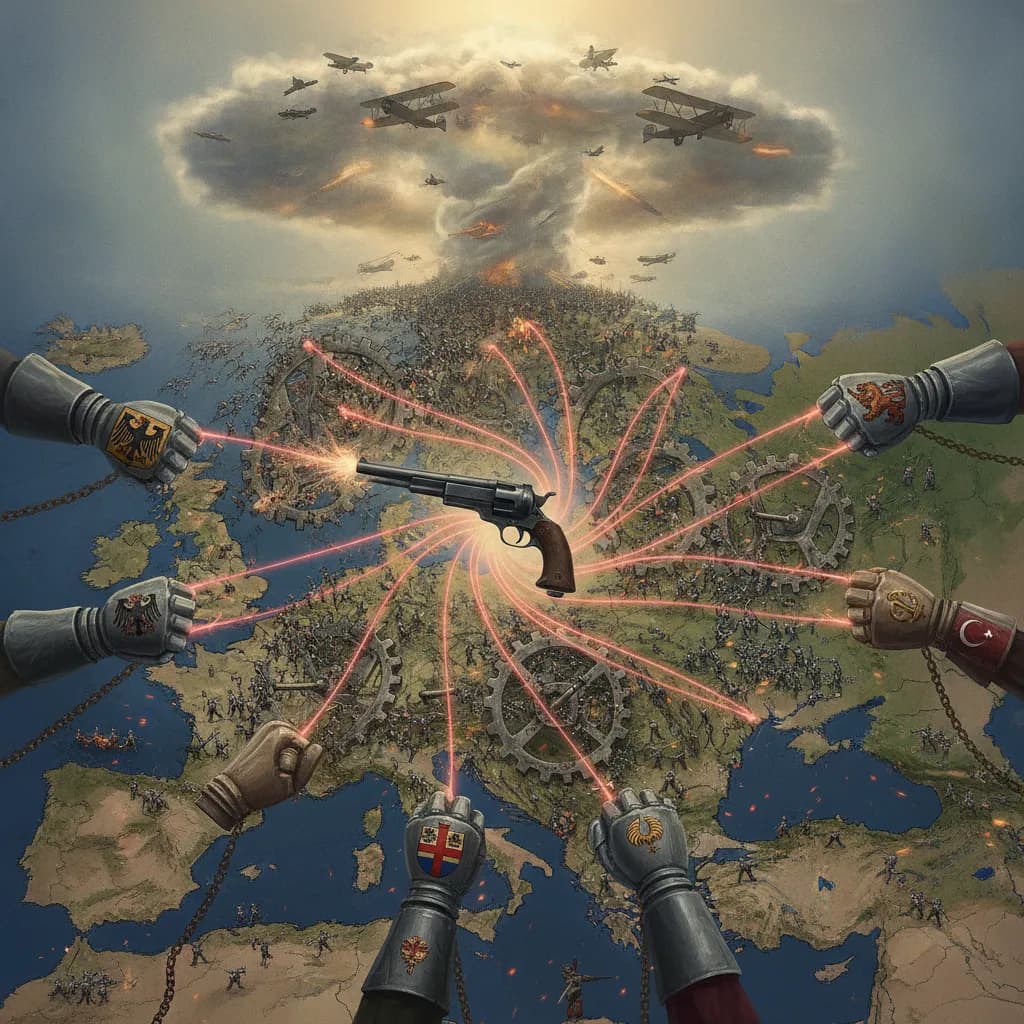
A war triggered by a single assassination that, thanks to a web of alliances, dragged the entire European continent into fighting within weeks.
Cheat Sheet
- World War I (1914-1918) was triggered by the assassination of Archduke Franz Ferdinand of Austria-Hungary, which set off a rapid chain reaction of alliance-bound declarations of war across Europe.
- The war was defined by trench warfare on the Western Front, where opposing armies dug in along fortified lines that barely moved for years despite catastrophic casualties.
- New military technology — machine guns, poison gas, tanks, and aircraft — made offensive attacks devastatingly costly, which is a major reason the front lines stayed so static.
- The war ended with Germany's surrender in November 1918, followed by the Treaty of Versailles in 1919, which imposed harsh reparations and territorial losses widely seen as fueling resentment that contributed to World War II.
- Roughly 8.5 million soldiers died and millions more were wounded, making it one of the deadliest conflicts in human history up to that point.
- The war reshaped the map of Europe and the Middle East, collapsing four empires — the German, Austro-Hungarian, Russian, and Ottoman — and redrawing borders that still shape geopolitics today.
The 60-Second Version
World War I (1914-1918) was triggered by the assassination of Archduke Franz Ferdinand of Austria-Hungary, which set off a rapid chain reaction of alliance-bound declarations of war across Europe. The war was defined by trench warfare on the Western Front, where opposing armies dug in along fortified lines that barely moved for years despite catastrophic casualties. New military technology, including machine guns, poison gas, tanks, and aircraft, made offensive attacks devastatingly costly, which is a major reason the front lines stayed so static for so long. The war ended with Germany's surrender in November 1918, followed by the Treaty of Versailles in 1919, which imposed harsh reparations and territorial losses widely seen as fueling the resentment that contributed to World War II a generation later. Roughly 8.5 million soldiers died and millions more were wounded, making it one of the deadliest conflicts in human history up to that point. The war also reshaped the map of Europe and the Middle East, collapsing four empires, the German, Austro-Hungarian, Russian, and Ottoman, and redrawing borders that still shape geopolitics today.
The Long Version
How One Assassination Started a World War
The war's immediate trigger was the assassination of Archduke Franz Ferdinand, heir to the Austro-Hungarian throne, by a Serbian nationalist in Sarajevo in June 1914. Austria-Hungary's subsequent declaration of war against Serbia activated a tangled web of pre-existing military alliances across Europe: Russia mobilized to support Serbia, Germany backed Austria-Hungary, and France and eventually Britain were drawn in against Germany, turning a regional dispute in the Balkans into a continent-spanning war within a matter of weeks.
Life and Death in the Trenches
The war's Western Front, spanning Belgium and northern France, became defined by trench warfare: opposing armies dug extensive networks of fortified trenches facing each other, often separated by a deadly, shell-cratered "no man's land." Massive offensives aimed at breaking through enemy lines frequently produced staggering casualties for minimal territorial gain, and the front lines shifted remarkably little for years at a time, creating a grinding, static form of warfare unlike anything European armies had previously experienced.
New Technology, Old Tactics
World War I introduced or dramatically scaled up several new military technologies, including machine guns capable of devastating rapid fire against advancing infantry, poison gas used as a chemical weapon, early tanks intended to break through fortified trench lines, and aircraft used initially for reconnaissance and eventually for combat. Much of the war's brutal, static character stemmed from a mismatch: military tactics and strategy hadn't yet caught up to how dramatically these new technologies had shifted the advantage toward defenders dug into fortified positions.
The Peace That Planted the Next War
Germany's surrender in November 1918 was followed by the Treaty of Versailles in 1919, which assigned Germany blame for the war and imposed substantial financial reparations along with significant territorial losses. While intended to prevent future German aggression, the treaty's harsh terms are widely seen by historians as fueling deep economic hardship and nationalist resentment within Germany, conditions that Adolf Hitler and the Nazi Party later exploited on the path to World War II barely two decades later.
Ad slot (placeholder — set NEXT_PUBLIC_ADSENSE_SLOT_ID once an ad unit is created)
Glossary
- Trench warfare
- A style of combat defined by opposing armies fighting from fortified, static trench lines, as on the Western Front.
- Central Powers
- The alliance led by Germany and Austria-Hungary during World War I.
- Allied Powers
- The alliance including France, Britain, Russia, and later the US, opposing the Central Powers.
- Treaty of Versailles
- The 1919 peace treaty that formally ended WWI and imposed harsh terms on Germany.
- Armistice
- A formal agreement to stop fighting, such as the one that ended WWI on November 11, 1918.