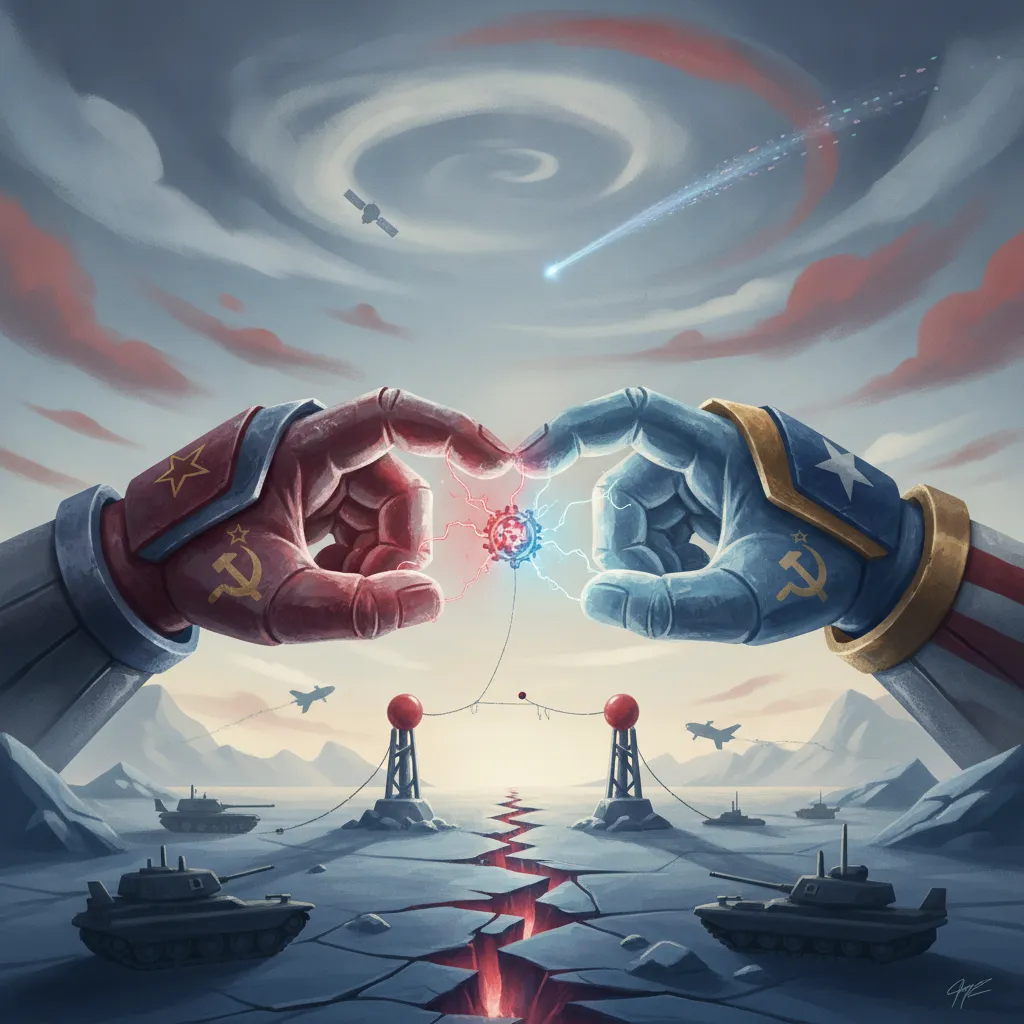
The Cold War
A four-decade standoff between two superpowers who never fought each other directly, but came within minutes of nuclear war more than once.
Cheat Sheet
- The Cold War (roughly 1947-1991) was a decades-long geopolitical standoff between the United States and the Soviet Union, defined by ideological rivalry rather than direct military combat between the two superpowers.
- "Cold" refers to the absence of direct large-scale fighting between the US and USSR themselves, even as both sides fought proxy wars (Korea, Vietnam, Afghanistan) and armed opposing sides in numerous regional conflicts.
- The nuclear arms race and the doctrine of "mutually assured destruction" (MAD) — the idea that any nuclear attack would trigger a retaliation destroying both sides — is widely credited with helping prevent direct war between the superpowers.
- The Berlin Wall, built in 1961 to divide Communist East Berlin from democratic West Berlin, became the era's most enduring physical symbol, until its fall in 1989.
- The Cuban Missile Crisis of 1962, sparked by Soviet nuclear missiles placed in Cuba, brought the two superpowers closer to direct nuclear war than at any other point in the conflict.
- The Cold War effectively ended with the collapse of the Soviet Union in 1991, leaving the United States as the world's sole remaining superpower for the following decades.
The 60-Second Version
The Cold War, running roughly from 1947 to 1991, was a decades-long geopolitical standoff between the United States and the Soviet Union, defined by ideological rivalry rather than direct military combat between the two superpowers. "Cold" refers specifically to the absence of direct large-scale fighting between the US and USSR themselves, even as both sides fought proxy wars in Korea, Vietnam, and Afghanistan, and armed opposing sides in numerous other regional conflicts around the world. The nuclear arms race and the doctrine of "mutually assured destruction" (MAD), the idea that any nuclear attack would trigger a retaliation destroying both sides, is widely credited with helping prevent direct war between the superpowers despite immense tension. The Berlin Wall, built in 1961 to divide Communist East Berlin from democratic West Berlin, became the era's most enduring physical symbol until its fall in 1989. The Cuban Missile Crisis of 1962, sparked by Soviet nuclear missiles placed in Cuba, brought the two superpowers closer to direct nuclear war than at any other point in the conflict. The Cold War effectively ended with the collapse of the Soviet Union in 1991, leaving the United States as the world's sole remaining superpower for the decades that followed.
The Long Version
A War Fought Everywhere but Directly
Despite the enormous scale of the rivalry, the US and Soviet Union never engaged each other in direct, large-scale military combat, which is exactly why the conflict is remembered as "cold" rather than hot. Instead, the two superpowers fought numerous proxy wars, supporting opposing sides in conflicts like the Korean War, the Vietnam War, and the Soviet-Afghan War, and backed opposing factions in political struggles and civil wars across Africa, Latin America, and Asia, turning much of the globe into an indirect battleground for influence.
The Nuclear Standoff That Kept the Peace
Both superpowers built enormous nuclear arsenals throughout the Cold War, and the resulting strategic doctrine of mutually assured destruction, the idea that a nuclear first strike by either side would guarantee a devastating retaliatory strike destroying both, is widely credited by historians with actually helping prevent direct war between the two, however counterintuitive that stability-through-terror logic might seem. This nuclear standoff also drove an intense arms race and space race, each side seeking any perceived technological or strategic edge over the other.
Flashpoints: Berlin and Cuba
Berlin, physically divided after World War II and further split by the construction of the Berlin Wall in 1961, became the Cold War's most visible symbol, separating Soviet-aligned East Germany from the Western-aligned world along what Winston Churchill famously termed the "Iron Curtain." The Cuban Missile Crisis of 1962, triggered when the Soviet Union placed nuclear missiles in Cuba, just off the US coast, brought the two superpowers closer to actual nuclear war than at any other point in the conflict, resolved only through tense, high-stakes diplomatic negotiation.
How It Ended
Tensions eased somewhat during a period known as détente in the 1970s, before rising again in the early 1980s. The Cold War's end came rapidly and largely peacefully: reform efforts within the Soviet Union under Mikhail Gorbachev, combined with the fall of the Berlin Wall in 1989 and a wave of revolutions across Eastern Europe, culminated in the formal dissolution of the Soviet Union itself in 1991, ending the conflict and leaving the United States as the world's sole remaining superpower for the following decades.
Ad slot (placeholder — set NEXT_PUBLIC_ADSENSE_SLOT_ID once an ad unit is created)
Glossary
- Proxy war
- A conflict where two rival powers support opposing sides rather than fighting each other directly.
- Mutually assured destruction (MAD)
- The doctrine that a nuclear attack by either superpower would guarantee a retaliatory strike destroying both.
- Iron Curtain
- The ideological and physical divide separating Soviet-aligned Eastern Europe from the Western-aligned world.
- Berlin Wall
- The barrier built in 1961 dividing Communist East Berlin from democratic West Berlin, torn down in 1989.
- Détente
- A period of eased tension and improved relations between the US and USSR, notably during the 1970s.