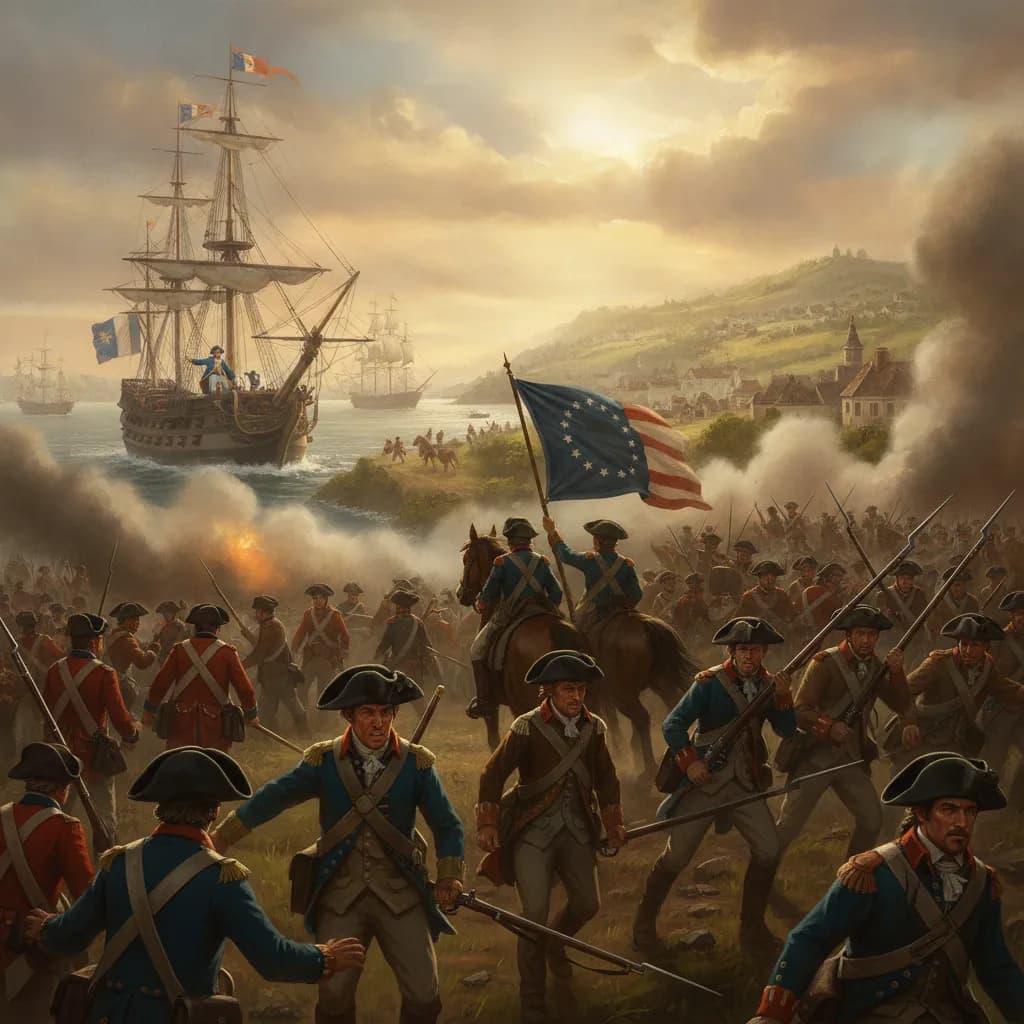
The American Revolution
A rebellion by thirteen colonies against the era's most powerful empire, that ultimately succeeded partly thanks to Britain's own longtime rival stepping in to help.
Cheat Sheet
- The American Revolution (1775-1783) was the successful rebellion of Britain's thirteen North American colonies, resulting in the founding of the United States as an independent nation.
- "No taxation without representation" captured colonial grievances over British taxes imposed without any colonial voice in the British Parliament that levied them.
- The Declaration of Independence, adopted on July 4, 1776, formally announced the colonies' break from British rule and articulated founding principles that continue to shape American political identity.
- France provided crucial military and financial support to the American colonists, partly motivated by its own long-standing rivalry with Britain rather than pure ideological alignment.
- The war concluded with the 1783 Treaty of Paris, in which Britain formally recognized American independence.
- The revolution's success directly inspired the drafting of the US Constitution, establishing a new system of government built around ideas like separation of powers and individual rights.
The 60-Second Version
The American Revolution, spanning 1775 to 1783, was the successful rebellion of Britain's thirteen North American colonies, resulting in the founding of the United States as an independent nation. "No taxation without representation" captured colonial grievances over British taxes imposed without any colonial voice in the British Parliament that levied them. The Declaration of Independence, adopted on July 4, 1776, formally announced the colonies' break from British rule and articulated founding principles that continue to shape American political identity. France provided crucial military and financial support to the American colonists, partly motivated by its own long-standing rivalry with Britain rather than pure ideological alignment. The war concluded with the 1783 Treaty of Paris, in which Britain formally recognized American independence. The revolution's success directly inspired the drafting of the US Constitution, establishing a new system of government built around ideas like separation of powers and individual rights.
The Long Version
Grievances That Led to Rebellion
Colonial resentment built steadily through the 1760s and early 1770s as Britain imposed a series of taxes and trade restrictions on the American colonies to help pay off debts from earlier wars, all without granting colonists any direct representation in the British Parliament that decided those policies, crystallizing into the enduring rallying cry "no taxation without representation."
Declaring Independence
Armed conflict began in 1775, and on July 4, 1776, the Continental Congress formally adopted the Declaration of Independence, announcing the colonies' complete break from British rule and articulating founding political principles, including the idea that legitimate government derives its authority from the consent of the governed, that would go on to deeply shape American political identity.
France's Crucial, Self-Interested Support
The struggling colonial forces received crucial military supplies, naval support, and financial backing from France, support driven significantly by France's own long-standing strategic rivalry with Britain rather than a pure ideological commitment to the colonists' cause, illustrating how great-power rivalry helped shape the war's ultimate outcome.
From Treaty of Paris to a New Constitution
The war concluded with the 1783 Treaty of Paris, in which Britain formally recognized American independence. In the years that followed, the new nation's leaders drafted the US Constitution, establishing a novel system of government built around principles like separation of powers among different branches of government and protection of individual rights, directly shaped by the revolutionary generation's experience under British rule.
Ad slot (placeholder — set NEXT_PUBLIC_ADSENSE_SLOT_ID once an ad unit is created)
Glossary
- Declaration of Independence
- The 1776 document formally announcing the American colonies' break from British rule.
- No taxation without representation
- A colonial rallying cry protesting British taxes imposed without any colonial representation in Parliament.
- Continental Army
- The combined colonial military force, led by George Washington, that fought against British forces.
- Treaty of Paris (1783)
- The agreement formally ending the Revolutionary War and recognizing American independence.
- US Constitution
- The founding governing document adopted after independence, establishing the structure of the new US government.