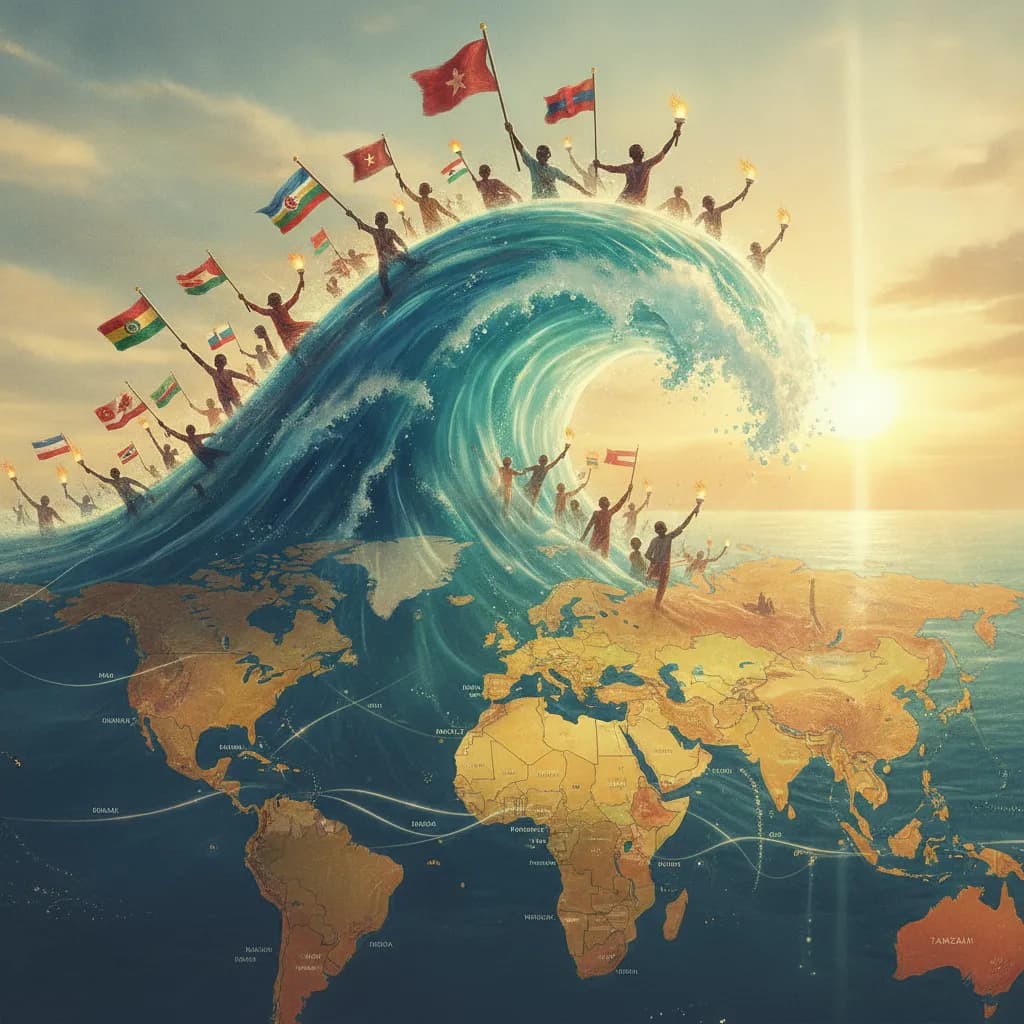
Decolonization
A wave of independence movements so large that dozens of new nations joined the world map within just a few decades of the mid-20th century.
Cheat Sheet
- Decolonization refers to the process, concentrated especially in the mid-20th century, by which former colonies across Africa, Asia, and elsewhere gained independence from European colonial powers.
- World War II significantly accelerated decolonization by weakening European colonial powers economically and militarily, while also exposing the contradiction of fighting for freedom abroad while maintaining colonial rule elsewhere.
- India's 1947 independence from British rule, achieved substantially through Mahatma Gandhi's nonviolent resistance movement, became one of the most influential examples of successful decolonization.
- Not all decolonization occurred peacefully — several independence movements, including in Algeria and Vietnam, involved prolonged and often extremely violent conflicts with colonial powers.
- Decolonization frequently left newly independent nations grappling with arbitrary colonial-era borders that didn't reflect existing ethnic, religious, or tribal boundaries, contributing to ongoing regional conflicts in some cases.
- The United Nations played a significant institutional role in decolonization, formally endorsing the principle of self-determination and providing a global platform for independence movements.
The 60-Second Version
Decolonization refers to the process, concentrated especially in the mid-20th century, by which former colonies across Africa, Asia, and elsewhere gained independence from European colonial powers. World War II significantly accelerated decolonization by weakening European colonial powers economically and militarily, while also exposing the contradiction of fighting for freedom abroad while maintaining colonial rule elsewhere. India's 1947 independence from British rule, achieved substantially through Mahatma Gandhi's nonviolent resistance movement, became one of the most influential examples of successful decolonization. Not all decolonization occurred peacefully — several independence movements, including in Algeria and Vietnam, involved prolonged and often extremely violent conflicts with colonial powers. Decolonization frequently left newly independent nations grappling with arbitrary colonial-era borders that didn't reflect existing ethnic, religious, or tribal boundaries, contributing to ongoing regional conflicts in some cases. The United Nations played a significant institutional role in decolonization, formally endorsing the principle of self-determination and providing a global platform for independence movements.
The Long Version
How World War II Accelerated Independence
World War II left major European colonial powers, including Britain and France, economically drained and militarily weakened, undermining their practical ability to maintain distant colonial territories by force. The war also highlighted a stark moral contradiction: nations fighting to defend freedom and self-determination in Europe were simultaneously denying those same principles to their own colonial subjects, a tension that fueled independence movements across the colonized world.
India's Nonviolent Path to Independence
India's 1947 independence from British colonial rule stands as one of the most influential decolonization examples, achieved substantially through Mahatma Gandhi's strategy of organized nonviolent resistance and civil disobedience, demonstrating that colonial rule could be successfully challenged without necessarily resorting to armed conflict, and inspiring other independence movements around the world.
When Decolonization Turned Violent
Independence wasn't always achieved peacefully. Movements in territories including Algeria and Vietnam involved prolonged, often brutally violent conflicts between colonial powers determined to retain control and independence movements willing to fight for it, resulting in significant casualties and lasting political and social consequences that extended well beyond the immediate fighting.
The Lasting Legacy of Colonial Borders
Many newly independent nations inherited borders originally drawn by colonial powers for administrative convenience, frequently without regard to existing ethnic, religious, or tribal divisions on the ground. This mismatch between colonial-era borders and actual social and cultural boundaries has contributed to ongoing regional tensions and conflicts in several post-colonial regions, a legacy that continues to shape geopolitics today.
Ad slot (placeholder — set NEXT_PUBLIC_ADSENSE_SLOT_ID once an ad unit is created)
Glossary
- Self-determination
- The principle that a people or nation has the right to determine its own political status and government.
- Mahatma Gandhi
- The leader of India's nonviolent independence movement against British colonial rule, achieving independence in 1947.
- Colonial borders
- Territorial boundaries drawn by colonial powers, often without regard to existing ethnic or tribal divisions.
- Non-Aligned Movement
- A coalition of newly independent and other states that avoided formal alignment with either major Cold War bloc.
- United Nations
- The international organization that formally endorsed self-determination and supported decolonization efforts globally.