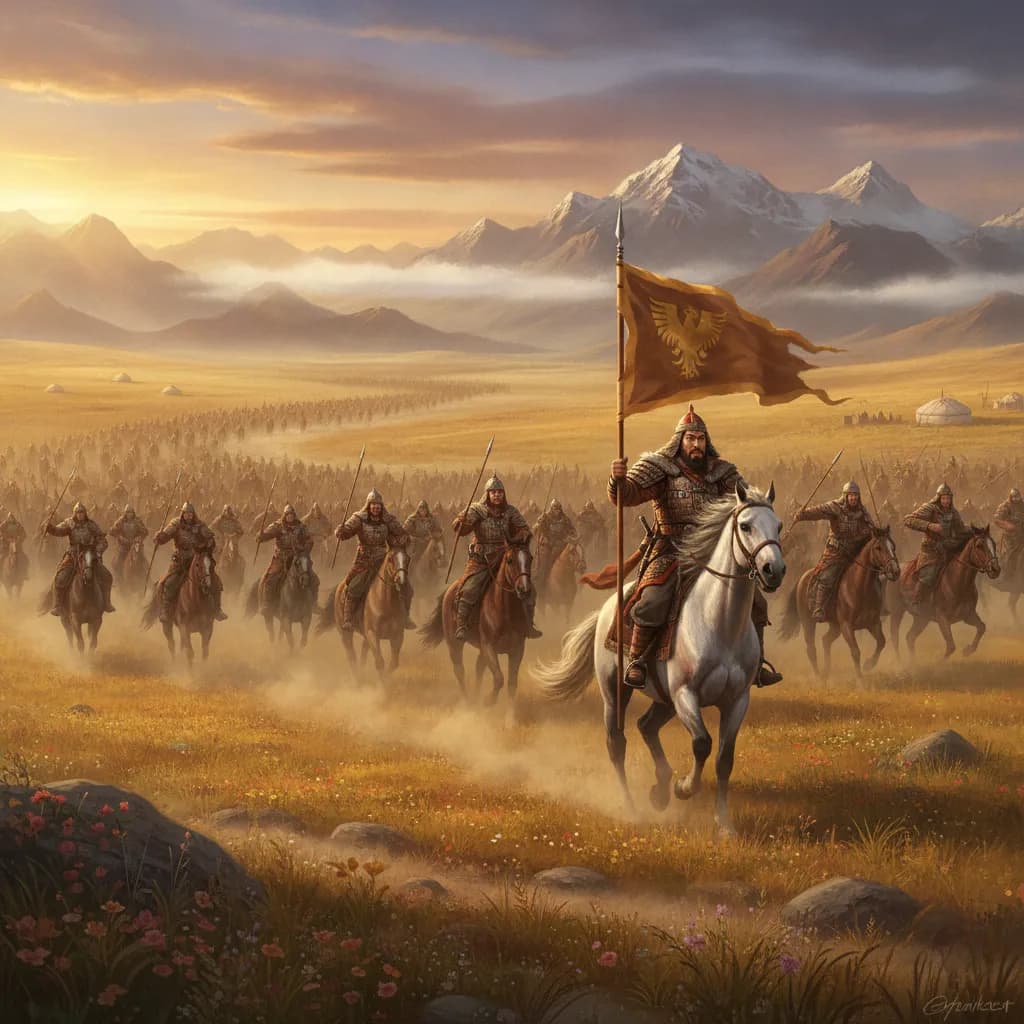
The Mongol Empire
The largest contiguous land empire ever assembled in world history was built, remarkably, by unifying scattered nomadic tribes that had previously spent generations fighting each other.
Cheat Sheet
- The Mongol Empire, founded by Genghis Khan in 1206, became the largest contiguous land empire in world history, stretching from Eastern Europe to the Pacific Ocean at its peak.
- Genghis Khan unified previously fragmented, often warring nomadic Mongol and Turkic tribes into a single, highly disciplined and effective military and political force.
- The Mongol military was renowned for exceptional horsemanship, mounted archery, and highly effective, coordinated battlefield tactics that allowed rapid conquest of a remarkably vast territory.
- Despite its fearsome reputation for conquest, the Mongol Empire established the Pax Mongolica, a period of relative stability that significantly facilitated trade and cultural exchange along the Silk Road.
- After Genghis Khan's death, the empire eventually divided into several separate khanates, ruled by his descendants, each governing a distinct region of the broader former empire.
- The Mongol Empire's vast reach facilitated significant exchange of goods, ideas, and unfortunately also disease, including likely contributing to the spread of the bubonic plague into Europe.
The 60-Second Version
The Mongol Empire, founded by Genghis Khan in 1206, became the largest contiguous land empire in world history, stretching from Eastern Europe to the Pacific Ocean at its peak. Genghis Khan unified previously fragmented, often warring nomadic Mongol and Turkic tribes into a single, highly disciplined and effective military and political force. The Mongol military was renowned for exceptional horsemanship, mounted archery, and highly effective, coordinated battlefield tactics that allowed rapid conquest of a remarkably vast territory. Despite its fearsome reputation for conquest, the Mongol Empire established the Pax Mongolica, a period of relative stability that significantly facilitated trade and cultural exchange along the Silk Road. After Genghis Khan's death, the empire eventually divided into several separate khanates, ruled by his descendants, each governing a distinct region of the broader former empire. The Mongol Empire's vast reach facilitated significant exchange of goods, ideas, and unfortunately also disease, including likely contributing to the spread of the bubonic plague into Europe.
The Long Version
Unifying a Fragmented Nomadic World
Before Genghis Khan's rise, the Mongolian steppe was home to numerous fragmented, frequently warring nomadic tribes. Genghis Khan's foundational achievement was unifying these previously divided groups into a single, highly disciplined political and military force beginning in 1206, an organizational feat that laid the essential groundwork for the empire's subsequent rapid and extraordinarily wide-reaching territorial expansion.
A Military Built on Horsemanship and Coordination
The Mongol military's remarkable effectiveness rested significantly on exceptional horsemanship and mounted archery, combined with highly coordinated battlefield tactics and effective logistics that allowed Mongol forces to move and strike with a speed and coordination most opposing armies of the era simply couldn't match, enabling conquest of a territorial scale rarely matched before or since.
Stability and Trade Along the Silk Road
Despite the empire's fearsome reputation for conquest, its consolidated control over such a vast territory established the Pax Mongolica, a period of relative internal stability that significantly facilitated trade and cultural exchange across the Silk Road, connecting East Asia and Europe more directly and safely than had been possible in the preceding fragmented political landscape.
Division Into Khanates, and a Complicated Global Legacy
Following Genghis Khan's death, the empire eventually divided into several separate khanates, each ruled by different descendants and governing a distinct region of the broader former empire. The Mongol Empire's vast interconnected reach facilitated significant exchange of goods and ideas across Eurasia, though this same connectivity likely also contributed to the spread of disease, including the bubonic plague's eventual devastating arrival in Europe.
Ad slot (placeholder — set NEXT_PUBLIC_ADSENSE_SLOT_ID once an ad unit is created)
Glossary
- Genghis Khan
- The founder of the Mongol Empire, who unified the Mongol tribes and led its initial rapid territorial expansion.
- Pax Mongolica
- A period of relative stability under Mongol rule that significantly facilitated trade and cultural exchange along the Silk Road.
- Khanate
- One of several separate territorial divisions the Mongol Empire eventually split into, each ruled by a descendant of Genghis Khan.
- Silk Road
- The network of trade routes connecting East Asia and Europe, whose activity was significantly facilitated during the Pax Mongolica.
- Mounted archery
- A key Mongol military tactic combining exceptional horsemanship with effective use of the bow in battle.