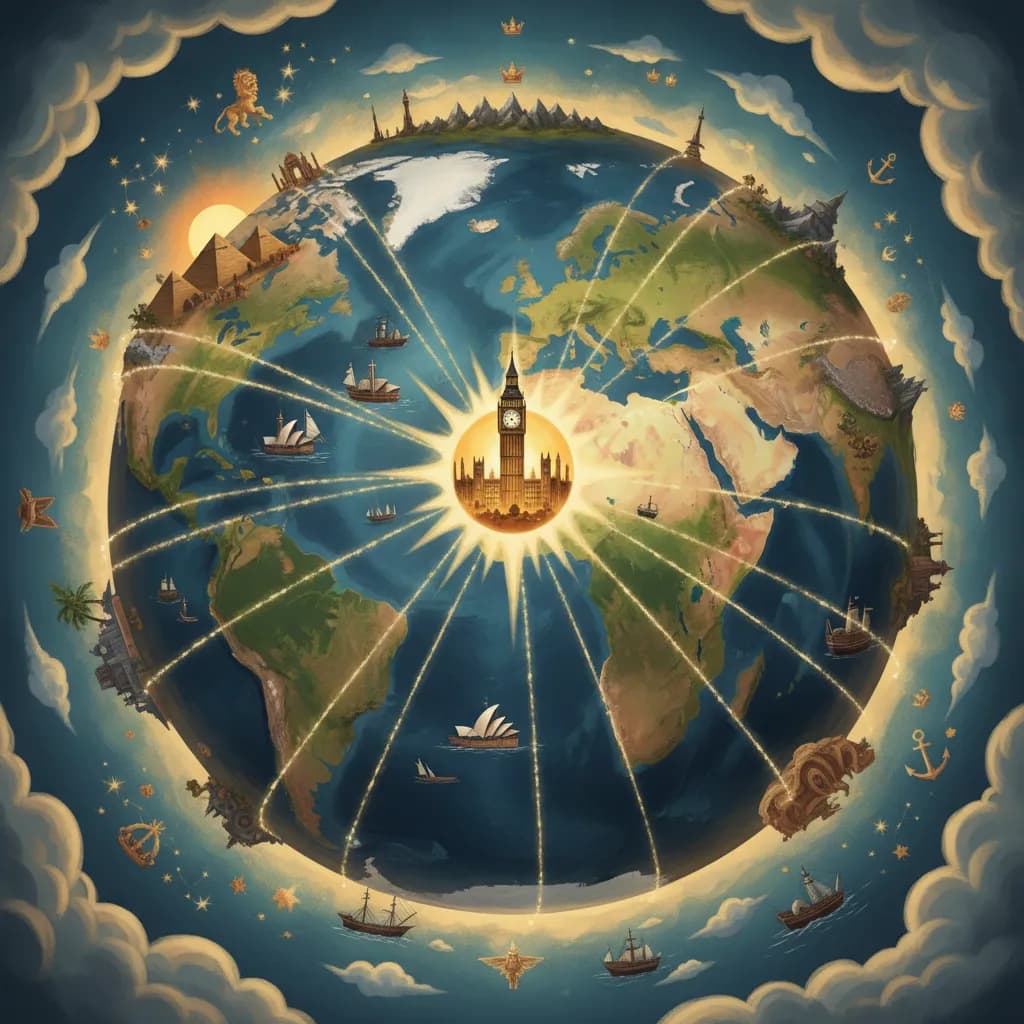
The British Empire
An empire so vast and spread across so many time zones that it was always daytime somewhere within its borders — hence the phrase, "the empire on which the sun never sets."
Cheat Sheet
- At its peak in the early 20th century, the British Empire was the largest empire in world history, controlling roughly a quarter of the planet's total land area and population.
- The phrase "the empire on which the sun never sets" reflected the fact that the empire's territories were spread across so many time zones that it was always daytime somewhere within its borders.
- British colonial expansion was driven by a combination of trade interests, military power, and competition with other European colonial powers for territory and resources.
- The empire left a lasting global legacy, including the widespread use of English as a global language and common law legal systems adopted across many former colonies.
- Colonial rule frequently involved significant exploitation and violence toward colonized populations, a legacy that remains a significant and actively debated part of how the empire's history is understood today.
- The empire declined rapidly after World War II amid the broader global wave of decolonization, with the vast majority of British colonies achieving independence within a few decades.
The 60-Second Version
At its peak in the early 20th century, the British Empire was the largest empire in world history, controlling roughly a quarter of the planet's total land area and population. The phrase "the empire on which the sun never sets" reflected the fact that the empire's territories were spread across so many time zones that it was always daytime somewhere within its borders. British colonial expansion was driven by a combination of trade interests, military power, and competition with other European colonial powers for territory and resources. The empire left a lasting global legacy, including the widespread use of English as a global language and common law legal systems adopted across many former colonies. Colonial rule frequently involved significant exploitation and violence toward colonized populations, a legacy that remains a significant and actively debated part of how the empire's history is understood today. The empire declined rapidly after World War II amid the broader global wave of decolonization, with the vast majority of British colonies achieving independence within a few decades.
The Long Version
An Empire of Unmatched Scale
At its territorial peak in the early 20th century, the British Empire controlled roughly a quarter of the world's entire land area and population, spanning territories across every inhabited continent, making it the largest empire in recorded world history by a considerable margin.
Trade, Power, and Competition
British colonial expansion developed gradually over centuries, driven by a combination of commercial trading interests, most notably early ventures like the East India Company, growing naval and military power, and intense ongoing competition with other European powers, including France and Spain, for control of valuable overseas territory and trade routes.
A Complicated, Lasting Global Legacy
The empire's reach left a deep and lasting global legacy still visible today, including the widespread adoption of English as a global lingua franca and common law legal systems used in many former colonies, including the United States, Canada, Australia, and India. At the same time, colonial rule frequently involved substantial exploitation, violence, and economic extraction imposed on colonized populations, a legacy that remains a significant and actively contested part of how the empire's history is discussed and taught today.
Rapid Decline After World War II
The empire's decline accelerated dramatically following World War II, as Britain emerged economically and militarily weakened while a powerful global wave of decolonization movements pushed for independence across colonial territories. Within just a few decades of the war's end, the vast majority of former British colonies had achieved formal independence, transforming the empire's remaining ties into the voluntary Commonwealth of Nations that continues in a much different form today.
Ad slot (placeholder — set NEXT_PUBLIC_ADSENSE_SLOT_ID once an ad unit is created)
Glossary
- Colony
- A territory under the political control of another country, in this case administered as part of the British Empire.
- Commonwealth of Nations
- A voluntary association of mostly former British colonies that maintains ongoing diplomatic and cultural ties today.
- Common law
- A legal system originating in England, adopted in many former British colonies and still used in countries like the US, Canada, and Australia.
- East India Company
- A powerful British trading company that played a major early role in British colonial expansion, particularly in India.
- Decolonization
- The mid-20th-century process by which former colonies, including most of the British Empire, gained independence.