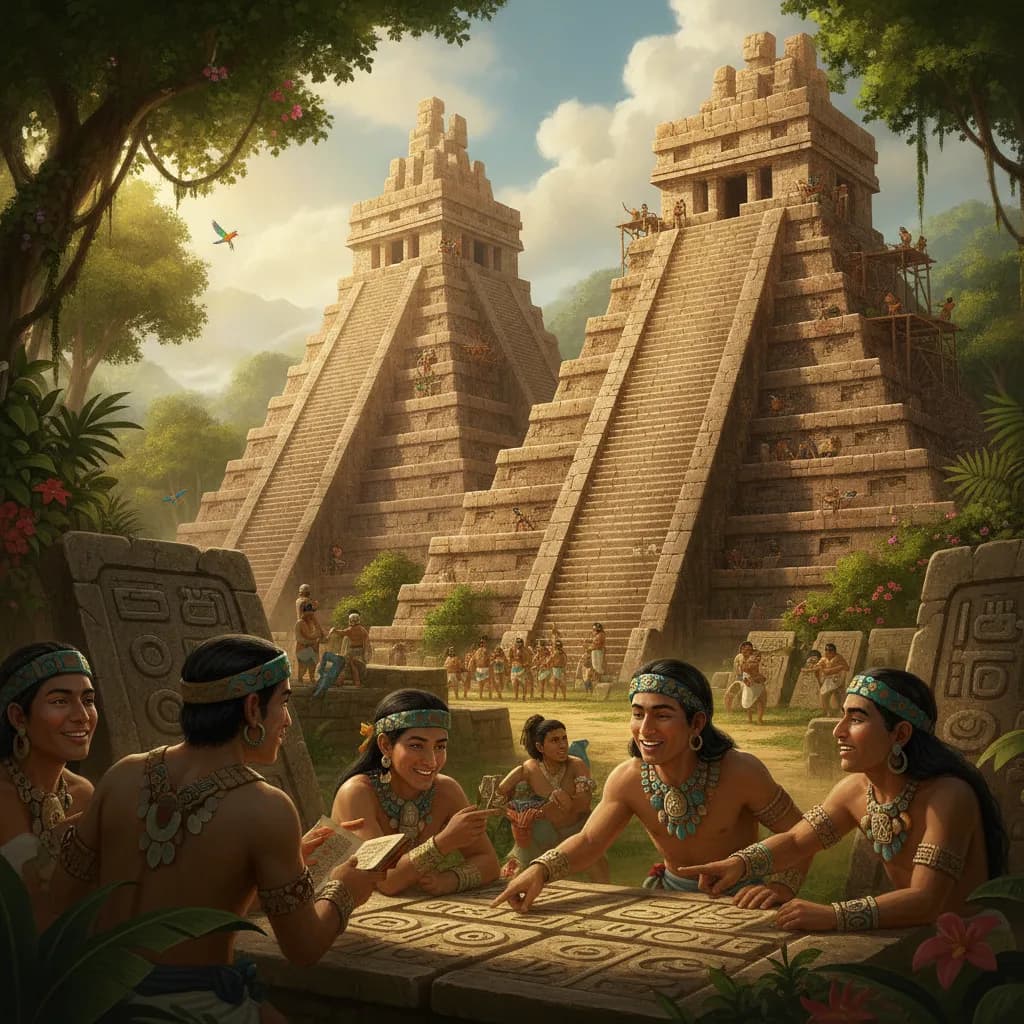
The Maya
A civilization that invented the concept of zero independently, then built some of the tallest structures in the Americas without metal tools or the wheel.
Cheat Sheet
- The Maya civilization flourished across present-day southern Mexico, Guatemala, Belize, and parts of Honduras and El Salvador, with its major cultural peak during the Classic Period (roughly 250-900 CE).
- Unlike Egypt or Rome, the Maya were never unified under one single empire — they lived in numerous independent city-states, like Tikal and Chichen Itza, that often warred with and traded among each other.
- Maya mathematics and astronomy were remarkably advanced, including an independently invented concept of zero and a highly accurate calendar system tracking celestial cycles.
- The Maya writing system was a sophisticated combination of logographic and syllabic glyphs, and it's now largely deciphered thanks to breakthroughs starting in the mid-20th century.
- The dramatic decline of major Classic Period cities around 900 CE remains debated among historians, with drought, warfare, and overpopulation among the leading theories.
- Maya culture and language never actually disappeared — millions of Maya people live in Mexico and Central America today, maintaining descendant languages and traditions.
The 60-Second Version
The Maya civilization flourished across present-day southern Mexico, Guatemala, Belize, and parts of Honduras and El Salvador, with its major cultural peak during the Classic Period, roughly 250-900 CE. Unlike Egypt or Rome, the Maya were never unified under a single empire — they lived in numerous independent city-states, like Tikal and Chichen Itza, that often warred with and traded among each other rather than answering to a central ruler. Maya mathematics and astronomy were remarkably advanced, including an independently invented concept of zero and a highly accurate calendar system tracking celestial cycles. The Maya writing system was a sophisticated combination of logographic and syllabic glyphs, and it's now largely deciphered thanks to breakthroughs starting in the mid-20th century. The dramatic decline of major Classic Period cities around 900 CE remains debated among historians, with drought, warfare, and overpopulation among the leading theories. Importantly, Maya culture and language never actually disappeared — millions of Maya people live in Mexico and Central America today, maintaining descendant languages and traditions.
The Long Version
A World of City-States, Not One Empire
Unlike many other major ancient civilizations organized under a single centralized empire, the Maya world was made up of numerous independent city-states, each with its own ruling dynasty, controlling its own surrounding territory. Cities like Tikal, Calakmul, and Chichen Itza rose and fell in relative power over centuries, sometimes forming alliances and sometimes waging war against each other, in a political landscape closer to ancient Greece's city-states than to Egypt's or Rome's unified rule.
Mathematics, Astronomy, and the Calendar
Maya scholars developed a sophisticated mathematical system, including an independently invented concept of zero, centuries before it was adopted in Europe. This mathematical skill fed directly into remarkably precise astronomical observation, tracking the cycles of the sun, moon, and Venus with impressive accuracy, and it all fed into an intricate system of interlocking calendars used for both timekeeping and religious and ceremonial planning, including the long count calendar that famously became the subject of overblown "end of the world" predictions around the year 2012.
Decoding a Written Language
The Maya writing system combined logographic glyphs, symbols representing whole words or concepts, with syllabic glyphs representing sounds, creating a genuinely complex and expressive script capable of recording history, mythology, and royal genealogies on stone monuments and in bark-paper books. For centuries after European contact, this writing system remained largely mysterious to outside scholars, and it wasn't until a series of breakthroughs starting in the mid-20th century, building on the work of both Western academics and Maya language experts, that the script became substantially decipherable.
The Mystery of the Classic Collapse
Around 900 CE, many of the great Classic Period Maya cities in the southern lowlands experienced a dramatic decline, marked by abandoned monumental construction and a sharp drop in population, while some northern Maya cities continued to thrive for centuries afterward. Historians still debate the exact causes, with leading theories pointing to prolonged drought, overpopulation straining agricultural capacity, and increased warfare between rival city-states, likely acting together rather than any single cause fully explaining the collapse on its own.
Ad slot (placeholder — set NEXT_PUBLIC_ADSENSE_SLOT_ID once an ad unit is created)
Glossary
- City-state
- An independent, self-governing city and its surrounding territory, the Maya's primary political unit.
- Classic Period
- The Maya civilization's cultural peak, roughly 250-900 CE, marked by major city-building and artistic achievement.
- Maya calendar
- A sophisticated system of interlocking calendars used to track time, astronomy, and religious cycles.
- Glyph
- A written symbol in the Maya writing system, combining logographic and syllabic elements.
- Tikal
- One of the largest and most powerful Maya city-states, located in present-day Guatemala.