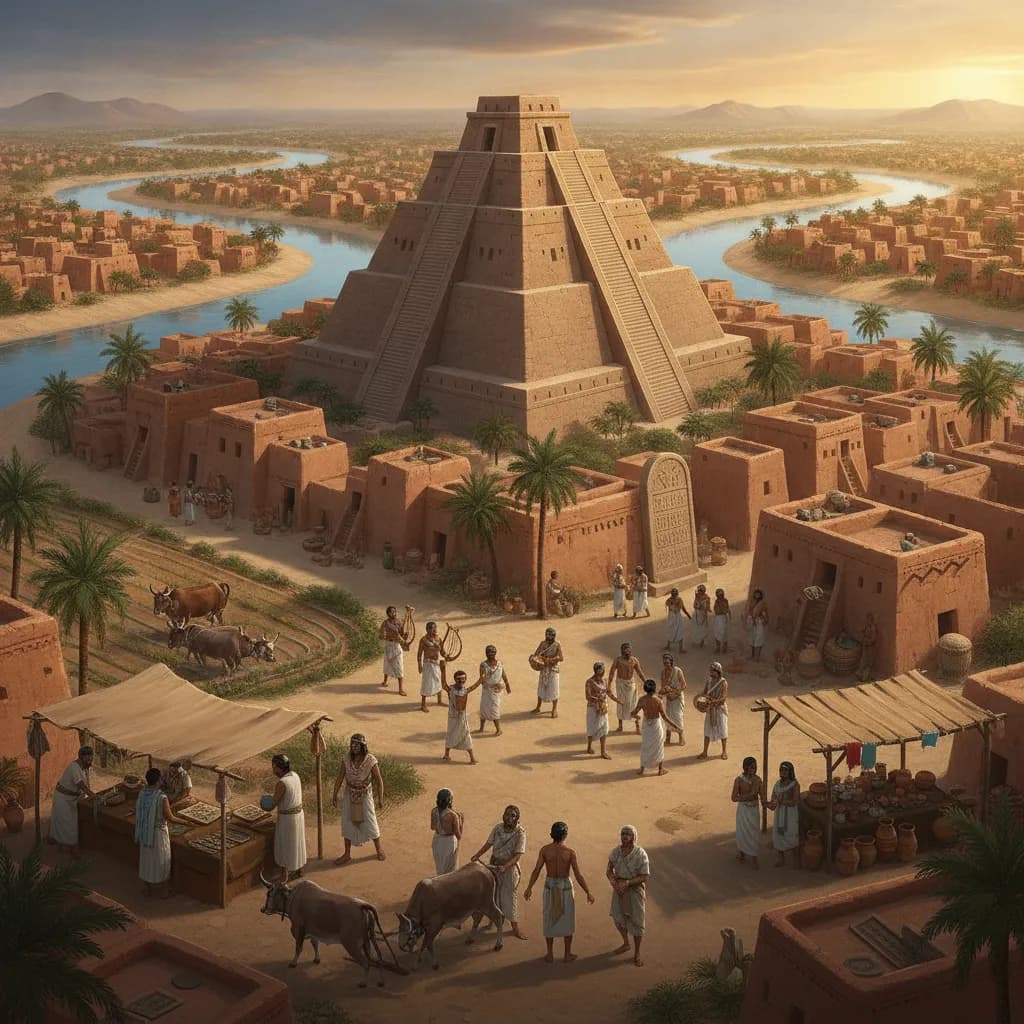
Mesopotamia
Long before Egypt's pyramids, a civilization nestled between two rivers had already invented writing, cities, and formal law codes — earning it the nickname "the cradle of civilization."
Cheat Sheet
- Mesopotamia, meaning "land between the rivers," refers to the ancient region located between the Tigris and Euphrates rivers in present-day Iraq and parts of surrounding countries.
- Mesopotamia is widely considered one of the earliest sites of urban civilization, agriculture, and writing in human history, earning it the frequently used designation "the cradle of civilization."
- The Sumerians, one of Mesopotamia's earliest major civilizations, developed cuneiform, among the world's earliest known writing systems, initially used primarily for record-keeping and administration.
- Mesopotamia was home to a succession of major civilizations and empires over thousands of years, including the Sumerians, Akkadians, Babylonians, and Assyrians.
- The Code of Hammurabi, a Babylonian legal code from roughly the 18th century BCE, is among the earliest and most extensively preserved written legal codes in human history.
- Mesopotamian innovations, including early forms of writing, mathematics, and organized urban administration, laid crucial foundational groundwork for numerous subsequent civilizations across the broader region.
The 60-Second Version
Mesopotamia, meaning "land between the rivers," refers to the ancient region located between the Tigris and Euphrates rivers in present-day Iraq and parts of surrounding countries. Mesopotamia is widely considered one of the earliest sites of urban civilization, agriculture, and writing in human history, earning it the frequently used designation "the cradle of civilization." The Sumerians, one of Mesopotamia's earliest major civilizations, developed cuneiform, among the world's earliest known writing systems, initially used primarily for record-keeping and administration. Mesopotamia was home to a succession of major civilizations and empires over thousands of years, including the Sumerians, Akkadians, Babylonians, and Assyrians. The Code of Hammurabi, a Babylonian legal code from roughly the 18th century BCE, is among the earliest and most extensively preserved written legal codes in human history. Mesopotamian innovations, including early forms of writing, mathematics, and organized urban administration, laid crucial foundational groundwork for numerous subsequent civilizations across the broader region.
The Long Version
Fertile Land Between Two Rivers
Mesopotamia's name, meaning "land between the rivers," directly reflects its geography, situated between the Tigris and Euphrates rivers in present-day Iraq and parts of surrounding countries, where regular river flooding deposited fertile soil that made large-scale early agriculture possible and directly enabled the region's subsequent development of settled urban civilization.
Why It's Called the Cradle of Civilization
Mesopotamia is widely considered one of the earliest sites of genuinely urban civilization, organized agriculture, and formal writing anywhere in human history, a combination of foundational developments that has earned the region its frequently used designation as "the cradle of civilization," reflecting its outsized role in laying groundwork for much of subsequent human societal development.
Cuneiform: Writing Before Anywhere Else
The Sumerians, among Mesopotamia's earliest major civilizations, developed cuneiform, one of the world's earliest known writing systems, initially used primarily for practical record-keeping and administrative purposes, such as tracking agricultural production and trade, before gradually expanding to record law, literature, and other more complex forms of written communication.
A Succession of Empires, and Hammurabi's Code
Over thousands of years, Mesopotamia was home to a succession of major civilizations and empires, including the Sumerians, Akkadians, Babylonians, and Assyrians, each contributing to the region's cumulative development. Among the most significant surviving artifacts from this period is the Code of Hammurabi, a Babylonian legal code from roughly the 18th century BCE, considered among the earliest and most extensively preserved written legal codes in human history.
Ad slot (placeholder — set NEXT_PUBLIC_ADSENSE_SLOT_ID once an ad unit is created)
Glossary
- Cuneiform
- One of the world's earliest known writing systems, developed by the Sumerians, initially used primarily for record-keeping.
- Sumerians
- One of Mesopotamia's earliest major civilizations, credited with developing cuneiform writing and early urban civilization.
- Code of Hammurabi
- A Babylonian legal code from roughly the 18th century BCE, among the earliest and most extensively preserved written legal codes.
- Cradle of civilization
- A common designation for Mesopotamia, reflecting its status as one of the earliest known sites of urban civilization and writing.
- Tigris and Euphrates
- The two rivers between which Mesopotamia was located, providing the fertile land essential to its early agricultural civilization.