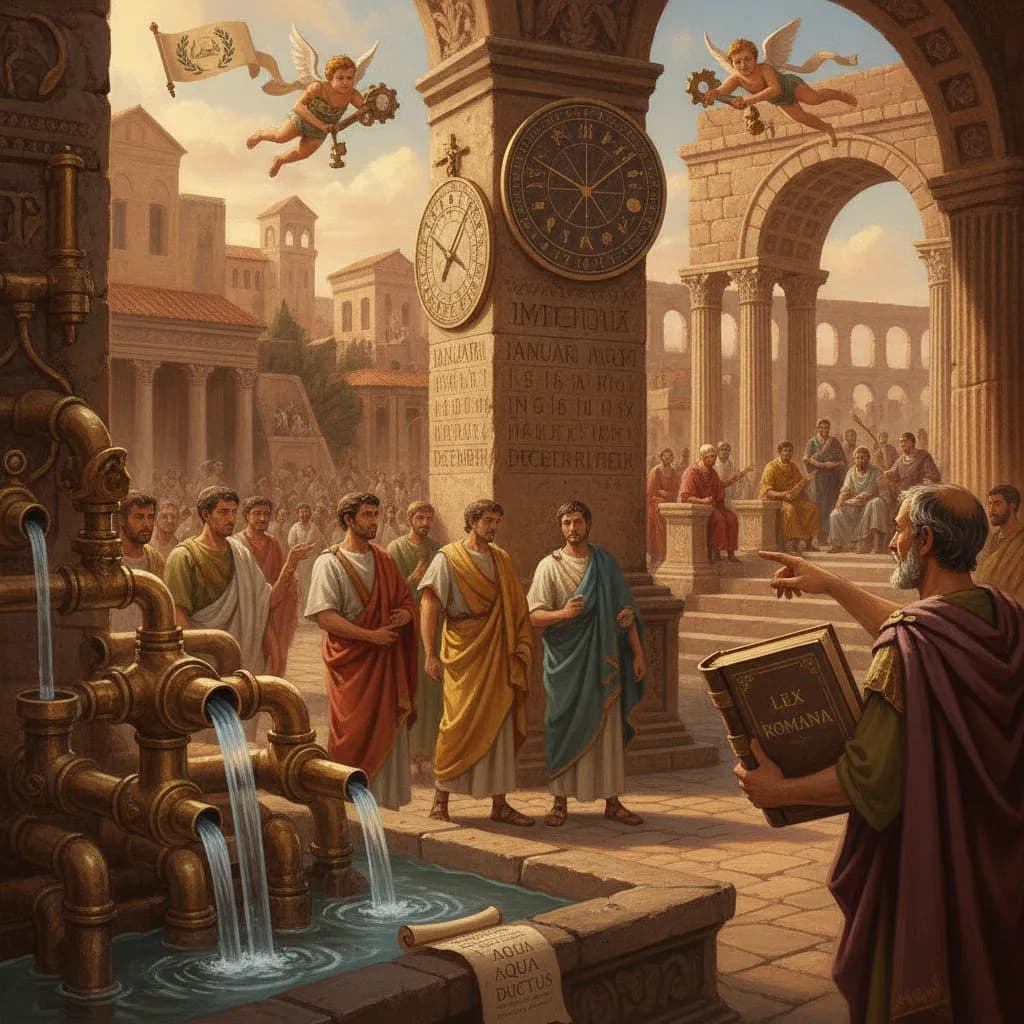
Ancient Rome
An empire that fell over 1,500 years ago and still runs your local plumbing, legal system, and calendar.
Cheat Sheet
- Rome began as a small city-state (traditionally dated 753 BCE) and grew into an empire spanning most of Europe, North Africa, and the Middle East.
- The Roman Republic (509-27 BCE) was governed by elected officials and the Senate; it ended when Augustus became the first emperor.
- The "Pax Romana" ("Roman Peace," roughly 27 BCE-180 CE) was a long stretch of relative stability that allowed trade, law, and infrastructure to flourish.
- Roman roads, aqueducts, concrete, and legal principles still influence infrastructure and law today — much of it directly inherited by later European systems.
- The Western Roman Empire fell in 476 CE, but the Eastern half survived for another thousand years as the Byzantine Empire.
- Latin, Rome's language, is the direct ancestor of Spanish, French, Italian, Portuguese, and Romanian, and still shapes English vocabulary and legal terminology.
The 60-Second Version
Ancient Rome started as a small city-state around 753 BCE and eventually grew into one of history's largest empires, spanning most of Europe, North Africa, and the Middle East at its peak. For roughly its first five centuries it was a Republic, governed by elected officials and the Senate rather than a king — that system ended when Augustus became the first emperor in 27 BCE, beginning the Roman Empire proper. The following two centuries, known as the Pax Romana, brought relative peace and stability that let trade, law, architecture, and infrastructure flourish across the empire. The Western Roman Empire eventually collapsed in 476 CE under pressure from invasions and internal decline, though its eastern half survived for another thousand years as the Byzantine Empire. Rome's legacy is everywhere: modern legal systems draw on Roman law, its roads and concrete engineering influenced infrastructure for centuries, and its language, Latin, is the direct ancestor of Spanish, French, Italian, Portuguese, and Romanian.
The Long Version
Conquest and Infrastructure
Rome's expansion was driven largely by its military, organized into disciplined legions that conquered vast territories and then stayed on to administer them, backed by an extensive road network built primarily for moving troops quickly across the empire. That same infrastructure, designed with military logistics in mind, also happened to enable trade, communication, and travel across a territory spanning three continents, tying together an empire that would otherwise have been almost impossible to govern from a single city.
Engineering Marvels
Roman engineering produced lasting achievements that still shape how we think about infrastructure today: aqueducts that carried water for miles using precisely calculated gradients rather than pumps, concrete durable enough that some structures — the Pantheon's dome among them — still stand nearly two thousand years later, and public works like the Colosseum, built for gladiatorial games and public spectacles that were central to Roman civic and political life, not just entertainment.
From Republic to Empire
Politically, the Republic gave way to Empire gradually rather than in a single clean break. The assassination of Julius Caesar in 44 BCE, stabbed by a group of senators fearing he intended to make himself a king, triggered a prolonged power struggle rather than a restoration of the old order. His adopted heir Octavian eventually won that struggle and became the first emperor under the name Augustus, formally ending the Republic while carefully preserving many of its outward forms and titles to make the transition feel less abrupt than it actually was.
Religion, Society, and Decline
Roman society rested heavily on a slave-based economy and a rigid class structure, a reality often glossed over in popular narratives focused on Rome's engineering and military "greatness." Christianity, initially persecuted under several emperors, was legalized under Constantine in the early 4th century and later became the empire's official religion, reshaping European religious history for the following 1,500 years. The Western Empire's eventual collapse in 476 CE stemmed from a mix of economic strain, political instability, and repeated invasions by various groups, while its eastern half persisted for another full millennium as the Byzantine Empire, centered on Constantinople, carrying Roman traditions forward long after Rome itself had fallen.
Ad slot (placeholder — set NEXT_PUBLIC_ADSENSE_SLOT_ID once an ad unit is created)
Glossary
- Republic
- Rome's governing system before the emperors, based on elected officials and the Senate.
- Empire
- Rome's governing system after Augustus, ruled by an emperor.
- Pax Romana
- A roughly 200-year period of relative peace and stability across the Roman Empire.
- Senate
- Rome's council of elite advisors and lawmakers, powerful under the Republic and reduced in influence under the emperors.