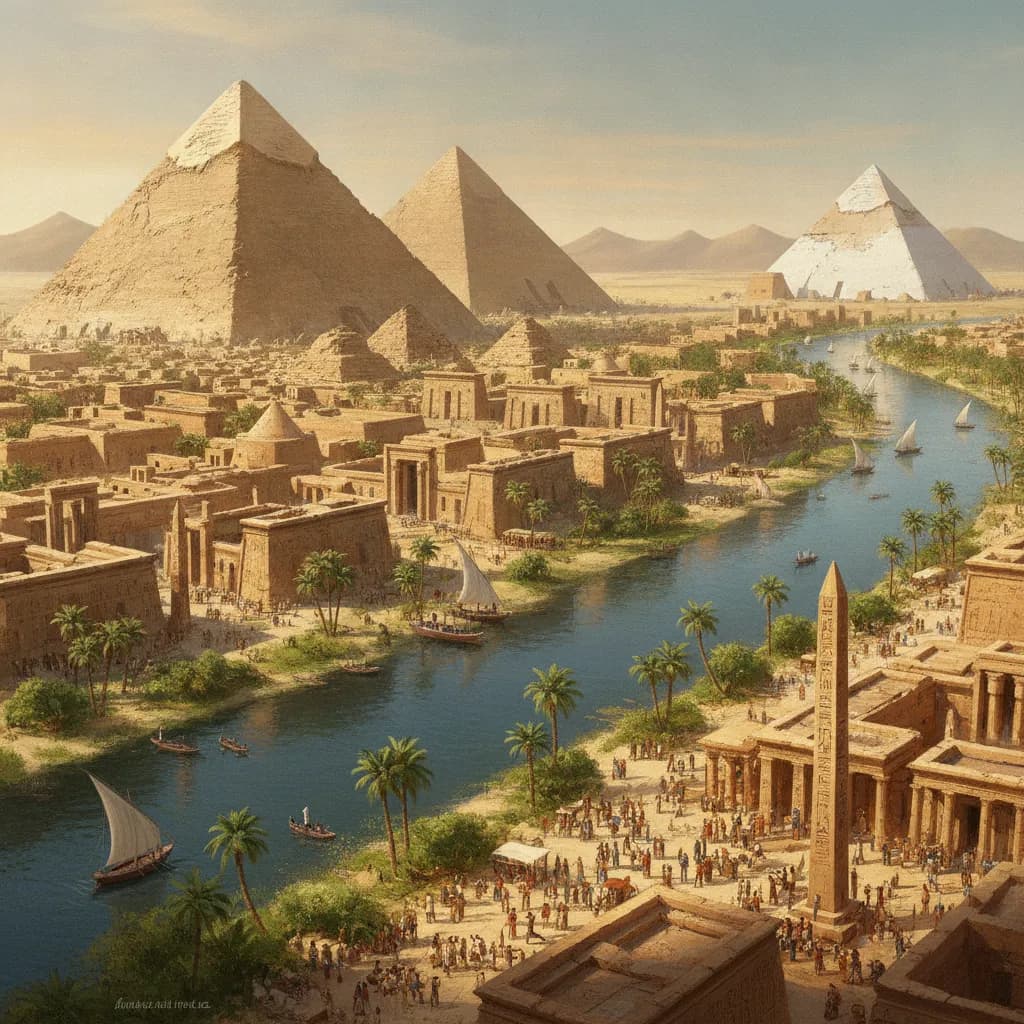
Ancient Egypt
A civilization so stable that it lasted longer than the time separating us from Cleopatra separates her from the building of the pyramids.
Cheat Sheet
- Ancient Egyptian civilization lasted over 3,000 years along the Nile River, remarkably stable and continuous compared to most other ancient civilizations.
- The Nile's predictable annual flooding deposited fertile silt onto surrounding farmland, and this reliable agricultural surplus was the foundation of Egypt's wealth and stability.
- Egypt was ruled by pharaohs, considered living gods and intermediaries between the divine and mortal worlds, organized into roughly 30 dynasties across three major kingdoms (Old, Middle, and New).
- The pyramids at Giza, built during the Old Kingdom around 2600-2500 BCE, served as elaborate tombs for pharaohs and remain among the most enduring engineering achievements in human history.
- Hieroglyphics, Egypt's writing system, went undeciphered by modern scholars for centuries until the discovery of the Rosetta Stone in 1799 provided the key to translation.
- Egyptian civilization eventually came under Persian, then Greek (Ptolemaic), and finally Roman rule, ending as an independent kingdom with Cleopatra's death in 30 BCE.
The 60-Second Version
Ancient Egyptian civilization lasted over 3,000 years along the Nile River, remarkably stable and continuous compared to most other ancient civilizations. The Nile's predictable annual flooding deposited fertile silt onto surrounding farmland, and this reliable agricultural surplus was the foundation of Egypt's wealth and long-term stability. Egypt was ruled by pharaohs, considered living gods and intermediaries between the divine and mortal worlds, organized across roughly 30 dynasties spanning three major kingdoms: the Old, Middle, and New Kingdoms. The pyramids at Giza, built during the Old Kingdom around 2600-2500 BCE, served as elaborate tombs for pharaohs and remain among the most enduring engineering achievements in human history. Hieroglyphics, Egypt's writing system, went undeciphered by modern scholars for centuries until the discovery of the Rosetta Stone in 1799 finally provided the key to translation. Egyptian civilization eventually came under Persian, then Greek (Ptolemaic), and finally Roman rule, ending as an independent kingdom with Cleopatra's death in 30 BCE.
The Long Version
A Civilization Built on a River's Schedule
Ancient Egypt's remarkable longevity owed enormously to the Nile River's predictable annual flooding cycle, which deposited rich, fertile silt across the surrounding farmland every year, creating an unusually reliable agricultural surplus in an otherwise desert environment. That dependable food supply supported a large, stable population and freed up labor and resources for the monumental building projects, extensive bureaucracy, and cultural achievements the civilization became known for.
Pharaohs and the Structure of Power
Egyptian political and religious authority were deeply fused: the pharaoh was considered a living god, serving as the essential intermediary between the divine realm and the human world, responsible for maintaining Ma'at, the fundamental cosmic order and balance the Egyptians believed governed the universe. Egyptian history is conventionally organized into roughly 30 dynasties across three major periods, the Old, Middle, and New Kingdoms, punctuated by intermediate periods of political fragmentation and instability between them.
The Pyramids and Old Kingdom Engineering
The pyramids at Giza, built during the Old Kingdom around 2600-2500 BCE as elaborate tombs for pharaohs including Khufu, Khafre, and Menkaure, represent one of ancient history's most staggering engineering achievements, involving the precise cutting, transport, and assembly of millions of massive stone blocks using tools that predate iron working. The scale and precision of this construction, achieved without the wheel-based heavy machinery of later eras, continues to draw serious study from modern engineers and archaeologists.
Decline, Conquest, and Decipherment
Egyptian independence gradually eroded through successive conquests: first by the Persian Empire, then by Alexander the Great, whose Greek Ptolemaic Dynasty ruled Egypt until Cleopatra's death in 30 BCE, after which Egypt became a province of Rome. Egyptian hieroglyphics, meanwhile, fell out of active use and remained undeciphered by modern scholars for well over a thousand years, until the 1799 discovery of the Rosetta Stone, which contained the same decree written in hieroglyphics, a later Egyptian script, and Greek, finally providing the comparative key scholars needed to translate the ancient writing system.
Ad slot (placeholder — set NEXT_PUBLIC_ADSENSE_SLOT_ID once an ad unit is created)
Glossary
- Pharaoh
- Egypt's ruler, considered a living god and intermediary between the divine and human worlds.
- Nile River
- The river whose predictable annual flooding provided the agricultural foundation of ancient Egyptian civilization.
- Hieroglyphics
- Ancient Egypt's writing system, combining logographic and alphabetic elements.
- Rosetta Stone
- An ancient inscribed stone, discovered in 1799, that provided the key to deciphering hieroglyphics.
- Ptolemaic Dynasty
- The Greek dynasty, ending with Cleopatra, that ruled Egypt following Alexander the Great's conquest.