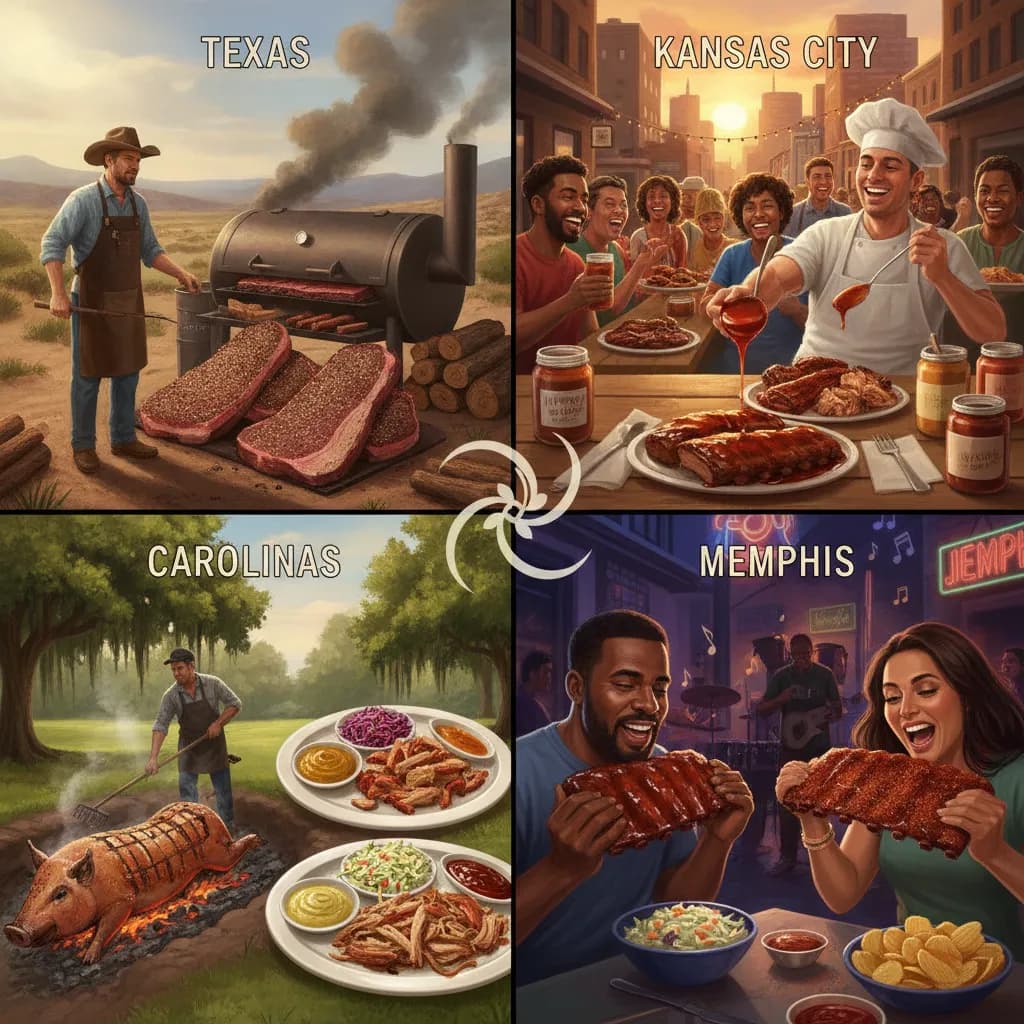
Barbecue Styles
Four American regions, four completely different definitions of what "barbecue" even means — and each will happily tell you the others are doing it wrong.
Cheat Sheet
- American barbecue centers on low-and-slow smoking (hours at low temperature) rather than direct high-heat grilling — the two are often confused but are fundamentally different cooking methods.
- The four major US regional styles — Carolina, Texas, Kansas City, and Memphis — differ by meat, sauce, and technique, and locals take the differences seriously.
- The "smoke ring" (a pink layer just under the meat's surface) is a visual sign of proper smoking, caused by a chemical reaction with smoke, not actual doneness.
- Wood choice matters: hickory and oak are common for beef and pork, while fruitwoods like apple and cherry give a milder, sweeter smoke.
- "Barbecue" as a noun refers to the smoked meat itself in most American regional traditions — "having a barbecue" (a grilling cookout) is a related but distinct, more casual use of the word.
- The internal "stall" — where a smoking brisket's temperature plateaus for hours — is a real, well-documented physical phenomenon (evaporative cooling), not a myth or a sign something's wrong.
The 60-Second Version
American barbecue centers on "low and slow" smoking — cooking meat for hours at low temperatures over indirect heat and wood smoke — a fundamentally different technique from quick, high-heat direct grilling, despite the two often getting lumped together. Four major regional styles dominate the American tradition, each with real local pride: Carolina barbecue centers on pork with a vinegar-based sauce, Texas barbecue centers on beef brisket with a simple dry rub and minimal sauce, Kansas City favors a wide variety of meats finished with a thick, sweet tomato-based sauce, and Memphis focuses on pork ribs served either "dry" (rub only) or "wet" (sauced). A pink "smoke ring" just beneath the meat's surface is a visual signature of proper smoking, caused by a chemical reaction with combustion gases rather than being an indicator of doneness. Wood choice shapes flavor significantly, with hickory and oak common for heartier meats and milder fruitwoods like apple and cherry used for a gentler smoke.
The Long Version
Low and Slow, Not High and Fast
The defining technical distinction of real barbecue is cooking meat at low temperatures (commonly around 225-275°F) over many hours using indirect heat and wood smoke, which slowly breaks down tough connective tissue in cuts like brisket and pork shoulder into something tender. This is a fundamentally different process from grilling, which cooks food quickly over direct high heat — the two get conflated constantly in casual conversation, but a pitmaster and someone flipping burgers on a backyard grill are doing genuinely different things.
The Big Four American Styles
Carolina barbecue (itself split into Eastern and Western North Carolina substyles) centers on whole-hog or pork shoulder, finished with a thin, tangy vinegar-based sauce rather than the thick, sweet sauce most outsiders associate with barbecue generally. Texas barbecue, especially the tradition centered around Central Texas, puts beef brisket at the center of the plate, typically seasoned with just salt and pepper and served with little to no sauce at all, letting the meat and smoke speak for themselves. Kansas City barbecue is the most eclectic of the major styles, smoking a wide range of meats and defined more by its thick, sweet, tomato-and-molasses-based sauce than any single cut. Memphis barbecue centers on pork ribs, served either "dry" (seasoned with a spice rub alone) or "wet" (basted or dipped in sauce), and the dry-versus-wet debate is taken seriously by locals on both sides.
The Science of Smoke
The "smoke ring," a pink band visible just under the surface of properly smoked meat, is caused by a chemical reaction between the meat's myoglobin and gases released from burning wood, not by heat or doneness — a well-smoked brisket can show a beautiful smoke ring and still be perfectly safe and fully cooked. Wood choice meaningfully shapes the final flavor: hickory and oak are common, assertive choices for beef and pork, while milder fruitwoods like apple and cherry contribute a gentler, slightly sweet smoke often favored for poultry. During a long smoke, meat commonly hits "the stall," a real, well-documented plateau where the internal temperature stops rising for hours, caused by evaporative cooling as moisture escapes the meat's surface — a frustrating but entirely normal part of the process, not a sign anything has gone wrong.
Barbecue Beyond America
While "barbecue styles" most often refers to these American regional traditions, the broader practice of slow-cooking meat over fire and smoke has deep, independently developed roots worldwide: South African braai centers on open-fire grilling as a major social occasion, Korean gui includes various grilled meat traditions often cooked tableside, and Argentine asado builds an entire social gathering around slow-grilled beef over wood or charcoal. These traditions share a family resemblance with American barbecue — fire, meat, and a strong social ritual around the cooking process — without being the same technique or lineage.
Ad slot (placeholder — set NEXT_PUBLIC_ADSENSE_SLOT_ID once an ad unit is created)
Glossary
- Low and slow
- The core barbecue technique of cooking meat at low temperatures over many hours, rather than quick high-heat grilling.
- Smoke ring
- A pink band just beneath the surface of smoked meat, caused by a chemical reaction with combustion gases.
- Brisket
- A cut of beef from the breast, the signature centerpiece of Texas barbecue, requiring many hours of smoking to become tender.
- Rub
- A blend of dry spices applied to meat before smoking, for flavor and often a flavorful crust ("bark").
- The stall
- A well-documented plateau in a smoking meat's internal temperature, caused by evaporative cooling.