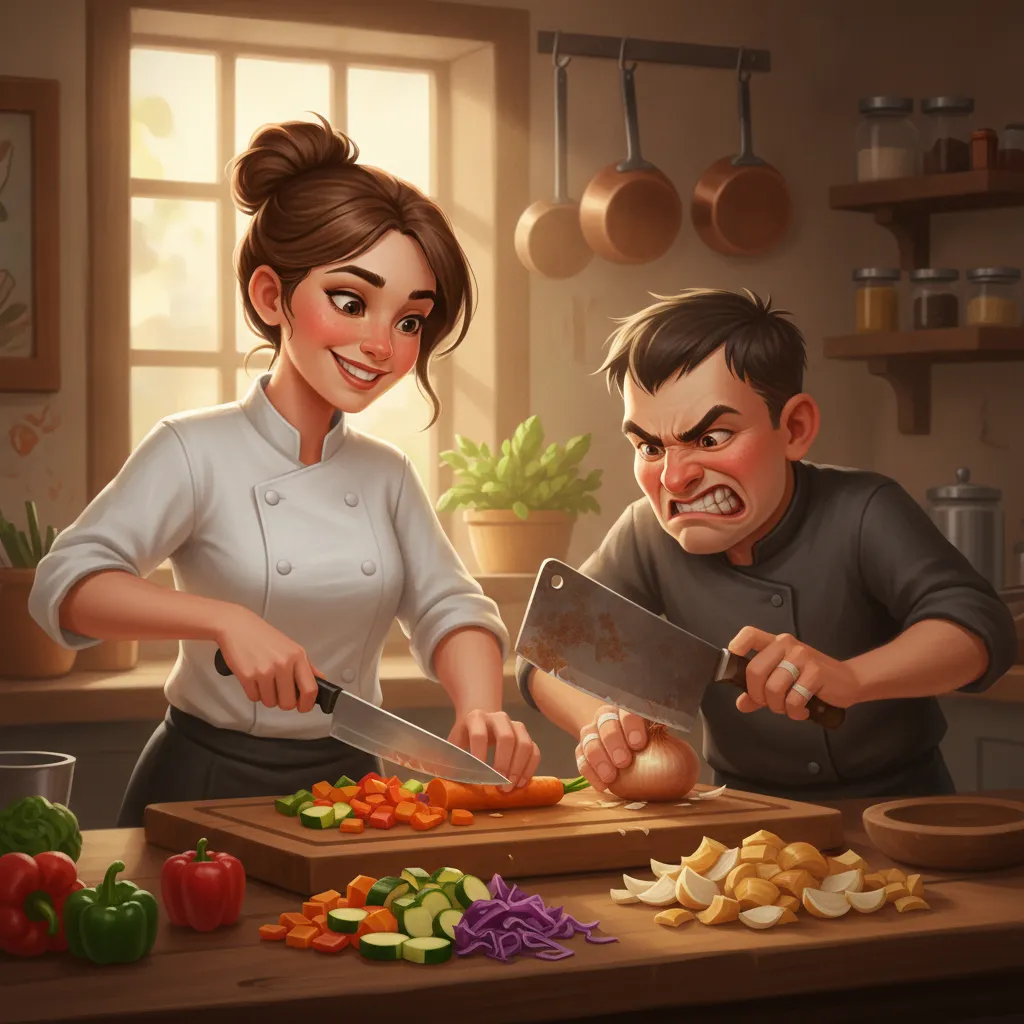
Knife Skills
A dull knife is more dangerous than a sharp one — it takes more force to cut with, and more force means more slips.
Cheat Sheet
- A sharp knife is actually safer than a dull one — dull blades require more force and are more likely to slip, causing accidental cuts.
- The "claw grip," tucking fingertips under and using knuckles to guide the blade, is the standard technique for protecting fingers while cutting.
- A chef's knife is the single most versatile blade in a kitchen, capable of handling the large majority of everyday cutting tasks.
- Common cutting styles — dice, julienne, chiffonade, mince — each describe a specific size and shape, chosen based on how quickly and evenly an ingredient needs to cook or present.
- Regular honing (realigning a blade's edge with a honing rod) is different from sharpening (actually removing metal to create a new edge), and most kitchens need honing far more often than sharpening.
- Learning just a few foundational cuts and a comfortable, safe grip covers the overwhelming majority of everyday home cooking needs.
The 60-Second Version
A sharp knife is actually safer than a dull one, since dull blades require more force to cut through food and are more likely to slip, causing accidental cuts. The "claw grip," tucking fingertips under and using knuckles to guide the blade, is the standard technique for protecting fingers while cutting. A chef's knife is the single most versatile blade in a kitchen, capable of handling the large majority of everyday cutting tasks without needing a specialized alternative. Common cutting styles — dice, julienne, chiffonade, mince — each describe a specific size and shape, chosen based on how quickly and evenly an ingredient needs to cook or how it should present on the plate. Regular honing, realigning a blade's edge with a honing rod, is different from sharpening, which actually removes metal to create a new edge, and most kitchens need honing far more often than true sharpening. Learning just a few foundational cuts and a comfortable, safe grip covers the overwhelming majority of everyday home cooking needs.
The Long Version
Why Sharp Is Actually Safer
It's a common misconception that a sharper knife is more dangerous, when the opposite is generally true in practice: a dull blade requires significantly more downward force and awkward sawing motion to cut through food, both of which increase the chance of the blade slipping off the food entirely and causing an uncontrolled, often deeper cut. A sharp blade, by contrast, glides through food with much less applied force and far more predictable control.
The Claw Grip: Protecting Your Fingers
The claw grip is the standard safe technique for holding food steady while cutting: fingertips are curled inward and tucked behind the knuckles, which are then used as a guide for the flat side of the blade, keeping fingertips well away from the cutting edge at all times as the hand naturally moves backward with each cut.
One Knife, Most Jobs: The Chef's Knife
Among the many specialized knives found in professional kitchens, a single large, versatile chef's knife handles the overwhelming majority of everyday cutting tasks, from slicing and dicing vegetables to breaking down proteins, making it the one blade most home cooks should prioritize owning and learning to use comfortably before investing in specialized alternatives.
Honing vs. Sharpening
Honing and sharpening are often confused but serve genuinely different purposes: honing, done frequently with a honing rod, simply realigns a blade's existing edge, which naturally bends slightly out of alignment with regular use, restoring its cutting performance without removing any metal. Sharpening, by contrast, actually grinds away a small amount of metal to create an entirely new edge, and is needed far less often, typically only every few months for a home cook depending on frequency of use.
Ad slot (placeholder — set NEXT_PUBLIC_ADSENSE_SLOT_ID once an ad unit is created)
Glossary
- Claw grip
- A knife-handling technique tucking fingertips under while using knuckles to guide the blade safely.
- Chef's knife
- A large, versatile all-purpose kitchen knife used for the majority of everyday cutting tasks.
- Julienne
- A cutting style producing thin, matchstick-shaped pieces.
- Honing
- Realigning a knife blade's existing edge using a honing rod, done far more frequently than actual sharpening.
- Mincing
- Cutting an ingredient into very small, fine pieces.
Go Deeper
- America's Test Kitchen — Knife Skills
- "The Professional Chef" by The Culinary Institute of America