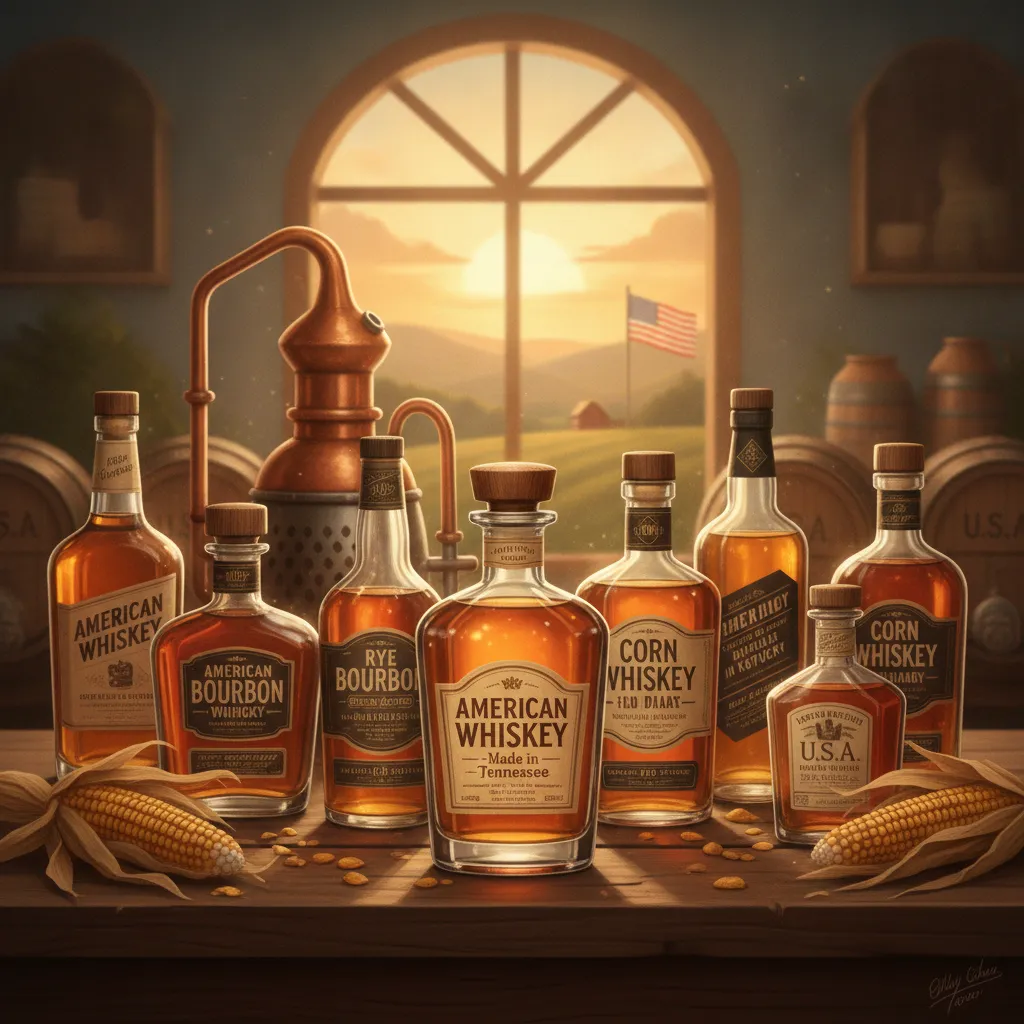
Whiskey
A bottle can legally call itself bourbon only if it's made in America — but nothing requires it to be made in Kentucky, despite what most people assume.
Cheat Sheet
- Whiskey is a spirit distilled from fermented grain mash (barley, corn, rye, or wheat) and aged in wooden barrels — the barrel is where most of its flavor and color comes from.
- Scotch, Bourbon, Irish, and Rye are the major styles, each defined by strict rules about grain, location, and aging.
- Bourbon must be made in the US from at least 51% corn and aged in new charred oak barrels — no exceptions, by law.
- Scotch must be made in Scotland and aged at least three years in oak; single malt means one distillery, one grain (malted barley).
- "Neat," "on the rocks," and "with a splash of water" are the three most common ways to actually drink whiskey — all legitimate, despite bar snobbery.
- Age statements on a bottle reflect the youngest whiskey in the blend, not an average — a "12 year" bottle may contain older whiskey too.
The 60-Second Version
Whiskey is a spirit distilled from fermented grain — typically barley, corn, rye, or wheat — and then aged in wooden barrels, which is where the vast majority of its color and flavor actually comes from; clear spirit goes into the barrel, and it's the wood that does the transforming. The major styles are defined by strict, often legally binding rules: Bourbon must be made in the United States from a mash of at least 51% corn and aged in new charred oak barrels; Scotch must be made in Scotland and aged at least three years in oak, with "single malt" meaning it comes from one distillery using 100% malted barley; Irish whiskey and Rye whiskey each carry their own grain and aging requirements. There's no single "correct" way to drink it — neat, on the rocks, or with a splash of water are all legitimate approaches, and a small amount of water can actually open up a whiskey's aroma rather than "ruining" it.
The Long Version
From Grain to Spirit
Whiskey production starts with a "mash bill" — the specific recipe of grains, commonly some mix of corn, rye, wheat, and malted barley — which is cooked with water and fermented with yeast to produce a low-alcohol liquid similar to beer. That liquid is then distilled, typically more than once, concentrating the alcohol and separating out desirable flavor compounds while removing harsher ones, producing a clear, high-proof spirit that hasn't yet developed whiskey's characteristic color or complexity.
The Barrel Does the Work
Freshly distilled whiskey is essentially colorless; virtually all of its final color and a large share of its flavor come from aging in wooden barrels, most commonly oak. Charring the inside of the barrel caramelizes sugars in the wood and creates a layer that interacts with the spirit over months or years, contributing notes like vanilla, caramel, and spice. During this long aging process, a portion of the whiskey evaporates through the wood — poetically called the "angel's share" — which is one reason older whiskeys are both rarer and typically more expensive.
The Major Styles
Bourbon, by US federal regulation, must be made in the United States from a mash of at least 51% corn and aged in new, charred oak barrels — a barrel can only be used once for bourbon, which is part of why so many used bourbon barrels get resold internationally for aging other spirits like Scotch or rum. Scotch must be made in Scotland, aged a minimum of three years in oak, and single malt specifically means it comes from a single distillery using 100% malted barley, as opposed to "blended" Scotch, which mixes whiskies from multiple distilleries. Irish whiskey is typically triple-distilled for a lighter character, while Rye whiskey, an American style built around a mash dominated by rye grain, tends toward a spicier, more assertive flavor profile than corn-heavy bourbon.
Reading a Label
An age statement on a bottle reflects the youngest whiskey included in that bottle, not an average of everything blended into it — a "12 year" bottle can legally contain whiskey considerably older than 12 years, as long as none of it is younger. "Cask strength" bottlings are taken straight from the barrel without dilution, resulting in a notably higher proof than standard bottles. Proof itself is a straightforward but often misunderstood number: in the US it's exactly double the alcohol-by-volume percentage, so an 80-proof whiskey is 40% alcohol by volume.
Ad slot (placeholder — set NEXT_PUBLIC_ADSENSE_SLOT_ID once an ad unit is created)
Glossary
- Mash bill
- The specific grain recipe (proportions of corn, rye, wheat, barley) used to make a particular whiskey.
- Single malt
- Whiskey made at one distillery from 100% malted barley.
- Cask strength
- Whiskey bottled directly from the barrel without dilution, resulting in a higher alcohol content.
- Angel's share
- The portion of whiskey that evaporates from the barrel during aging.
- Proof
- A measure of alcohol content — in the US, proof is exactly double the alcohol-by-volume percentage.