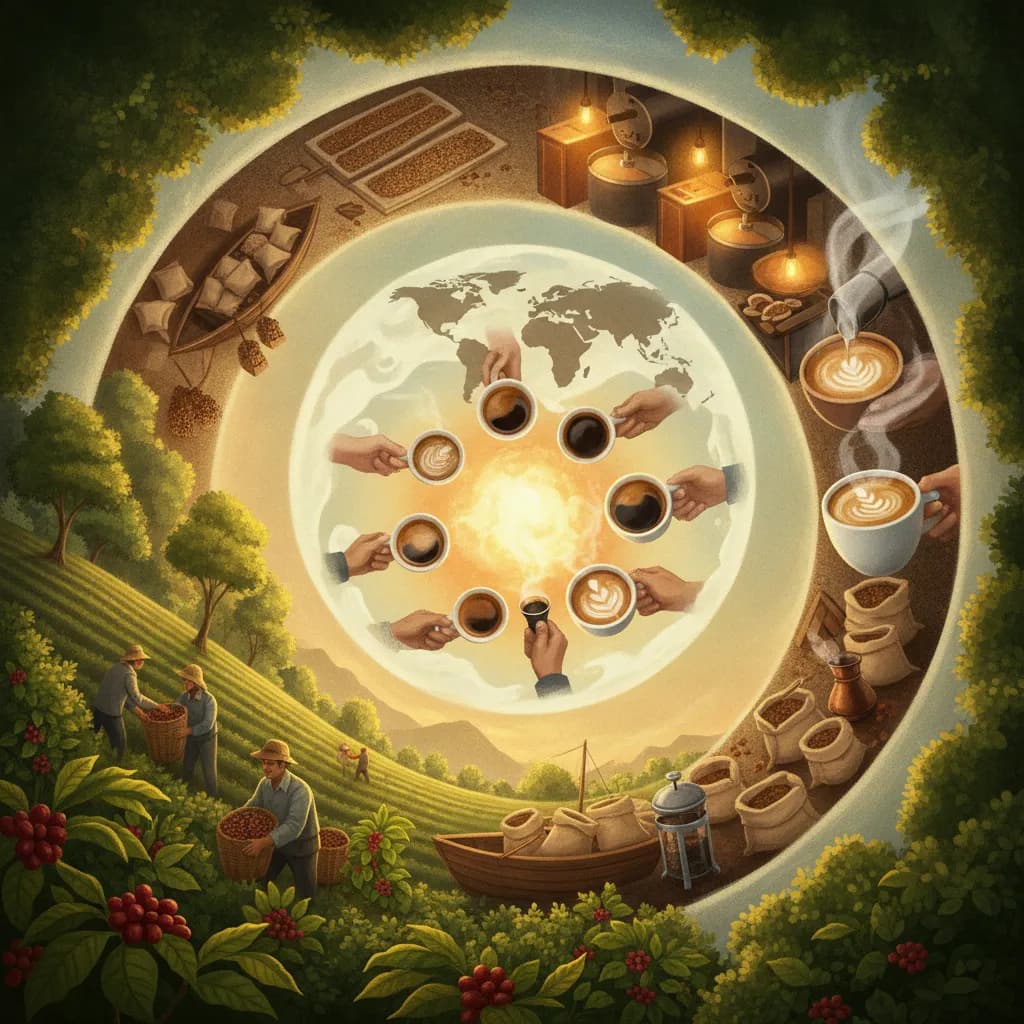
Coffee
The world's most popular ritual is also one of its most quietly complicated crops.
Cheat Sheet
- Arabica beans are smoother and more common in specialty coffee; Robusta is harsher but higher in caffeine and cheaper.
- Roast level (light, medium, dark) is a choice, not a quality signal — light roasts preserve more of the bean's original flavor, dark roasts taste more of the roasting itself.
- Espresso is a brewing method (finely-ground coffee, forced through under pressure), not a bean type — a latte, cappuccino, and americano all start as espresso.
- Crema is the thin layer of golden foam on top of a fresh espresso shot — a sign it was pulled correctly.
- Cold brew and iced coffee aren't the same thing: cold brew is steeped in cold water for hours; iced coffee is just hot-brewed coffee poured over ice.
- "Single-origin" means the beans come from one specific farm or region, as opposed to a blend of several.
The 60-Second Version
Coffee starts as a cherry-like fruit; the "bean" inside is the seed, which gets dried, roasted, and ground before it ever meets water. Two species dominate: Arabica (smoother, more aromatic, most specialty coffee) and Robusta (harsher, more caffeine, cheaper, common in instant coffee and some espresso blends). Roasting is where flavor gets built — lighter roasts keep more of the bean's original character (fruity, floral, acidic), while darker roasts taste smokier and more bitter, from the roasting process itself rather than the bean's origin. From there it's all brewing method: espresso forces hot water through finely-ground coffee under pressure; drip and pour-over let water pass through grounds by gravity; French press steeps grounds directly in water before pressing them out. Nobody needs to master all of it — just enough to order with confidence.
The Long Version
From Cherry to Bean
Coffee starts life as a cherry-like fruit growing on a shrub, with the "bean" actually the seed inside — after harvesting, that seed goes through processing to separate it from the fruit before it's ever dried, roasted, or ground. "Washed" processing removes the fruit before drying, producing a cleaner, brighter cup; "natural" processing dries the whole cherry around the bean, producing a fruitier, heavier body; "honey" processing leaves some of the sticky fruit pulp on during drying, landing somewhere in between. These choices, made at the farm level long before a bag ever reaches a shelf, shape a coffee's flavor as much as the roast does.
Roasting and Brewing
Roasting drives a chemical reaction called the Maillard reaction — the same one responsible for browning bread crust and seared steak — that builds most of coffee's flavor compounds, with audible cues marking key transitions: a "first crack" partway through, and for darker roasts, a "second crack" later on. Espresso is defined by pressure as much as fineness: it's brewed by forcing hot water through tightly packed, finely ground coffee at around 9 bars of pressure, extracting a concentrated shot topped with crema. Despite its "strong" reputation, an espresso shot actually contains less caffeine than a full cup of drip coffee, simply because the serving size is so much smaller — strength and caffeine content aren't the same thing, a common point of confusion.
A Global Industry
Coffee is one of the most heavily traded agricultural commodities in the world, with Brazil, Vietnam, and Colombia standing as major producers, each associated with a different dominant style — Brazil for smooth, low-acid beans often used in blends, Vietnam largely for high-volume Robusta, and Colombia for well-balanced, sought-after Arabica. Ethiopia, where wild coffee plants originate and are still harvested from forest growth today, remains considered the birthplace of the crop. Because so much coffee is grown by smallholder farmers in developing economies while consumed largely in wealthier ones, sourcing practices — direct trade, Fair Trade certification, and "single-origin" transparency — have become a significant part of how the specialty coffee industry markets and prices its beans.
Ad slot (placeholder — set NEXT_PUBLIC_ADSENSE_SLOT_ID once an ad unit is created)
Glossary
- Crema
- The golden foam layer on a properly-pulled espresso shot.
- Single-origin
- Coffee sourced from one specific farm or region, rather than blended.
- Cupping
- A standardized tasting method professionals use to evaluate coffee quality.
- Cold brew
- Coffee steeped in cold water for an extended time, producing a smoother, less acidic drink.