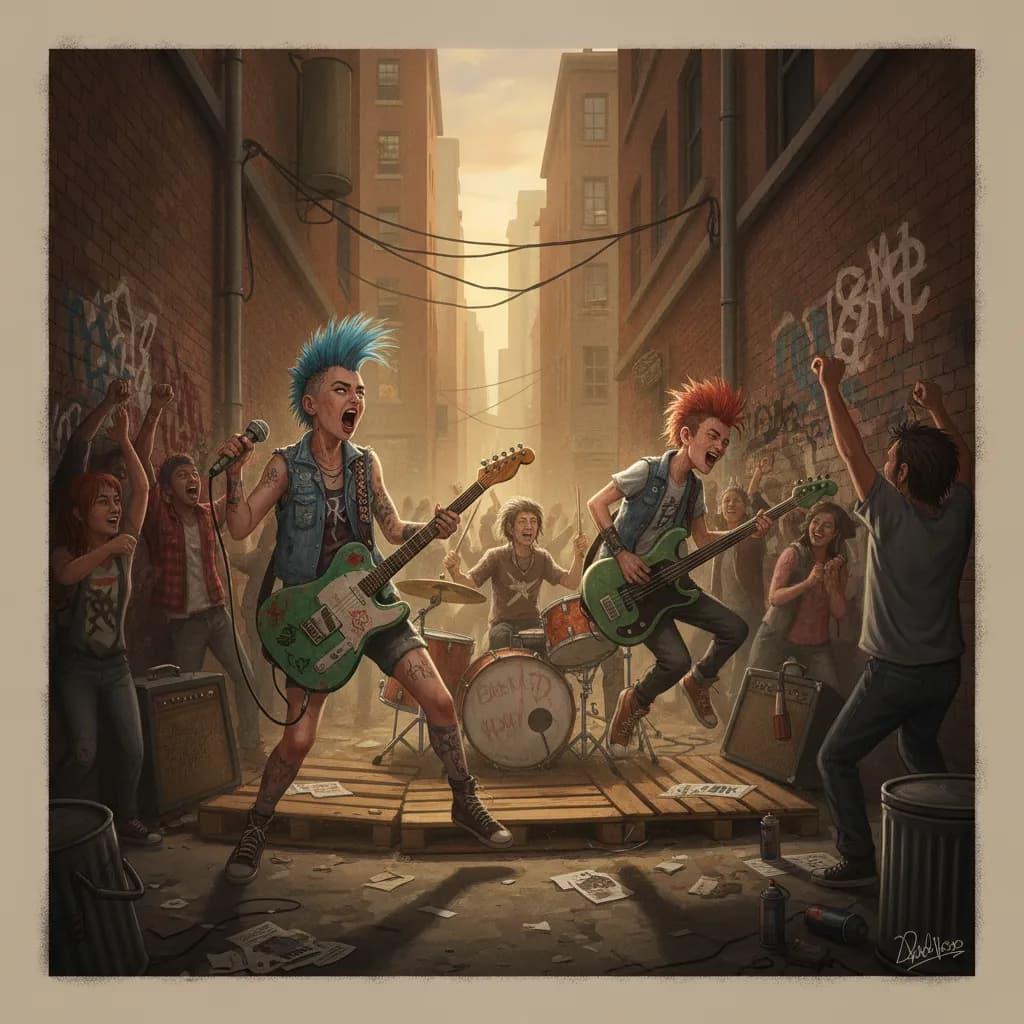
Punk
A genre whose entire founding philosophy was that you didn't need to be good at your instrument to start a band — you just needed something to say.
Cheat Sheet
- Punk emerged in the mid-1970s as a raw, stripped-down reaction against what its early fans saw as bloated, overproduced rock music.
- The Ramones, the Sex Pistols, and The Clash are the genre's most commonly cited foundational bands, though punk sprang up independently on both sides of the Atlantic around the same time.
- Musically, punk favors short songs, simple chord structures, and fast tempos over technical virtuosity — the DIY attitude was as important as the sound itself.
- "DIY" (do it yourself) became punk's defining ethos beyond music too — independent labels, zines, and self-organized shows over corporate music industry structures.
- Punk fashion (safety pins, leather, deliberately torn clothing) became as culturally significant and recognizable as the music itself.
- Punk directly influenced numerous later genres, including post-punk, hardcore, pop-punk, and grunge.
The 60-Second Version
Punk emerged in the mid-1970s as a deliberately raw, stripped-down reaction against what its early fans saw as bloated, overproduced rock music that had drifted too far from its energetic roots. Musically, it favors short songs, simple chord structures, and fast tempos over technical virtuosity — the point was accessibility and urgency, not polish. Bands like the Ramones in New York and the Sex Pistols and The Clash in London are the genre's most commonly cited founders, though punk scenes developed somewhat independently on both sides of the Atlantic around the same time. "DIY" (do it yourself) became punk's defining ethos well beyond the music itself: independent record labels, self-published zines, and self-organized shows over relying on major-label industry infrastructure. That attitude, paired with punk's instantly recognizable fashion — safety pins, leather, deliberately torn clothing — made punk as much a broader cultural stance as a musical style, and it directly influenced numerous later genres including hardcore, post-punk, pop-punk, and grunge.
The Long Version
A Reaction Against Rock Excess
By the mid-1970s, a segment of rock music had grown increasingly elaborate — long instrumental solos, complex arrangements, big-budget studio production — and punk emerged as a deliberate, almost aggressive rejection of all of it. Punk bands stripped songs down to their bare essentials: short running times, simple two- or three-chord "power chord" structures, and fast, driving tempos, prioritizing raw energy and directness over musical complexity or technical polish.
Key Bands, Two Scenes
Punk developed simultaneously in more than one place. In New York, bands like the Ramones and Television built a scene centered around clubs like CBGB, playing tight, fast, stripped-down rock songs. In London, the Sex Pistols and The Clash fronted a more explicitly political and confrontational British scene, closely tied to youth unemployment and class frustration in mid-1970s Britain. These scenes developed with real independence from each other, converging on a similar raw musical philosophy from genuinely different social contexts on opposite sides of the Atlantic.
DIY as a Whole Philosophy
"DIY," or "do it yourself," extended punk's stripped-down approach well beyond the music itself into an entire alternative cultural infrastructure: independent record labels that operated outside major-label industry control, self-published zines that served as punk's primary media and critical voice long before the internet existed, and self-organized, often makeshift, live shows that bypassed traditional concert venues and promoters entirely. This DIY structure meant punk could function as a genuinely independent subculture, with its own economy and communication channels largely separate from the mainstream music industry.
What Came After
Punk's influence rippled directly into numerous subsequent genres: hardcore emerged in the early 1980s as an even faster, more aggressive and stripped-down evolution of punk's core sound; post-punk took punk's DIY spirit in a more experimental, atmospheric, and often moodier musical direction; pop-punk later married punk's energy and structure to more polished, melodic, radio-friendly songwriting; and grunge, emerging in the late 1980s and early 1990s, carried forward punk's raw, anti-establishment attitude while incorporating heavier, more distorted guitar tones.
Ad slot (placeholder — set NEXT_PUBLIC_ADSENSE_SLOT_ID once an ad unit is created)
Glossary
- DIY
- "Do it yourself" — punk's ethos of self-producing music, media, and events independent of mainstream industry structures.
- Zine
- A self-published, low-budget magazine, a key medium for punk community and criticism.
- Hardcore
- A faster, more aggressive subgenre that emerged from punk in the early 1980s.
- Post-punk
- A more experimental, atmospheric musical movement that emerged directly out of punk's initial wave.
- Power chord
- A simplified two- or three-note chord, a foundational building block of punk and rock guitar playing.
Go Deeper
- Rock & Roll Hall of Fame — Punk
- "Please Kill Me" by Legs McNeil and Gillian McCain