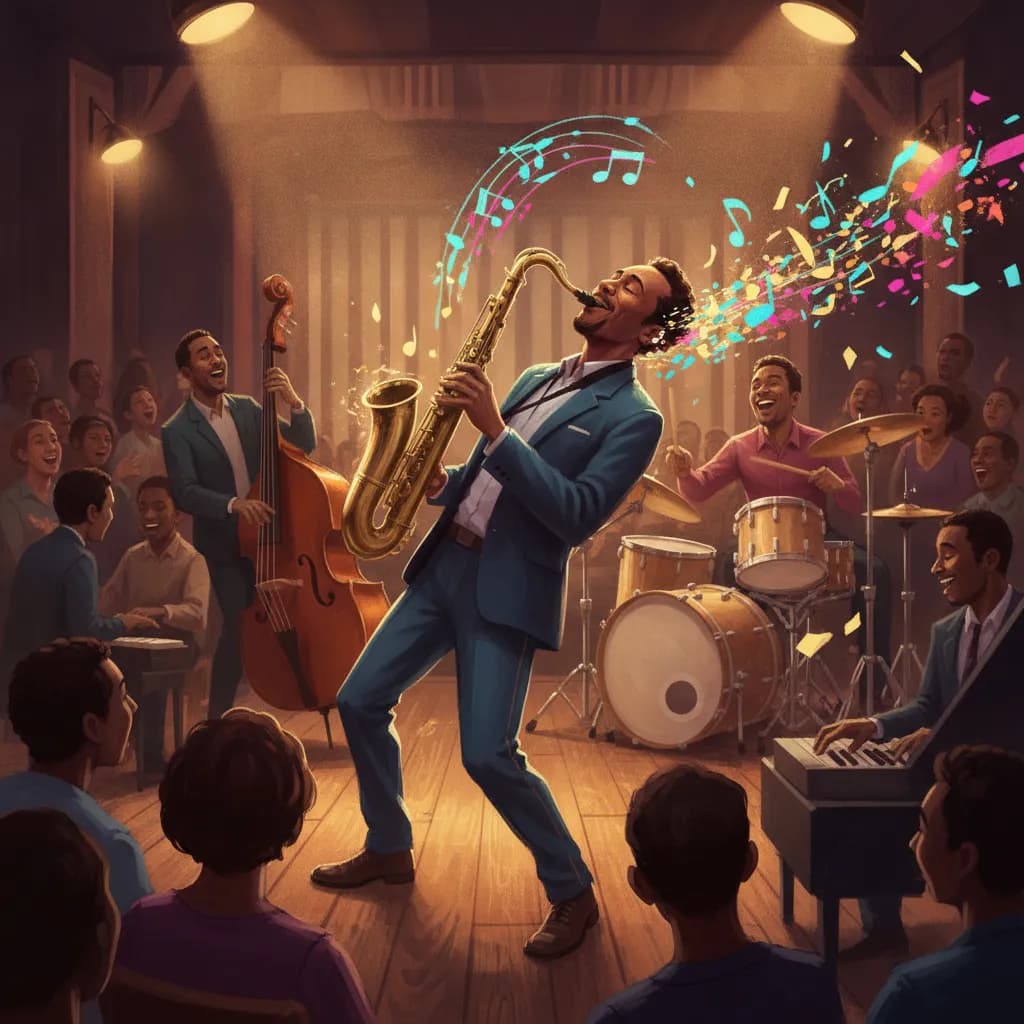
Jazz
It's the genre where breaking the rules, in real time, in front of an audience, is the entire point.
Cheat Sheet
- Improvisation is jazz's defining feature — musicians make up melodic lines in the moment, often over a fixed chord structure.
- A "standard" is a well-known song that's become a shared reference point musicians are expected to know and can play together on the spot.
- Swing refers to a rhythmic feel — notes played with a loose, bouncing timing rather than mechanically even — as much as it names an era (the 1930s-40s Swing Era).
- Bebop (1940s) was a faster, more harmonically complex style that shifted jazz from danceable big-band music toward serious listening music.
- "Call and response" — one musician plays a phrase, another answers it — traces back to jazz's roots in blues and African musical traditions.
- A "blue note" is a slightly bent or flattened pitch that gives jazz (and blues) its distinctive, expressive edge.
The 60-Second Version
Jazz emerged in New Orleans in the early 20th century, blending blues, ragtime, and brass-band traditions into something new. Its defining feature is improvisation — rather than just playing a song as written, musicians make up melodic lines on the spot, usually taking turns soloing over a fixed underlying chord structure while the rest of the band keeps time. The genre has moved through distinct eras: the collective, danceable sound of early New Orleans jazz, the big-band Swing Era of the 1930s-40s, and the faster, more cerebral Bebop that followed in the 1940s and shifted jazz toward serious listening music rather than dancing. A typical group splits into a rhythm section (piano, bass, drums, often guitar) laying down the groove, and soloists taking turns improvising over it — which is why no two performances of the same jazz standard ever sound quite the same.
The Long Version
Roots in New Orleans
New Orleans in the early 1900s was a genuine musical melting pot — African rhythmic traditions, blues, ragtime's syncopation, and brass-band marching music all overlapping in the same city — and jazz emerged from that mix as something distinctly new, built around collective, largely improvised group playing rather than a single soloist out front. Louis Armstrong helped shift the genre's center of gravity toward the virtuoso soloist, using his trumpet playing and singing to make individual expression as important as the group sound. Duke Ellington, working mostly through his own big band, proved jazz composition could be as sophisticated and ambitious as anything being written in classical music at the time.
From Swing to Bebop
The Swing Era of the 1930s and 40s turned jazz into mainstream popular and dance music, carried by large touring big bands playing arranged, danceable charts to packed ballrooms across the country. That popularity gave way in the 1940s to Bebop, a deliberate reaction led by musicians like Charlie Parker and Dizzy Gillespie, who pushed the music toward faster tempos, denser harmony, and small-group settings aimed at serious listening rather than dancing. The shift effectively split jazz's audience in two — a mainstream that stuck with swing-era dance bands, and a smaller, more devoted listening audience that followed jazz into its more demanding, artistically ambitious future.
Jazz Keeps Splintering
From Bebop, jazz kept branching into new subgenres roughly every decade: the mellower, more relaxed "Cool Jazz" of the 1950s pulled back from Bebop's intensity; the boundary-dissolving "Free Jazz" pioneered by artists like Ornette Coleman abandoned fixed chord structures almost entirely in favor of pure improvisational freedom; and the "Fusion" movement of the late 1960s and 70s, with Miles Davis as a key figure, blended jazz improvisation with rock and funk instrumentation and electric instruments. Each new style provoked real debate among musicians and fans about what still counted as "real" jazz — arguments that, in one form or another, continue among jazz purists today.
The Craft Behind Improvisation
Improvisation itself isn't random invention on the spot — soloists work within the song's underlying chord progression, often drawing on specific scales and pre-practiced melodic phrases ("licks") that fit each chord as it passes, combined in the moment in ways that feel spontaneous to the listener. That's why serious jazz musicians spend years studying harmony and transcribing recorded solos note-for-note, even though the eventual performance is genuinely happening live and unrepeatably in real time. A jazz "standard" gives musicians who've never played together before a shared reference point — the same chord structure everyone already knows — which is what makes it possible for strangers to improvise together convincingly on a bandstand.
Ad slot (placeholder — set NEXT_PUBLIC_ADSENSE_SLOT_ID once an ad unit is created)
Glossary
- Improvisation
- Composing a melodic line spontaneously, in real time, over a song's existing chord structure.
- Standard
- A widely known jazz song that functions as shared repertoire among musicians.
- Swing
- A loose, bouncing rhythmic feel central to jazz, also naming its 1930s-40s big-band era.
- Bebop
- A faster, harmonically complex jazz style that emerged in the 1940s.
Go Deeper
- Jazz at Lincoln Center
- "Jazz: A History of America's Music" by Geoffrey C. Ward and Ken Burns