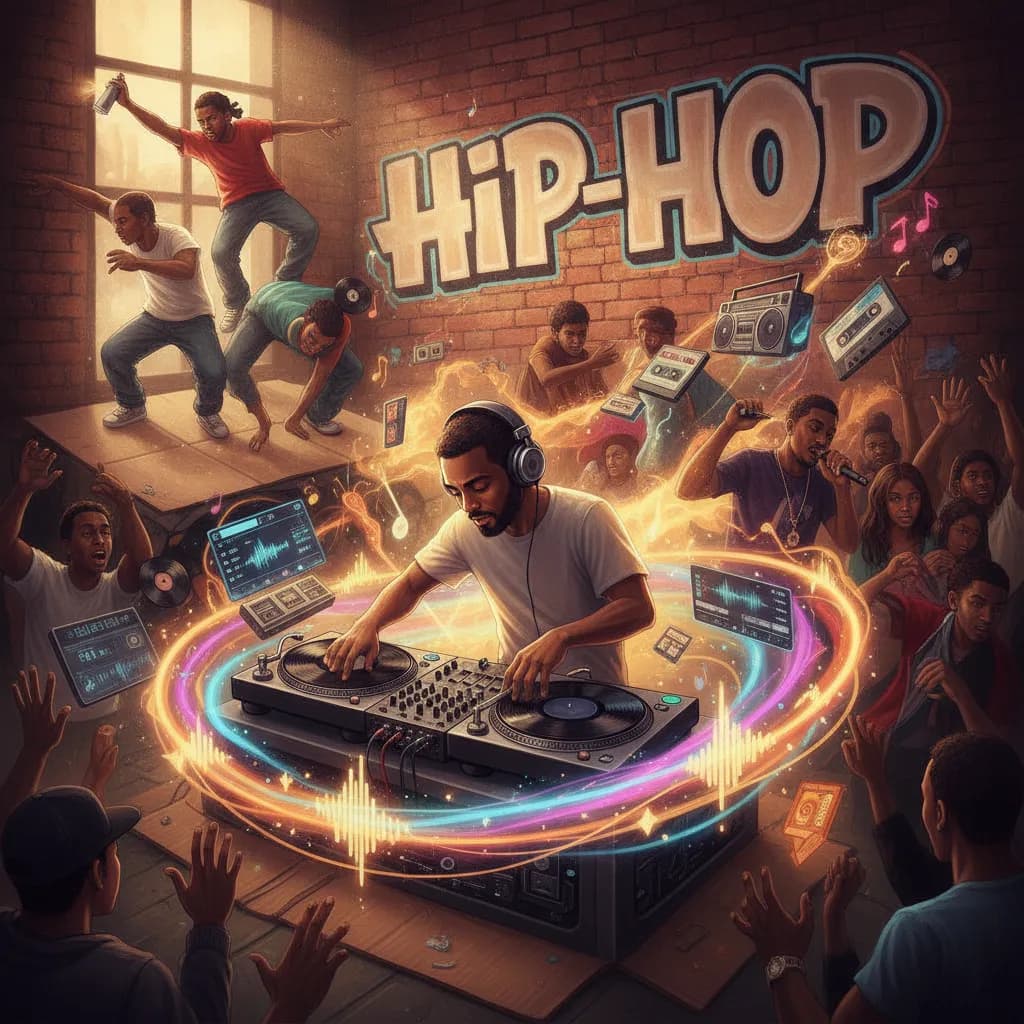
Hip-Hop
A genre born from DJs looping the same ten seconds of a record over and over — now the single most-streamed music genre in America.
Cheat Sheet
- Hip-hop emerged in the early 1970s in the Bronx, built on four foundational elements: MCing (rapping), DJing, breakdancing, and graffiti art.
- DJ Kool Herc's technique of isolating and looping a song's percussion break ("the break") at parties is widely credited as hip-hop's founding moment.
- Sampling — reusing a snippet of an existing recording as a building block for a new song — is one of hip-hop's most foundational and legally contested production techniques.
- The genre has moved through distinct eras: old school (late 70s-80s), golden age (late 80s-early 90s), and a constantly evolving landscape of regional subgenres since.
- East Coast vs. West Coast rivalry in the 1990s was a major, sometimes deadly, cultural flashpoint that shaped the genre's mainstream visibility.
- Hip-hop is now the most-consumed music genre in the United States by streaming numbers, having overtaken rock in the mid-2010s.
The 60-Second Version
Hip-hop emerged in the early 1970s in the Bronx, built on four foundational elements: MCing (rapping), DJing, breakdancing, and graffiti art, all originating from the same block-party culture. DJ Kool Herc's technique of isolating and looping the percussion-heavy "break" section of funk and soul records, giving dancers an extended stretch of pure rhythm, is widely credited as the genre's founding moment. Sampling — reusing a snippet of an existing recording as a building block for a new song — became one of hip-hop's most foundational production techniques, and remains legally contested to this day over who owns and gets paid for reused material. The genre has moved through distinct eras, from old school through the golden age of the late 80s and early 90s to today's constantly evolving regional and stylistic landscape, and it's now the most-streamed music genre in the United States, having overtaken rock in the mid-2010s.
The Long Version
Born in the Bronx
Hip-hop's origin is tied to a specific time, place, and even a specific party: DJ Kool Herc's back-to-school jams in the Bronx in 1973, where he pioneered isolating and looping the short percussion "break" in funk and soul records using two copies of the same record on two turntables, giving dancers an extended stretch of pure beat to move to. Around that same scene, the genre's four foundational elements crystallized together: MCing (rapping over the beat, originally to hype up the crowd), DJing (mixing and manipulating the records), breakdancing (an acrobatic dance style suited to the extended breaks), and graffiti art, which provided the visual identity of the surrounding youth culture even though it developed somewhat independently.
Sampling as Foundation
Sampling — taking a portion of an existing sound recording, often a drum break, bassline, or vocal snippet, and reusing it as a building block within a new song — became one of hip-hop's core production techniques almost from the start, letting producers build entirely new tracks from fragments of existing music. As the genre grew commercially, sampling triggered major legal battles over copyright and compensation, most notably a series of lawsuits in the late 1980s and early 1990s that established clearing samples legally (getting permission and paying the original rights holders) as standard industry practice, fundamentally changing how producers approached the technique going forward.
Eras of the Genre
Hip-hop's history is commonly divided into recognizable eras: the "old school" period of the late 1970s and early-to-mid 1980s established the genre's basic templates; the "golden age" of the late 1980s through early 1990s is widely regarded as a period of exceptional lyrical and stylistic innovation; and the 1990s also saw a real and sometimes dangerous East Coast versus West Coast rivalry, exemplified by the deaths of Tupac Shakur and The Notorious B.I.G., that became a defining, sobering chapter in the genre's mainstream visibility. Since then, hip-hop has continued fragmenting into an ever-expanding set of regional scenes and subgenres, from Southern trap to drill to countless other localized styles.
From Underground to Mainstream Dominance
What began as a regional, largely underground youth culture grew into the commercially dominant force in American music: hip-hop officially overtook rock as the most-consumed genre in the United States by total streams and sales in the mid-2010s, a milestone that reflected decades of steadily building mainstream crossover success. That commercial rise has run alongside hip-hop's continued role as a vehicle for social commentary and storytelling, a dual identity — pop chart dominance and serious cultural and political voice — that few other genres carry simultaneously at the same scale.
Ad slot (placeholder — set NEXT_PUBLIC_ADSENSE_SLOT_ID once an ad unit is created)
Glossary
- MCing
- Rhythmic, rhyming vocal delivery over a beat — commonly called rapping.
- Sampling
- Reusing a portion of an existing sound recording as an element in a new composition.
- The break
- The percussion-heavy instrumental section of a song, isolated and looped by early hip-hop DJs.
- Freestyle
- Improvised, off-the-cuff rapping composed on the spot rather than pre-written.
- Beef
- An ongoing public rivalry or conflict between artists, often played out through diss tracks.
Go Deeper
- Rock & Roll Hall of Fame — Hip-Hop
- "Can't Stop Won't Stop" by Jeff Chang