Classical Music
You already know more classical music than you think — most of it, you've just heard it in a movie trailer.
Cheat Sheet
- "Classical music" is used two ways: broadly, for centuries of Western art music, and narrowly, for a specific period (roughly 1750-1820) between the Baroque and Romantic eras.
- The major eras run: Medieval, Renaissance, Baroque (Bach, Vivaldi), Classical (Mozart, Haydn), Romantic (Beethoven, Chopin), and 20th-century/Modern (Stravinsky, Debussy).
- A symphony is a large-scale orchestral piece, typically in four movements, each with a different tempo and character.
- An orchestra is organized into sections — strings, woodwinds, brass, percussion — each contributing a distinct texture to the overall sound.
- Opera combines orchestral music with singing and staged drama, and has its own distinct vocal tradition (arias, recitatives).
- Many pieces you already know from movies, ads, and games are classical music — the genre is far more embedded in everyday culture than people realize.
The 60-Second Version
"Classical music" gets used two different ways: broadly, to describe centuries of Western art music from the medieval period to today, and narrowly, to describe one specific era, roughly 1750 to 1820, sitting between the ornate Baroque period (Bach, Vivaldi) and the emotionally expansive Romantic era (Beethoven, Chopin) that followed. In the broad sense, the tradition runs through Medieval and Renaissance music, into Baroque, Classical, and Romantic eras, and on into 20th-century and modern composers like Stravinsky and Debussy who deliberately broke from earlier conventions. An orchestra is organized into sections — strings, woodwinds, brass, and percussion — each contributing a distinct texture, typically led by a conductor coordinating tempo and expression. A symphony is a large-scale orchestral work typically in four contrasting movements, while opera adds staged drama and solo and choral singing on top of the orchestral foundation.
The Long Version
Broad Genre vs. Specific Era
The confusing double meaning of "classical music" trips up a lot of newcomers: used broadly, it covers the entire multi-century Western art music tradition, but used narrowly by musicologists, it refers specifically to the Classical era (roughly 1750-1820), known for balance, clarity, and structural elegance, exemplified by composers like Mozart and Haydn. That era sits between the elaborate, ornamented Baroque period before it and the more emotionally dramatic, expansive Romantic period that followed, with 20th-century and modern composers later pushing the tradition in far more experimental directions.
How an Orchestra Works
A full orchestra is organized into distinct sections that each contribute a different texture: strings (violins, violas, cellos, double basses) typically form the largest section and carry much of the melodic material; woodwinds (flutes, oboes, clarinets, bassoons) add color and character; brass (trumpets, horns, trombones, tuba) provide power and fanfare; and percussion anchors rhythm and dramatic accents. A conductor stands at the front coordinating tempo, dynamics, and overall interpretation, functioning less like a strict timekeeper and more like an interpretive guide shaping how dozens of musicians play together as one unified voice.
Forms Worth Knowing
A symphony is a large-scale work for full orchestra, conventionally structured in four movements with contrasting tempos and moods, evolving from a light opening through slower, more reflective sections to an energetic finale. A concerto features a solo instrument, like a piano or violin, showcased against the orchestra, often highlighting a soloist's individual virtuosity. Opera combines orchestral music with staged drama and singing, built around distinct vocal forms: arias, extended solo showcases of emotion and vocal skill, and recitatives, more speech-like sung passages that advance the plot between arias.
Why It's More Familiar Than You Think
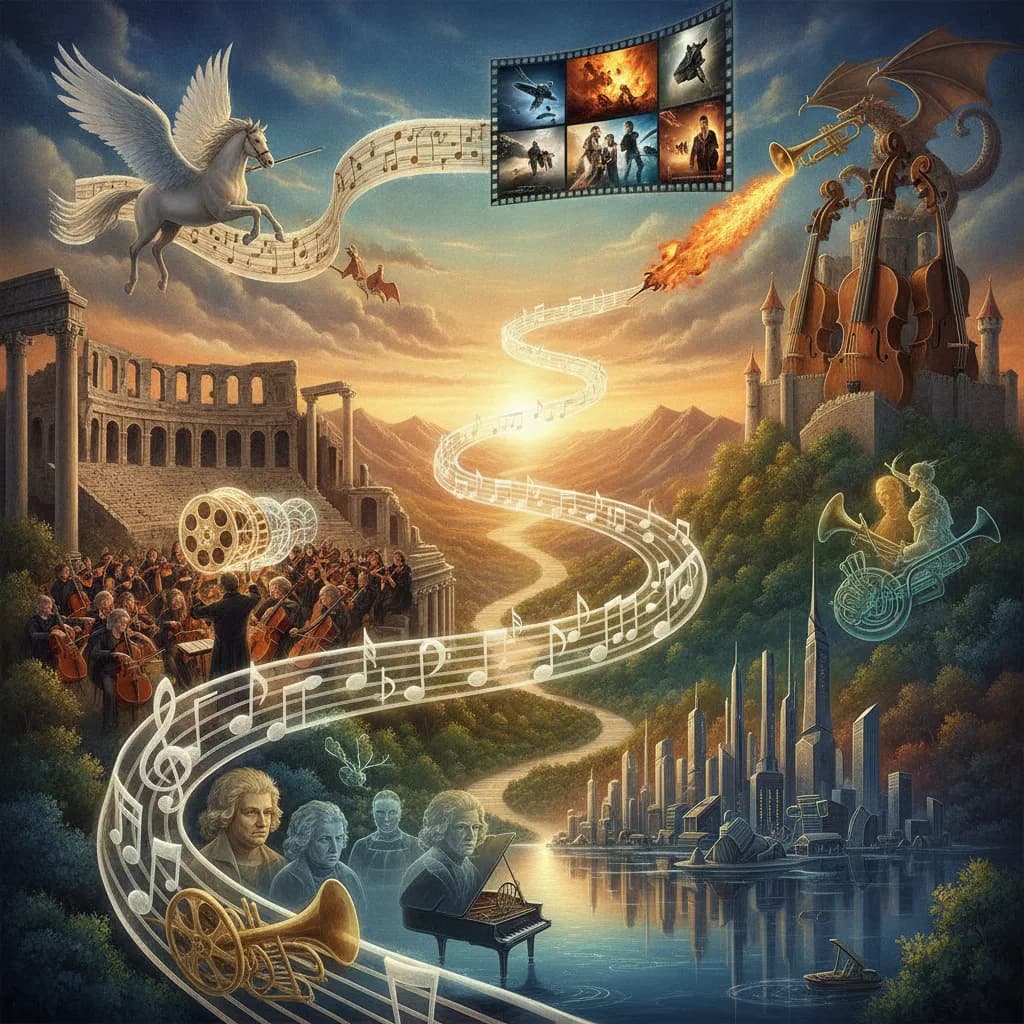
Classical music is embedded in everyday culture far more than most people realize — film scores routinely draw on or directly imitate classical conventions, well-known pieces like Beethoven's Fifth Symphony or Vivaldi's "Four Seasons" show up constantly in advertising, and video game soundtracks frequently lean on full orchestral scores modeled directly on classical tradition. Many people who claim no interest in classical music can still hum several genuinely famous classical melodies without realizing where they originally came from.
Ad slot (placeholder — set NEXT_PUBLIC_ADSENSE_SLOT_ID once an ad unit is created)
Glossary
- Symphony
- A large-scale composition for orchestra, typically structured in four contrasting movements.
- Movement
- A self-contained section of a longer musical work, each with its own tempo and mood.
- Concerto
- A piece featuring a solo instrument accompanied by an orchestra.
- Opus
- A number assigned to a composer's work indicating its place in their catalog of compositions.
- Libretto
- The text or words used in an opera or other extended vocal work.